Biology notes · Chapter 9 of 19
Respiratory System
10 sections, 62 flashcards. Open a card to check your answer, or revise them in the app with spaced revision.
What is Respiration?
- Respiration is taking in oxygen to slowly 'burn' food and release the energy locked inside it.
- Inputs and outputs: O ₂ and glucose are used; CO ₂, water and energy are released.
- The main fuel broken down is glucose; fats and proteins can also be used when needed.
- CO ₂ is a harmful waste gas that the body must throw out continuously.
- Breathing is only the physical taking in and pushing out of air – the first step of respiration.
- Respiration is bigger than breathing: it adds the chemical release of energy inside cells.
| Term | Meaning |
|---|---|
| Breathing | Physical exchange of air (in and out) |
| Respiration | Breathing + energy release in cells |
Check yourself
What is Respiration?
- Respiration is taking in oxygen to slowly 'burn' food and release the energy locked inside it.
- Inputs and outputs: O ₂ and glucose are used; CO ₂, water and energy are released.
- The main fuel broken down is glucose; fats and proteins can also be used when needed.
- CO ₂ is a harmful waste gas that the body must throw out continuously.
- Breathing is only the physical taking in and pushing out of air – the first step of respiration.
- Respiration is bigger than breathing: it adds the chemical release of energy inside cells.
- Breathing — Physical exchange of air (in and out)
- Respiration — Breathing + energy release in cells
is taking in oxygen to slowly 'burn' food and release the energy locked inside it.
Respiration is taking in oxygen to slowly 'burn' food and release the energy locked inside it.
Inputs and outputs: O ₂ and glucose are used; are released.
Inputs and outputs: O ₂ and glucose are used; CO ₂, water and energy are released.
The main fuel broken down is ; fats and proteins can also be used when needed.
The main fuel broken down is glucose; fats and proteins can also be used when needed.
that the body must throw out continuously.
CO ₂ is a harmful waste gas that the body must throw out continuously.
is only the physical taking in and pushing out of air – the first step of respiration.
Breathing is only the physical taking in and pushing out of air – the first step of respiration.
: it adds the chemical release of energy inside cells.
Respiration is bigger than breathing: it adds the chemical release of energy inside cells.
Respiratory Organs in Different Animals
- The organ used depends on where the animal lives and how complex its body is.
- Simplest method is diffusion – gases spread from high to low concentration, no special organ needed.
- Sponges, coelenterates (Hydra), flatworms exchange gases by diffusion over the whole body surface.
- Earthworm breathes through its moist skin – called cutaneous respiration.
- Insects use a network of air tubes called tracheal tubes carrying air to inner tissues.
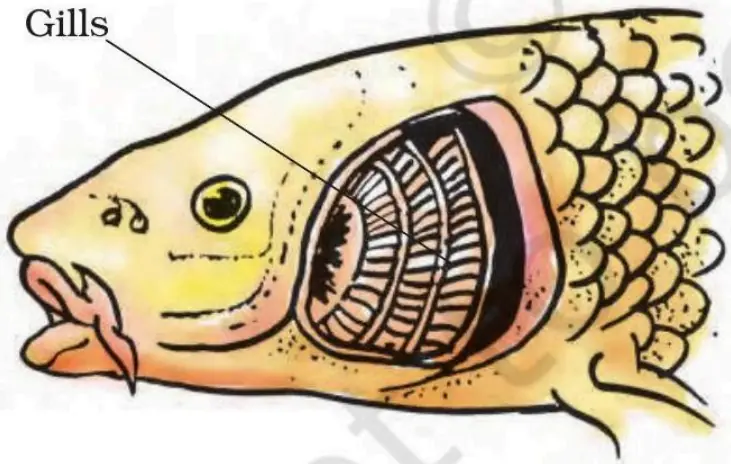
- Gills take dissolved O ₂ from water (fishes); lungs are used by land animals.
- The frog has lungs but also breathes through its moist skin (only via skin during hibernation).
| Animal / Group | Respiratory organ / method |
|---|---|
| Sponge, Hydra, flatworm | Diffusion over body surface |
| Earthworm | Moist skin (cutaneous) |
| Insects | Tracheal tubes |
| Fishes | Gills (branchial) |
| Frog (amphibian) | Lungs + moist skin |
| Reptiles, birds, mammals | Lungs (pulmonary) |
Check yourself
Respiratory Organs in Different Animals
- The organ used depends on where the animal lives and how complex its body is.
- Simplest method is diffusion – gases spread from high to low concentration, no special organ needed.
- Sponges, coelenterates (Hydra), flatworms exchange gases by diffusion over the whole body surface.
- Earthworm breathes through its moist skin – called cutaneous respiration.
- Insects use a network of air tubes called tracheal tubes carrying air to inner tissues.
- Gills take dissolved O ₂ from water (fishes); lungs are used by land animals.
- The frog has lungs but also breathes through its moist skin (only via skin during hibernation).
- Sponge, Hydra, flatworm — Diffusion over body surface
- Earthworm — Moist skin (cutaneous)
- Insects — Tracheal tubes
- Fishes — Gills (branchial)
- Frog (amphibian) — Lungs + moist skin
- Reptiles, birds, mammals — Lungs (pulmonary)
Simplest method is – gases spread from high to low concentration, no special organ needed.
Simplest method is diffusion – gases spread from high to low concentration, no special organ needed.
exchange gases by diffusion over the whole body surface.
Sponges, coelenterates (Hydra), flatworms exchange gases by diffusion over the whole body surface.
breathes through its moist skin – called .
Earthworm breathes through its moist skin – called cutaneous respiration.
use a network of air tubes called carrying air to inner tissues.
Insects use a network of air tubes called tracheal tubes carrying air to inner tissues.
take dissolved O ₂ from water (fishes); are used by land animals.
Gills take dissolved O ₂ from water (fishes); lungs are used by land animals.
The has lungs but also breathes through its moist skin (only via skin during hibernation).
The frog has lungs but also breathes through its moist skin (only via skin during hibernation).
Human Respiratory System – Pathway of Air
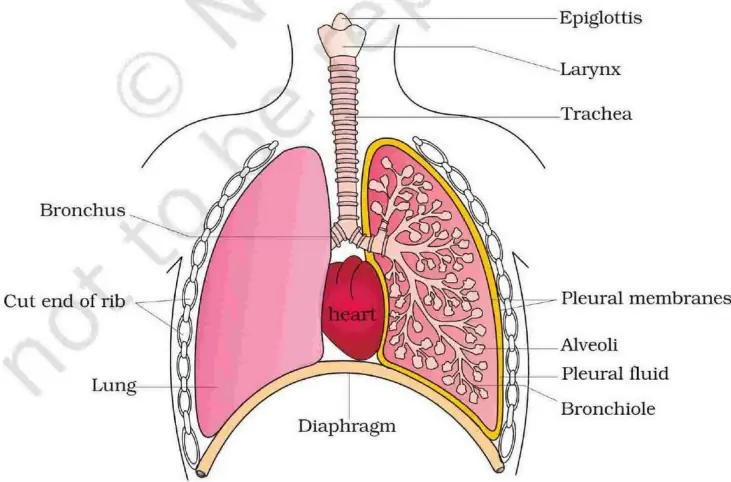
- Air route: Nostrils → Nasal chamber → Pharynx → Larynx → Trachea → Bronchi → Bronchioles → Alveoli.
- Nasal chamber filters dust, warms and moistens the incoming air.
- Pharynx (throat) is a common passage for both food and air.
- Larynx is the sound box (voice box); the epiglottis flap stops food entering the airway.
- Trachea (windpipe) divides at the 5th thoracic vertebra into right and left primary bronchi.
- Trachea and bronchi are kept open by incomplete Cshaped cartilage rings so airways never collapse.
- Each bronchiole ends in millions of thin-walled, bloodrich alveoli – the gas-exchange air sacs.
Check yourself
Human Respiratory System – Pathway of Air
- Air route: Nostrils → Nasal chamber → Pharynx → Larynx → Trachea → Bronchi → Bronchioles → Alveoli.
- Nasal chamber filters dust, warms and moistens the incoming air.
- Pharynx (throat) is a common passage for both food and air.
- Larynx is the sound box (voice box); the epiglottis flap stops food entering the airway.
- Trachea (windpipe) divides at the 5th thoracic vertebra into right and left primary bronchi.
- Trachea and bronchi are kept open by incomplete Cshaped cartilage rings so airways never collapse.
- Each bronchiole ends in millions of thin-walled, bloodrich alveoli – the gas-exchange air sacs.
filters dust, warms and moistens the incoming air.
Nasal chamber filters dust, warms and moistens the incoming air.
is a common passage for both food and air.
Pharynx (throat) is a common passage for both food and air.
is the sound box (voice box); the flap stops food entering the airway.
Larynx is the sound box (voice box); the epiglottis flap stops food entering the airway.
(windpipe) divides at the 5th thoracic vertebra into right and left .
Trachea (windpipe) divides at the 5th thoracic vertebra into right and left primary bronchi.
Trachea and bronchi are kept open by so airways never collapse.
Trachea and bronchi are kept open by incomplete Cshaped cartilage rings so airways never collapse.
Each bronchiole ends in millions of thin-walled, bloodrich – the gas-exchange air sacs.
Each bronchiole ends in millions of thin-walled, bloodrich alveoli – the gas-exchange air sacs.
Lungs and the Thoracic Chamber
- The branching bronchi, bronchioles and alveoli make up the two pink, elastic lungs.
- Each lung is wrapped in a double-layered membrane called the pleura.
- Pleural fluid between the layers reduces friction as the lungs move.
- Lungs sit in an air-tight thoracic chamber (chest cavity).
- Boundaries: vertebral column at back, sternum in front, ribs at sides, diaphragm below.
- The dome-shaped diaphragm is the main driver (muscle) of breathing.
| Part | Function |
|---|---|
| Nasal chamber | Filter, warm, moisten air |
| Pharynx | Common food + air passage |
| Larynx | Sound production (voice box) |
| Epiglottis | Covers glottis during swallowing |
| Trachea / bronchi | Carry air; held open by cartilage |
| Alveoli | Site of gas exchange |
| Diaphragm | Main breathing muscle |
Check yourself
Lungs and the Thoracic Chamber
- The branching bronchi, bronchioles and alveoli make up the two pink, elastic lungs.
- Each lung is wrapped in a double-layered membrane called the pleura.
- Pleural fluid between the layers reduces friction as the lungs move.
- Lungs sit in an air-tight thoracic chamber (chest cavity).
- Boundaries: vertebral column at back, sternum in front, ribs at sides, diaphragm below.
- The dome-shaped diaphragm is the main driver (muscle) of breathing.
- Nasal chamber — Filter, warm, moisten air
- Pharynx — Common food + air passage
- Larynx — Sound production (voice box)
- Epiglottis — Covers glottis during swallowing
- Trachea / bronchi — Carry air; held open by cartilage
- Alveoli — Site of gas exchange
- Diaphragm — Main breathing muscle
The branching bronchi, bronchioles and alveoli make up the two pink, elastic .
The branching bronchi, bronchioles and alveoli make up the two pink, elastic lungs.
Each lung is wrapped in a double-layered membrane called the .
Each lung is wrapped in a double-layered membrane called the pleura.
between the layers reduces friction as the lungs move.
Pleural fluid between the layers reduces friction as the lungs move.
The dome-shaped is the main driver (muscle) of breathing.
The dome-shaped diaphragm is the main driver (muscle) of breathing.
Mechanism of Breathing
- The chest works like a bellows: make space bigger and air rushes in, smaller and air is pushed out.
- Two stages: inspiration (inhalation) draws air in, expiration (exhalation) pushes air out.
- We cannot squeeze lungs directly, so we change the chest volume and the lungs follow.
- Air always flows from high pressure to low pressure; lung pressure is the intra-pulmonary pressure.
- Muscles used: the diaphragm and the external and internal intercostal muscles between ribs.
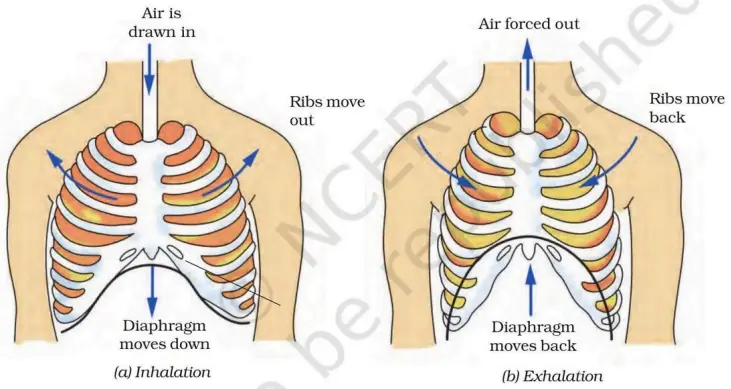
- Inspiration: diaphragm flattens, ribs lift, chest volume rises, lung pressure falls below atmospheric.
- Expiration: muscles relax, ribs fall, chest volume shrinks, lung pressure rises above atmospheric.
| Feature | Inspiration | Expiration |
|---|---|---|
| Diaphragm | Contracts, flattens | Relaxes, domes up |
| Ribs / sternum | Move up and out | Move down and in |
| Chest volume | Increases | Decreases |
| Lung pressure | Below atmospheric | Above atmospheric |
| Air movement | Air rushes in | Air pushed out |
Check yourself
Mechanism of Breathing
- The chest works like a bellows: make space bigger and air rushes in, smaller and air is pushed out.
- Two stages: inspiration (inhalation) draws air in, expiration (exhalation) pushes air out.
- We cannot squeeze lungs directly, so we change the chest volume and the lungs follow.
- Air always flows from high pressure to low pressure; lung pressure is the intra-pulmonary pressure.
- Muscles used: the diaphragm and the external and internal intercostal muscles between ribs.
- Inspiration: diaphragm flattens, ribs lift, chest volume rises, lung pressure falls below atmospheric.
- Expiration: muscles relax, ribs fall, chest volume shrinks, lung pressure rises above atmospheric.
- Diaphragm — Contracts, flattens — Relaxes, domes up
- Ribs / sternum — Move up and out — Move down and in
- Chest volume — Increases — Decreases
- Lung pressure — Below atmospheric — Above atmospheric
- Air movement — Air rushes in — Air pushed out
The chest works like a : make space bigger and air rushes in, smaller and air is pushed out.
The chest works like a bellows: make space bigger and air rushes in, smaller and air is pushed out.
Two stages: draws air in, pushes air out.
Two stages: inspiration (inhalation) draws air in, expiration (exhalation) pushes air out.
We cannot squeeze lungs directly, so we and the lungs follow.
We cannot squeeze lungs directly, so we change the chest volume and the lungs follow.
Air always flows from ; lung pressure is the .
Air always flows from high pressure to low pressure; lung pressure is the intra-pulmonary pressure.
Muscles used: the and the muscles between ribs.
Muscles used: the diaphragm and the external and internal intercostal muscles between ribs.
diaphragm flattens, ribs lift, chest volume rises, lung pressure falls below atmospheric.
Inspiration: diaphragm flattens, ribs lift, chest volume rises, lung pressure falls below atmospheric.
muscles relax, ribs fall, chest volume shrinks, lung pressure rises above atmospheric.
Expiration: muscles relax, ribs fall, chest volume shrinks, lung pressure rises above atmospheric.
Breathing Rate and Lung Measurement
- A healthy human breathes about 12–16 times per minute at rest.
- Relaxed breathing is enough at rest; during heavy exercise we use abdominal muscles for forced breathing.
- A spirometer measures the volume of air a person moves.
- Spirometry is used for the clinical assessment of lung (pulmonary) function.
Check yourself
Breathing Rate and Lung Measurement
- A healthy human breathes about 12–16 times per minute at rest.
- Relaxed breathing is enough at rest; during heavy exercise we use abdominal muscles for forced breathing.
- A spirometer measures the volume of air a person moves.
- Spirometry is used for the clinical assessment of lung (pulmonary) function.
A healthy human breathes about at rest.
A healthy human breathes about 12–16 times per minute at rest.
Relaxed breathing is enough at rest; during heavy exercise we use for forced breathing.
Relaxed breathing is enough at rest; during heavy exercise we use abdominal muscles for forced breathing.
A measures the volume of air a person moves.
A spirometer measures the volume of air a person moves.
Exchange and Transport of Gases
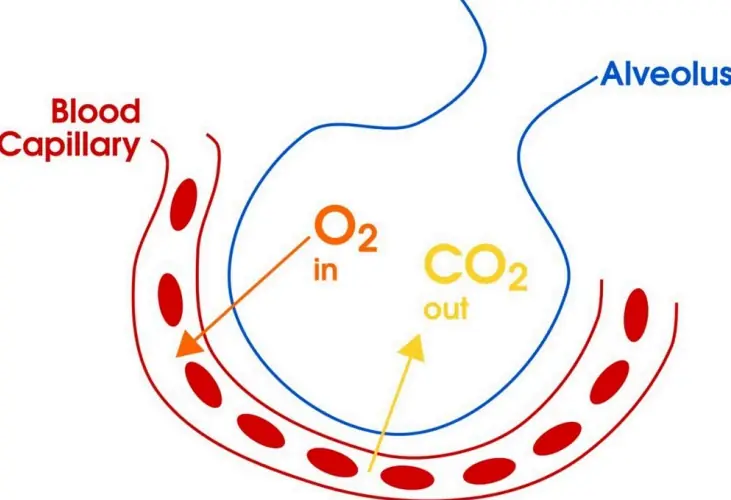
- Breathing only brings air to the alveoli; the real swap happens at the alveoli and at the tissues.
- Both exchanges occur by simple diffusion, never by active pumping.
- Partial pressure (pO ₂, pCO ₂) is the share of pressure of one gas in a mixture.
- Rule: each gas moves from higher partial pressure to lower partial pressure.
- At alveoli: high pO ₂ sends O ₂ into blood; high pCO ₂ in blood sends CO ₂ into alveoli to be breathed out.
- At tissues: O ₂ leaves blood for cells; CO ₂ from cells enters the blood.
| Site | O₂ moves | CO₂ moves |
|---|---|---|
| Alveoli | Air → blood | Blood → air (out) |
| Tissues | Blood → cells | Cells → blood |
Check yourself
Exchange and Transport of Gases
- Breathing only brings air to the alveoli; the real swap happens at the alveoli and at the tissues.
- Both exchanges occur by simple diffusion, never by active pumping.
- Partial pressure (pO ₂, pCO ₂) is the share of pressure of one gas in a mixture.
- Rule: each gas moves from higher partial pressure to lower partial pressure.
- At alveoli: high pO ₂ sends O ₂ into blood; high pCO ₂ in blood sends CO ₂ into alveoli to be breathed out.
- At tissues: O ₂ leaves blood for cells; CO ₂ from cells enters the blood.
- Alveoli — Air → blood — Blood → air (out)
- Tissues — Blood → cells — Cells → blood
Breathing only brings air to the alveoli; the real swap happens at the .
Breathing only brings air to the alveoli; the real swap happens at the alveoli and at the tissues.
Both exchanges occur by , never by active pumping.
Both exchanges occur by simple diffusion, never by active pumping.
(pO ₂, pCO ₂) is the share of pressure of one gas in a mixture.
Partial pressure (pO ₂, pCO ₂) is the share of pressure of one gas in a mixture.
Transport of Oxygen and Carbon Dioxide in Blood
- About 97% of oxygen is carried by haemoglobin in red blood cells as oxyhaemoglobin.
- The remaining ~3% of oxygen is carried dissolved in blood plasma.
- Most CO ₂ (about 70%) is carried as bicarbonate ions in the plasma.
- About 20–23% of CO ₂ binds haemoglobin as carbamino-haemoglobin; ~7% stays dissolved.
- The pigment haemoglobin gives blood its red colour and binds oxygen reversibly.
- Carbon monoxide (CO) binds haemoglobin far more strongly than O ₂, so it is a dangerous poison.
| Gas | Main transport form | Approx % |
|---|---|---|
| O₂ | Oxyhaemoglobin | 97% |
| O₂ | Dissolved in plasma | 3% |
| CO₂ | Bicarbonate ions | 70% |
| CO₂ | Carbamino-haemoglobin | 20–23% |
| CO₂ | Dissolved in plasma | 7% |
Check yourself
Transport of Oxygen and Carbon Dioxide in Blood
- About 97% of oxygen is carried by haemoglobin in red blood cells as oxyhaemoglobin.
- The remaining ~3% of oxygen is carried dissolved in blood plasma.
- Most CO ₂ (about 70%) is carried as bicarbonate ions in the plasma.
- About 20–23% of CO ₂ binds haemoglobin as carbamino-haemoglobin; ~7% stays dissolved.
- The pigment haemoglobin gives blood its red colour and binds oxygen reversibly.
- Carbon monoxide (CO) binds haemoglobin far more strongly than O ₂, so it is a dangerous poison.
- O₂ — Oxyhaemoglobin — 97%
- O₂ — Dissolved in plasma — 3%
- CO₂ — Bicarbonate ions — 70%
- CO₂ — Carbamino-haemoglobin — 20–23%
- CO₂ — Dissolved in plasma — 7%
About is carried by in red blood cells as .
About 97% of oxygen is carried by haemoglobin in red blood cells as oxyhaemoglobin.
The remaining is carried dissolved in blood plasma.
The remaining ~3% of oxygen is carried dissolved in blood plasma.
Most CO ₂ (about ) is carried as in the plasma.
Most CO ₂ (about 70%) is carried as bicarbonate ions in the plasma.
About binds haemoglobin as ; ~7% stays dissolved.
About 20–23% of CO ₂ binds haemoglobin as carbamino-haemoglobin; ~7% stays dissolved.
The pigment gives blood its red colour and binds oxygen reversibly.
The pigment haemoglobin gives blood its red colour and binds oxygen reversibly.
binds haemoglobin far more strongly than O ₂, so it is a dangerous poison.
Carbon monoxide (CO) binds haemoglobin far more strongly than O ₂, so it is a dangerous poison.
Special Cases and Common Facts
- Dolphins and whales are mammals that breathe air through blowholes on top of the head.
- Fish die out of water because gills work only with dissolved O ₂ in water, not with air.
- Aerobic respiration uses O ₂ and gives more energy; anaerobic works without O ₂.
- In our muscles during heavy exercise, lack of O ₂ forms lactic acid, causing cramps.
- Yeast respires anaerobically producing alcohol and CO ₂ (fermentation).
| Type | Needs O₂? | End products |
|---|---|---|
| Aerobic | Yes | CO₂ + water + much energy |
| Anaerobic (muscle) | No | Lactic acid + little energy |
| Anaerobic (yeast) | No | Alcohol + CO₂ + little energy |
Check yourself
Special Cases and Common Facts
- Dolphins and whales are mammals that breathe air through blowholes on top of the head.
- Fish die out of water because gills work only with dissolved O ₂ in water, not with air.
- Aerobic respiration uses O ₂ and gives more energy; anaerobic works without O ₂.
- In our muscles during heavy exercise, lack of O ₂ forms lactic acid, causing cramps.
- Yeast respires anaerobically producing alcohol and CO ₂ (fermentation).
- Aerobic — Yes — CO₂ + water + much energy
- Anaerobic (muscle) — No — Lactic acid + little energy
- Anaerobic (yeast) — No — Alcohol + CO₂ + little energy
are mammals that breathe air through on top of the head.
Dolphins and whales are mammals that breathe air through blowholes on top of the head.
because gills work only with dissolved O ₂ in water, not with air.
Fish die out of water because gills work only with dissolved O ₂ in water, not with air.
uses O ₂ and gives more energy; works without O ₂.
Aerobic respiration uses O ₂ and gives more energy; anaerobic works without O ₂.
In our muscles during heavy exercise, lack of O ₂ forms , causing cramps.
In our muscles during heavy exercise, lack of O ₂ forms lactic acid, causing cramps.
respires anaerobically producing (fermentation).
Yeast respires anaerobically producing alcohol and CO ₂ (fermentation).
Respiratory Disorders and First Aid
- CPR stands for Cardio-Pulmonary Resuscitation – emergency aid to restart breathing and heartbeat.
- Asthma: bronchioles narrow causing difficulty in breathing and wheezing.
- Emphysema: alveolar walls are damaged, reducing gasexchange surface (often from smoking).
- Pneumonia: infection that fills alveoli with fluid, blocking gas exchange.
- Occupational lung diseases like silicosis and asbestosis come from inhaling dust/fibres at work.
- Tobacco smoking is the leading preventable cause of lung damage and lung cancer.
Check yourself
Respiratory Disorders and First Aid
- CPR stands for Cardio-Pulmonary Resuscitation – emergency aid to restart breathing and heartbeat.
- Asthma: bronchioles narrow causing difficulty in breathing and wheezing.
- Emphysema: alveolar walls are damaged, reducing gasexchange surface (often from smoking).
- Pneumonia: infection that fills alveoli with fluid, blocking gas exchange.
- Occupational lung diseases like silicosis and asbestosis come from inhaling dust/fibres at work.
- Tobacco smoking is the leading preventable cause of lung damage and lung cancer.
stands for – emergency aid to restart breathing and heartbeat.
CPR stands for Cardio-Pulmonary Resuscitation – emergency aid to restart breathing and heartbeat.
: bronchioles narrow causing difficulty in breathing and wheezing.
Asthma: bronchioles narrow causing difficulty in breathing and wheezing.
: alveolar walls are damaged, reducing gasexchange surface (often from ).
Emphysema: alveolar walls are damaged, reducing gasexchange surface (often from smoking).
: infection that fills alveoli with fluid, blocking gas exchange.
Pneumonia: infection that fills alveoli with fluid, blocking gas exchange.
like silicosis and asbestosis come from inhaling dust/fibres at work.
Occupational lung diseases like silicosis and asbestosis come from inhaling dust/fibres at work.
is the leading preventable cause of lung damage and lung cancer.
Tobacco smoking is the leading preventable cause of lung damage and lung cancer.
All 19 chapters of Biology notes
- Cell: Structure & Function12 sections
- Biomolecules & DNA/RNA11 sections
- Plant Kingdom & Classification11 sections
- Plant Tissues & Anatomy12 sections
- Plant Physiology: Photosynthesis, Respiration & Nutrition14 sections
- Animal Kingdom, Morphology & Classification16 sections
- Nutrition & Digestive System12 sections
- Circulatory System & Body Fluids12 sections
- Respiratory System10 sections
- Excretory System12 sections
- Nervous System & Sense Organs12 sections
- Endocrine System & Hormones14 sections
- Skeletal & Muscular System12 sections
- Reproductive System & Reproductive Health12 sections
- Genetics & Evolution13 sections
- Human Health, Diseases & Immunity16 sections
- Ecology, Ecosystem & Biodiversity12 sections
- Biology in Everyday Life & Applied Biology12 sections
- Inventions, Discoveries & Scientists10 sections