Biology notes · Chapter 14 of 19
Reproductive System & Reproductive Health
12 sections, 76 flashcards. Open a card to check your answer, or revise them in the app with spaced revision.
Why Reproduction Matters
- Reproduction is the process by which living things make new individuals of their own kind.
- No organism lives forever, so reproduction keeps the species from dying out.
- Parents pass on a copy of their genes (instruction book) to offspring.
- The zygote is the single first cell of every new individual.
- The zygote is diploid – it has the full restored set of chromosomes.
Check yourself
Why Reproduction Matters
- Reproduction is the process by which living things make new individuals of their own kind.
- No organism lives forever, so reproduction keeps the species from dying out.
- Parents pass on a copy of their genes (instruction book) to offspring.
- The zygote is the single first cell of every new individual.
- The zygote is diploid – it has the full restored set of chromosomes.
is the process by which living things make new individuals of their own kind.
Reproduction is the process by which living things make new individuals of their own kind.
No organism lives forever, so reproduction keeps the from dying out.
No organism lives forever, so reproduction keeps the species from dying out.
Parents pass on a copy of their (instruction book) to offspring.
Parents pass on a copy of their genes (instruction book) to offspring.
The is the single first cell of every new individual.
The zygote is the single first cell of every new individual.
The zygote is – it has the full restored set of chromosomes.
The zygote is diploid – it has the full restored set of chromosomes.
Asexual vs Sexual Reproduction
- Asexual reproduction needs one parent and gives identical clones.
- Sexual reproduction needs two parents (male and female) and gives variation.
- Variation helps a species survive changing conditions.
- Each parent makes a sex cell called a gamete carrying half the chromosomes.
- Most higher animals, including humans, reproduce sexually.
| Feature | Asexual | Sexual |
|---|---|---|
| Parents | One | Two |
| Offspring | Identical clones | Show variation |
| Speed | Fast, simple | Slower |
| Examples | Budding in Hydra, spores | Humans, most plants |
Check yourself
Asexual vs Sexual Reproduction
- Asexual reproduction needs one parent and gives identical clones.
- Sexual reproduction needs two parents (male and female) and gives variation.
- Variation helps a species survive changing conditions.
- Each parent makes a sex cell called a gamete carrying half the chromosomes.
- Most higher animals, including humans, reproduce sexually.
- Parents — One — Two
- Offspring — Identical clones — Show variation
- Speed — Fast, simple — Slower
- Examples — Budding in Hydra, spores — Humans, most plants
needs one parent and gives identical clones.
Asexual reproduction needs one parent and gives identical clones.
needs two parents (male and female) and gives variation.
Sexual reproduction needs two parents (male and female) and gives variation.
Variation helps a species survive .
Variation helps a species survive changing conditions.
Each parent makes a sex cell called a carrying half the chromosomes.
Each parent makes a sex cell called a gamete carrying half the chromosomes.
Most higher animals, including , reproduce sexually.
Most higher animals, including humans, reproduce sexually.
Chromosomes: Haploid & Diploid
- A chromosome is a thread-like structure that carries the genes.
- A human body cell has 46 chromosomes arranged as 23 pairs.
- A cell with the full double set is diploid (2n).
- A cell with only half the set is haploid (n) – 23 in humans.
- Sperm and egg are haploid so that 23 + 23 = 46 at fertilisation.
| Type | Symbol | Chromosomes (human) |
|---|---|---|
| Diploid | 2n | 46 |
| Haploid | n | 23 |
Check yourself
Chromosomes: Haploid & Diploid
- A chromosome is a thread-like structure that carries the genes.
- A human body cell has 46 chromosomes arranged as 23 pairs.
- A cell with the full double set is diploid (2n).
- A cell with only half the set is haploid (n) – 23 in humans.
- Sperm and egg are haploid so that 23 + 23 = 46 at fertilisation.
- Diploid — 2n — 46
- Haploid — n — 23
A is a thread-like structure that carries the genes.
A chromosome is a thread-like structure that carries the genes.
A human body cell has arranged as 23 pairs.
A human body cell has 46 chromosomes arranged as 23 pairs.
A cell with the full double set is .
A cell with the full double set is diploid (2n).
A cell with only half the set is – 23 in humans.
A cell with only half the set is haploid (n) – 23 in humans.
Sperm and egg are haploid so that at fertilisation.
Sperm and egg are haploid so that 23 + 23 = 46 at fertilisation.
Cell Division & Gamete Formation
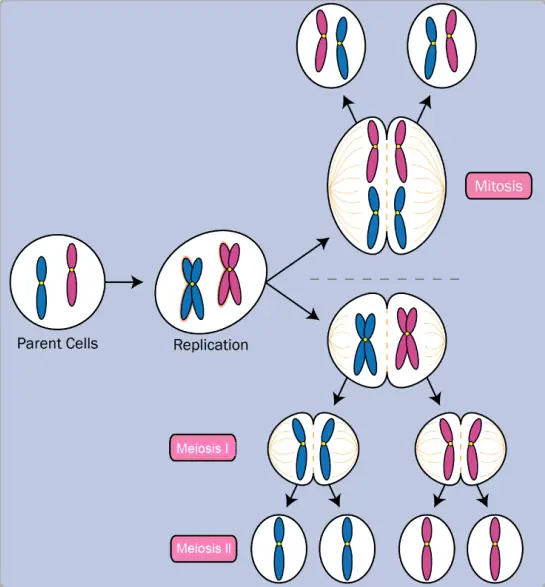
- Mitosis makes two identical cells with the same number (46 to 46).
- Mitosis is used for growth, repair and asexual reproduction.
- Meiosis is a reduction division that halves the number (46 to 23).
- Meiosis produces the haploid gametes.
- Making gametes is gametogenesis: spermatogenesis (male), oogenesis (female).
| Division | Result | Use |
|---|---|---|
| Mitosis | 46 to 46, identical | Body cells, growth |
| Meiosis | 46 to 23, halved | Gametes |
Check yourself
Cell Division & Gamete Formation
- Mitosis makes two identical cells with the same number (46 to 46).
- Mitosis is used for growth, repair and asexual reproduction.
- Meiosis is a reduction division that halves the number (46 to 23).
- Meiosis produces the haploid gametes.
- Making gametes is gametogenesis: spermatogenesis (male), oogenesis (female).
- Mitosis — 46 to 46, identical — Body cells, growth
- Meiosis — 46 to 23, halved — Gametes
makes two identical cells with the same number (46 to 46).
Mitosis makes two identical cells with the same number (46 to 46).
Mitosis is used for and asexual reproduction.
Mitosis is used for growth, repair and asexual reproduction.
is a reduction division that halves the number (46 to 23).
Meiosis is a reduction division that halves the number (46 to 23).
Meiosis produces the .
Meiosis produces the haploid gametes.
Making gametes is : spermatogenesis (male), oogenesis (female).
Making gametes is gametogenesis: spermatogenesis (male), oogenesis (female).
Types of Gametes & Patterns of Fusion
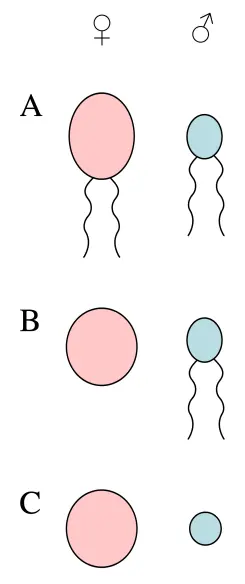
- Homogametes (isogametes) look alike, e.g. in alga Ulothrix.
- Heterogametes look different: small motile male, large still female.
- Isogamy = fusion of two same-sized gametes (Spirogyra, Ulothrix).
- Anisogamy = fusion of two different-sized gametes (Eudorina).
- Oogamy = large non-moving egg fuses with small moving sperm (Volvox, humans).
| Pattern | Gametes | Example |
|---|---|---|
| Isogamous | Same size | Spirogyra, Ulothrix |
| Anisogamous | Different size | Eudorina |
| Oogamous | Big egg + tiny sperm | Volvox, Fucus, human |
Check yourself
Types of Gametes & Patterns of Fusion
- Homogametes (isogametes) look alike, e.g. in alga Ulothrix.
- Heterogametes look different: small motile male, large still female.
- Isogamy = fusion of two same-sized gametes (Spirogyra, Ulothrix).
- Anisogamy = fusion of two different-sized gametes (Eudorina).
- Oogamy = large non-moving egg fuses with small moving sperm (Volvox, humans).
- Isogamous — Same size — Spirogyra, Ulothrix
- Anisogamous — Different size — Eudorina
- Oogamous — Big egg + tiny sperm — Volvox, Fucus, human
look alike, e.g. in alga Ulothrix.
Homogametes (isogametes) look alike, e.g. in alga Ulothrix.
look different: small motile male, large still female.
Heterogametes look different: small motile male, large still female.
= fusion of two same-sized gametes (Spirogyra, Ulothrix).
Isogamy = fusion of two same-sized gametes (Spirogyra, Ulothrix).
= fusion of two different-sized gametes (Eudorina).
Anisogamy = fusion of two different-sized gametes (Eudorina).
= large non-moving egg fuses with small moving sperm (Volvox, humans).
Oogamy = large non-moving egg fuses with small moving sperm (Volvox, humans).
Human Male Reproductive System
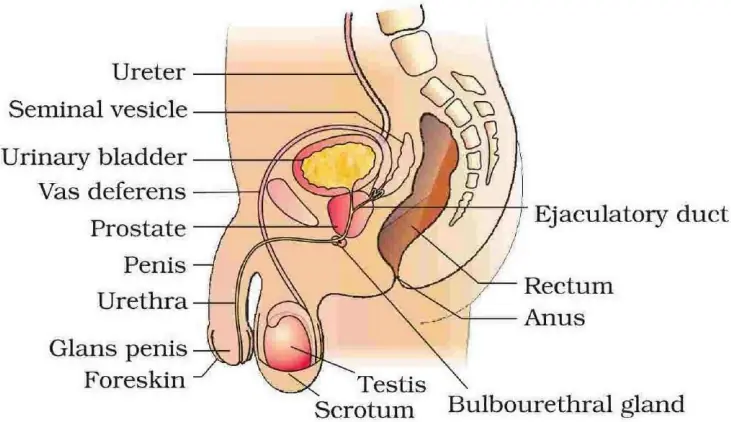
- Its two jobs are to make sperms and to deliver them into the female body.
- The testes are the primary male sex organs that make sperms and testosterone.
- Testes hang in a skin pouch, the scrotum, which keeps them cooler than body temperature.
- Sperms form inside coiled seminiferous tubules, supported by Sertoli (nurse) cells.
- The vas deferens carries sperms toward the urethra in the penis.
- Semen = sperms plus fluid from seminal vesicle, prostate and bulbourethral glands.
Check yourself
Human Male Reproductive System
- Its two jobs are to make sperms and to deliver them into the female body.
- The testes are the primary male sex organs that make sperms and testosterone.
- Testes hang in a skin pouch, the scrotum, which keeps them cooler than body temperature.
- Sperms form inside coiled seminiferous tubules, supported by Sertoli (nurse) cells.
- The vas deferens carries sperms toward the urethra in the penis.
- Semen = sperms plus fluid from seminal vesicle, prostate and bulbourethral glands.
The are the primary male sex organs that make sperms and testosterone.
The testes are the primary male sex organs that make sperms and testosterone.
Testes hang in a skin pouch, the , which keeps them cooler than body temperature.
Testes hang in a skin pouch, the scrotum, which keeps them cooler than body temperature.
Sperms form inside coiled , supported by Sertoli (nurse) cells.
Sperms form inside coiled seminiferous tubules, supported by Sertoli (nurse) cells.
The carries sperms toward the urethra in the penis.
The vas deferens carries sperms toward the urethra in the penis.
= sperms plus fluid from seminal vesicle, prostate and bulbourethral glands.
Semen = sperms plus fluid from seminal vesicle, prostate and bulbourethral glands.
Spermatogenesis: Making Sperms
- Spermatogenesis happens in the seminiferous tubules from puberty onward.
- The diploid starting cell is the spermatogonium (46 chromosomes).
- A primary spermatocyte undergoes meiosis I to give two haploid secondary spermatocytes.
- One primary spermatocyte finally yields four haploid spermatids.
- Spermatids reshape into sperms by spermiogenesis, then are released by spermiation.
- A mature sperm has four parts: head, neck, middle piece and tail.
| Stage | Chromosomes | Number |
|---|---|---|
| Spermatogonium | 46 (2n) | 1 |
| Primary spermatocyte | 46 (2n) | 1 |
| Secondary spermatocyte | 23 (n) | 2 |
| Spermatid / Sperm | 23 (n) | 4 |
Check yourself
Spermatogenesis: Making Sperms
- Spermatogenesis happens in the seminiferous tubules from puberty onward.
- The diploid starting cell is the spermatogonium (46 chromosomes).
- A primary spermatocyte undergoes meiosis I to give two haploid secondary spermatocytes.
- One primary spermatocyte finally yields four haploid spermatids.
- Spermatids reshape into sperms by spermiogenesis, then are released by spermiation.
- A mature sperm has four parts: head, neck, middle piece and tail.
- Spermatogonium — 46 (2n) — 1
- Primary spermatocyte — 46 (2n) — 1
- Secondary spermatocyte — 23 (n) — 2
- Spermatid / Sperm — 23 (n) — 4
happens in the seminiferous tubules from puberty onward.
Spermatogenesis happens in the seminiferous tubules from puberty onward.
The diploid starting cell is the (46 chromosomes).
The diploid starting cell is the spermatogonium (46 chromosomes).
A primary spermatocyte undergoes meiosis I to give two haploid .
A primary spermatocyte undergoes meiosis I to give two haploid secondary spermatocytes.
One primary spermatocyte finally yields .
One primary spermatocyte finally yields four haploid spermatids.
Spermatids reshape into sperms by , then are released by spermiation.
Spermatids reshape into sperms by spermiogenesis, then are released by spermiation.
Human Female System & Oogenesis
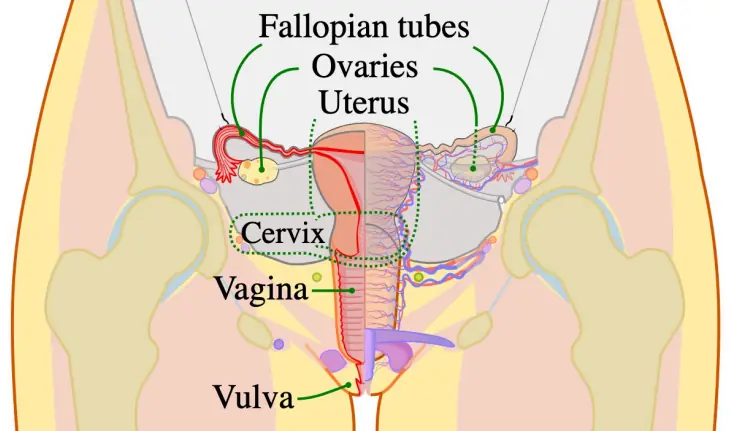
- The ovaries are the primary female sex organs that make eggs and hormones.
- The fallopian tube (oviduct) carries the egg and is where fertilisation occurs.
- The uterus (womb) shelters and nourishes the developing baby.
- Oogenesis begins before birth and produces the egg (ovum).
- One primary oocyte gives only one ovum plus tiny polar bodies.
- Females normally release one egg per cycle (ovulation).
| Organ | Main role |
|---|---|
| Ovary | Makes eggs and hormones |
| Fallopian tube | Site of fertilisation |
| Uterus | Shelters the embryo |
| Vagina | Receives sperms; birth canal |
Check yourself
Human Female System & Oogenesis
- The ovaries are the primary female sex organs that make eggs and hormones.
- The fallopian tube (oviduct) carries the egg and is where fertilisation occurs.
- The uterus (womb) shelters and nourishes the developing baby.
- Oogenesis begins before birth and produces the egg (ovum).
- One primary oocyte gives only one ovum plus tiny polar bodies.
- Females normally release one egg per cycle (ovulation).
- Ovary — Makes eggs and hormones
- Fallopian tube — Site of fertilisation
- Uterus — Shelters the embryo
- Vagina — Receives sperms; birth canal
The are the primary female sex organs that make eggs and hormones.
The ovaries are the primary female sex organs that make eggs and hormones.
The carries the egg and is where fertilisation occurs.
The fallopian tube (oviduct) carries the egg and is where fertilisation occurs.
The shelters and nourishes the developing baby.
The uterus (womb) shelters and nourishes the developing baby.
begins before birth and produces the egg (ovum).
Oogenesis begins before birth and produces the egg (ovum).
One primary oocyte gives only plus tiny polar bodies.
One primary oocyte gives only one ovum plus tiny polar bodies.
Females normally release (ovulation).
Females normally release one egg per cycle (ovulation).
Menstrual Cycle & Hormones
- The menstrual cycle in human females repeats about every 28 days.
- Ovulation (release of the egg) occurs around day 14, mid-cycle.
- If no fertilisation occurs, the uterus lining sheds as menstruation (bleeding).
- Oestrogen and progesterone are the main female hormones controlling the cycle.
- The cycle starts at puberty (menarche) and ends near 45-50 (menopause).
Check yourself
Menstrual Cycle & Hormones
- The menstrual cycle in human females repeats about every 28 days.
- Ovulation (release of the egg) occurs around day 14, mid-cycle.
- If no fertilisation occurs, the uterus lining sheds as menstruation (bleeding).
- Oestrogen and progesterone are the main female hormones controlling the cycle.
- The cycle starts at puberty (menarche) and ends near 45-50 (menopause).
The in human females repeats about every 28 days.
The menstrual cycle in human females repeats about every 28 days.
(release of the egg) occurs around day 14, mid-cycle.
Ovulation (release of the egg) occurs around day 14, mid-cycle.
If no fertilisation occurs, the uterus lining sheds as .
If no fertilisation occurs, the uterus lining sheds as menstruation (bleeding).
are the main female hormones controlling the cycle.
Oestrogen and progesterone are the main female hormones controlling the cycle.
The cycle starts at puberty () and ends near 45-50 ().
The cycle starts at puberty (menarche) and ends near 45-50 (menopause).
Fertilisation, Pregnancy & Birth
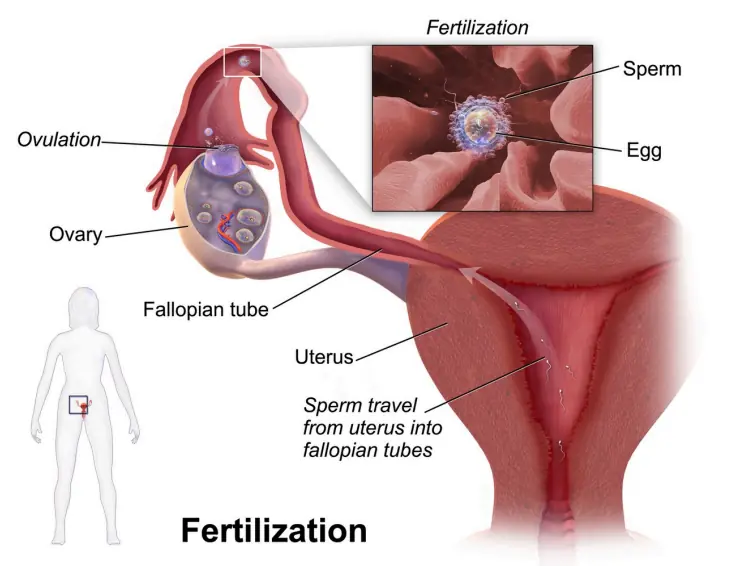
- Fertilisation is the fusion of one sperm with one egg, forming a zygote.
- In humans fertilisation occurs in the fallopian tube (oviduct).
- The zygote divides repeatedly to form an embryo that implants in the uterus.
- The placenta supplies the embryo with food and oxygen from the mother.
- Human pregnancy (gestation) lasts about nine months (280 days).
- Birth of the fully formed baby is called parturition.
Check yourself
Fertilisation, Pregnancy & Birth
- Fertilisation is the fusion of one sperm with one egg, forming a zygote.
- In humans fertilisation occurs in the fallopian tube (oviduct).
- The zygote divides repeatedly to form an embryo that implants in the uterus.
- The placenta supplies the embryo with food and oxygen from the mother.
- Human pregnancy (gestation) lasts about nine months (280 days).
- Birth of the fully formed baby is called parturition.
is the fusion of one sperm with one egg, forming a zygote.
Fertilisation is the fusion of one sperm with one egg, forming a zygote.
In humans fertilisation occurs in the .
In humans fertilisation occurs in the fallopian tube (oviduct).
The zygote divides repeatedly to form an that implants in the uterus.
The zygote divides repeatedly to form an embryo that implants in the uterus.
The supplies the embryo with food and oxygen from the mother.
The placenta supplies the embryo with food and oxygen from the mother.
Human pregnancy (gestation) lasts about .
Human pregnancy (gestation) lasts about nine months (280 days).
Birth of the fully formed baby is called .
Birth of the fully formed baby is called parturition.
Sexual Reproduction in Flowering Plants
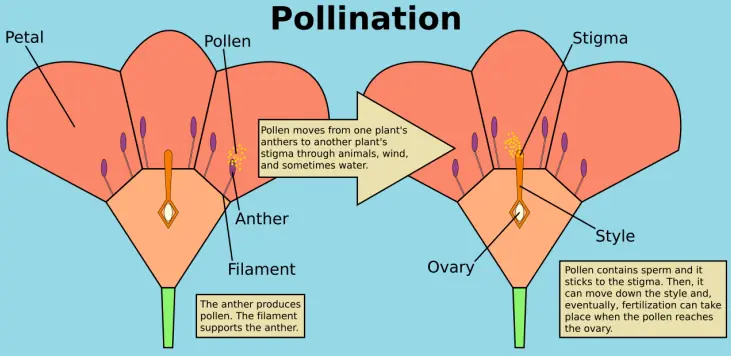
- The flower is the reproductive organ of a flowering plant.
- The stamen (anther + filament) is the male part making pollen grains.
- The pistil/carpel (stigma, style, ovary) is the female part holding ovules.
- Pollination is the transfer of pollen from the anther to the stigma.
- Self-pollination is within the same flower; crosspollination is between two flowers.
- Pollen reaching the ovule causes fertilisation, and the ovule becomes a seed.
| Part | Belongs to | Role |
|---|---|---|
| Anther | Stamen (male) | Makes pollen |
| Stigma | Pistil (female) | Receives pollen |
| Ovary | Pistil (female) | Holds ovules, becomes fruit |
Check yourself
Sexual Reproduction in Flowering Plants
- The flower is the reproductive organ of a flowering plant.
- The stamen (anther + filament) is the male part making pollen grains.
- The pistil/carpel (stigma, style, ovary) is the female part holding ovules.
- Pollination is the transfer of pollen from the anther to the stigma.
- Self-pollination is within the same flower; crosspollination is between two flowers.
- Pollen reaching the ovule causes fertilisation, and the ovule becomes a seed.
- Anther — Stamen (male) — Makes pollen
- Stigma — Pistil (female) — Receives pollen
- Ovary — Pistil (female) — Holds ovules, becomes fruit
The is the reproductive organ of a flowering plant.
The flower is the reproductive organ of a flowering plant.
The (anther + filament) is the male part making pollen grains.
The stamen (anther + filament) is the male part making pollen grains.
The (stigma, style, ovary) is the female part holding ovules.
The pistil/carpel (stigma, style, ovary) is the female part holding ovules.
is the transfer of pollen from the anther to the stigma.
Pollination is the transfer of pollen from the anther to the stigma.
is within the same flower; is between two flowers.
Self-pollination is within the same flower; crosspollination is between two flowers.
Pollen reaching the ovule causes , and the ovule becomes a seed.
Pollen reaching the ovule causes fertilisation, and the ovule becomes a seed.
Reproductive Health & Adolescence
- Puberty is when the body becomes capable of reproduction (about 10-14 years).
- Secondary sexual characters appear, e.g. facial hair in boys, breasts in girls.
- Testosterone (male) and oestrogen (female) drive these changes.
- Contraception (birth control) is used to prevent unwanted pregnancy.
- STDs like AIDS and syphilis spread through sexual contact.
- A balanced diet, hygiene and awareness support good reproductive health.
Check yourself
Reproductive Health & Adolescence
- Puberty is when the body becomes capable of reproduction (about 10-14 years).
- Secondary sexual characters appear, e.g. facial hair in boys, breasts in girls.
- Testosterone (male) and oestrogen (female) drive these changes.
- Contraception (birth control) is used to prevent unwanted pregnancy.
- STDs like AIDS and syphilis spread through sexual contact.
- A balanced diet, hygiene and awareness support good reproductive health.
is when the body becomes capable of reproduction (about 10-14 years).
Puberty is when the body becomes capable of reproduction (about 10-14 years).
appear, e.g. facial hair in boys, breasts in girls.
Secondary sexual characters appear, e.g. facial hair in boys, breasts in girls.
(male) and (female) drive these changes.
Testosterone (male) and oestrogen (female) drive these changes.
(birth control) is used to prevent unwanted pregnancy.
Contraception (birth control) is used to prevent unwanted pregnancy.
like AIDS and syphilis spread through sexual contact.
STDs like AIDS and syphilis spread through sexual contact.
A balanced diet, hygiene and awareness support good .
A balanced diet, hygiene and awareness support good reproductive health.
All 19 chapters of Biology notes
- Cell: Structure & Function12 sections
- Biomolecules & DNA/RNA11 sections
- Plant Kingdom & Classification11 sections
- Plant Tissues & Anatomy12 sections
- Plant Physiology: Photosynthesis, Respiration & Nutrition14 sections
- Animal Kingdom, Morphology & Classification16 sections
- Nutrition & Digestive System12 sections
- Circulatory System & Body Fluids12 sections
- Respiratory System10 sections
- Excretory System12 sections
- Nervous System & Sense Organs12 sections
- Endocrine System & Hormones14 sections
- Skeletal & Muscular System12 sections
- Reproductive System & Reproductive Health12 sections
- Genetics & Evolution13 sections
- Human Health, Diseases & Immunity16 sections
- Ecology, Ecosystem & Biodiversity12 sections
- Biology in Everyday Life & Applied Biology12 sections
- Inventions, Discoveries & Scientists10 sections