Biology notes · Chapter 5 of 19
Plant Physiology: Photosynthesis, Respiration & Nutrition
14 sections, 85 flashcards. Open a card to check your answer, or revise them in the app with spaced revision.
What Plant Physiology Studies
- Plant physiology is the study of how a plant's lifeprocesses work inside it.
- A plant works like a tiny food factory: leaves are the kitchen, roots are the pumps, stem holds the delivery pipes.
- Leaves make food; roots absorb water and minerals; xylem and phloem transport them.
- Four big life-jobs: photosynthesis (making food), respiration (getting energy), nutrition (minerals), and transport.
- Plants that make their own food are autotrophs; those that depend on others are heterotrophs.
Check yourself
What Plant Physiology Studies
- Plant physiology is the study of how a plant's lifeprocesses work inside it.
- A plant works like a tiny food factory: leaves are the kitchen, roots are the pumps, stem holds the delivery pipes.
- Leaves make food; roots absorb water and minerals; xylem and phloem transport them.
- Four big life-jobs: photosynthesis (making food), respiration (getting energy), nutrition (minerals), and transport.
- Plants that make their own food are autotrophs; those that depend on others are heterotrophs.
is the study of how a plant's lifeprocesses work inside it.
Plant physiology is the study of how a plant's lifeprocesses work inside it.
A plant works like a : leaves are the kitchen, roots are the pumps, stem holds the delivery pipes.
A plant works like a tiny food factory: leaves are the kitchen, roots are the pumps, stem holds the delivery pipes.
make food; absorb water and minerals; transport them.
Leaves make food; roots absorb water and minerals; xylem and phloem transport them.
Plants that make their own food are ; those that depend on others are .
Plants that make their own food are autotrophs; those that depend on others are heterotrophs.
Photosynthesis – Making Food from Light
- Photosynthesis = making food using light (photo = light, synthesis = making).
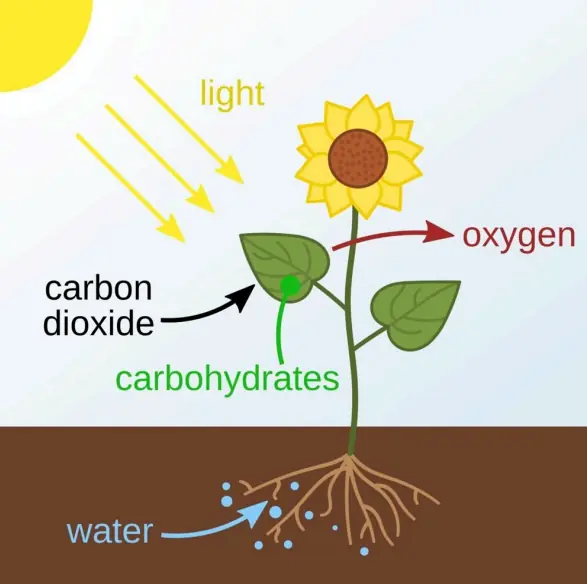
- Green plants use sunlight, CO2 and water to make glucose and release oxygen.
- Word equation: 6CO2 + 6H2O + light → C6H12O6 + 6O2.
- The main product is glucose (the food); oxygen is only a by-product.
- The released oxygen comes from the splitting of water, not from CO2.
- CO2 enters through tiny leaf-pores called stomata; water comes from the roots.
- Main site of photosynthesis is the mesophyll cells of the leaf.
| Raw material | Source |
|---|---|
| Carbon dioxide | Air (through stomata) |
| Water | Soil (absorbed by roots) |
| Sunlight | The Sun |
| Chlorophyll | Green leaf cells |
Check yourself
Photosynthesis – Making Food from Light
- Photosynthesis = making food using light (photo = light, synthesis = making).
- Green plants use sunlight, CO2 and water to make glucose and release oxygen.
- Word equation: 6CO2 + 6H2O + light → C6H12O6 + 6O2.
- The main product is glucose (the food); oxygen is only a by-product.
- The released oxygen comes from the splitting of water, not from CO2.
- CO2 enters through tiny leaf-pores called stomata; water comes from the roots.
- Main site of photosynthesis is the mesophyll cells of the leaf.
- Carbon dioxide — Air (through stomata)
- Water — Soil (absorbed by roots)
- Sunlight — The Sun
- Chlorophyll — Green leaf cells
= making food using light (photo = light, synthesis = making).
Photosynthesis = making food using light (photo = light, synthesis = making).
Green plants use to make glucose and release oxygen.
Green plants use sunlight, CO2 and water to make glucose and release oxygen.
The main product is (the food); .
The main product is glucose (the food); oxygen is only a by-product.
The released oxygen comes from the , not from CO2.
The released oxygen comes from the splitting of water, not from CO2.
CO2 enters through tiny leaf-pores called ; water comes from the roots.
CO2 enters through tiny leaf-pores called stomata; water comes from the roots.
Chlorophyll and Photosynthetic Pigments
- Chlorophyll is the green pigment that traps sunlight; it sits inside chloroplasts.
- Chlorophyll contains the metal magnesium (Mg) at its centre.
- Chlorophyll a is the chief (main) pigment of photosynthesis.
- Chlorophyll b and carotenoids are accessory pigments that capture extra light.
- Chlorophyll absorbs light best in the blue and red regions of the spectrum.
- Green light is reflected (not absorbed), so leaves look green.
- Chlorophyll is used to trap and convert light energy for making food.
| Pigment | Role |
|---|---|
| Chlorophyll a | Chief pigment |
| Chlorophyll b | Accessory pigment |
| Carotenoids | Accessory (yellow-orange) |
Check yourself
Chlorophyll and Photosynthetic Pigments
- Chlorophyll is the green pigment that traps sunlight; it sits inside chloroplasts.
- Chlorophyll contains the metal magnesium (Mg) at its centre.
- Chlorophyll a is the chief (main) pigment of photosynthesis.
- Chlorophyll b and carotenoids are accessory pigments that capture extra light.
- Chlorophyll absorbs light best in the blue and red regions of the spectrum.
- Green light is reflected (not absorbed), so leaves look green.
- Chlorophyll is used to trap and convert light energy for making food.
- Chlorophyll a — Chief pigment
- Chlorophyll b — Accessory pigment
- Carotenoids — Accessory (yellow-orange)
is the green pigment that traps sunlight; it sits inside .
Chlorophyll is the green pigment that traps sunlight; it sits inside chloroplasts.
Chlorophyll contains the metal at its centre.
Chlorophyll contains the metal magnesium (Mg) at its centre.
is the chief (main) pigment of photosynthesis.
Chlorophyll a is the chief (main) pigment of photosynthesis.
are accessory pigments that capture extra light.
Chlorophyll b and carotenoids are accessory pigments that capture extra light.
Chlorophyll absorbs light best in the regions of the spectrum.
Chlorophyll absorbs light best in the blue and red regions of the spectrum.
(not absorbed), so leaves look green.
Green light is reflected (not absorbed), so leaves look green.
Light Reaction and Dark Reaction
- Photosynthesis runs in two stages inside the chloroplast.
- Light reaction happens on the thylakoid membranes (grana) and needs light.
- In the light reaction, water is split (photolysis), releasing O2 and storing energy as ATP and NADPH.
- Dark reaction (Calvin cycle) happens in the stroma and fixes CO2 into glucose.
- It is called 'dark' because it does not directly need light, not because it needs darkness.
- Two photosystems: PS I (P700) and PS II (P680); watersplitting is linked with PS II.
| Feature | Light reaction | Dark reaction |
|---|---|---|
| Place | Thylakoid (grana) | Stroma |
| Needs light | Yes | Not directly |
| Output | ATP, NADPH, O2 | Glucose |
Check yourself
Light Reaction and Dark Reaction
- Photosynthesis runs in two stages inside the chloroplast.
- Light reaction happens on the thylakoid membranes (grana) and needs light.
- In the light reaction, water is split (photolysis), releasing O2 and storing energy as ATP and NADPH.
- Dark reaction (Calvin cycle) happens in the stroma and fixes CO2 into glucose.
- It is called 'dark' because it does not directly need light, not because it needs darkness.
- Two photosystems: PS I (P700) and PS II (P680); watersplitting is linked with PS II.
- Place — Thylakoid (grana) — Stroma
- Needs light — Yes — Not directly
- Output — ATP, NADPH, O2 — Glucose
Photosynthesis runs in inside the chloroplast.
Photosynthesis runs in two stages inside the chloroplast.
happens on the and needs light.
Light reaction happens on the thylakoid membranes (grana) and needs light.
In the light reaction, water is split (), releasing O2 and storing energy as .
In the light reaction, water is split (photolysis), releasing O2 and storing energy as ATP and NADPH.
happens in the and fixes CO2 into glucose.
Dark reaction (Calvin cycle) happens in the stroma and fixes CO2 into glucose.
It is called 'dark' because it , not because it needs darkness.
It is called 'dark' because it does not directly need light, not because it needs darkness.
Two photosystems: and ; watersplitting is linked with PS II.
Two photosystems: PS I (P700) and PS II (P680); watersplitting is linked with PS II.
Factors Affecting Rate of Photosynthesis
- Rate of photosynthesis = how fast a plant makes food; it is not fixed.
- Four main factors: light intensity, CO2 amount, temperature, and water.
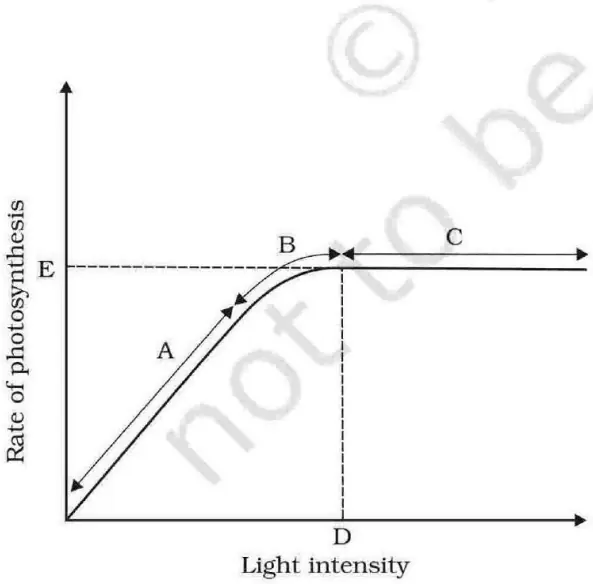
- More light raises the rate, but only up to a point, then it plateaus (levels off).
- Blackman's Law of Limiting Factors: the rate is set by the factor in shortest supply.
- That scarce factor is called the limiting factor.
- Very high temperature damages enzymes and lowers the rate.
| Factor | Effect on rate |
|---|---|
| Light intensity | Rises, then plateaus |
| CO2 level | Rises with more CO2 |
| Temperature | Optimum, then falls |
| Water | Shortage lowers rate |
Check yourself
Factors Affecting Rate of Photosynthesis
- Rate of photosynthesis = how fast a plant makes food; it is not fixed.
- Four main factors: light intensity, CO2 amount, temperature, and water.
- More light raises the rate, but only up to a point, then it plateaus (levels off).
- Blackman's Law of Limiting Factors: the rate is set by the factor in shortest supply.
- That scarce factor is called the limiting factor.
- Very high temperature damages enzymes and lowers the rate.
- Light intensity — Rises, then plateaus
- CO2 level — Rises with more CO2
- Temperature — Optimum, then falls
- Water — Shortage lowers rate
= how fast a plant makes food; it is not fixed.
Rate of photosynthesis = how fast a plant makes food; it is not fixed.
More light raises the rate, but only up to a point, then it .
More light raises the rate, but only up to a point, then it plateaus (levels off).
: the rate is set by the factor in shortest supply.
Blackman's Law of Limiting Factors: the rate is set by the factor in shortest supply.
That scarce factor is called the .
That scarce factor is called the limiting factor.
Very high temperature and lowers the rate.
Very high temperature damages enzymes and lowers the rate.
Respiration – Releasing Energy from Food
- Respiration is the controlled breakdown of glucose to release energy as ATP.
- Equation: C6H12O6 + 6O2 → 6CO2 + 6H2O + energy.
- Respiration is almost the reverse of photosynthesis.
- Plants respire day and night, but photosynthesise only in light.
- Aerobic respiration uses oxygen and gives a lot of energy.
- Anaerobic respiration (fermentation) works without oxygen and gives little energy.
- Respiration occurs in the mitochondria, the 'powerhouse of the cell'.
| Feature | Photosynthesis | Respiration |
|---|---|---|
| Energy | Stored | Released |
| Oxygen | Released | Used up |
| When | Daytime only | Day and night |
| Site | Chloroplast | Mitochondria |
Check yourself
Respiration – Releasing Energy from Food
- Respiration is the controlled breakdown of glucose to release energy as ATP.
- Equation: C6H12O6 + 6O2 → 6CO2 + 6H2O + energy.
- Respiration is almost the reverse of photosynthesis.
- Plants respire day and night, but photosynthesise only in light.
- Aerobic respiration uses oxygen and gives a lot of energy.
- Anaerobic respiration (fermentation) works without oxygen and gives little energy.
- Respiration occurs in the mitochondria, the 'powerhouse of the cell'.
- Energy — Stored — Released
- Oxygen — Released — Used up
- When — Daytime only — Day and night
- Site — Chloroplast — Mitochondria
is the controlled breakdown of glucose to release energy as ATP.
Respiration is the controlled breakdown of glucose to release energy as ATP.
Plants , but photosynthesise only in light.
Plants respire day and night, but photosynthesise only in light.
uses oxygen and gives a lot of energy.
Aerobic respiration uses oxygen and gives a lot of energy.
Respiration occurs in the , the 'powerhouse of the cell'.
Respiration occurs in the mitochondria, the 'powerhouse of the cell'.
Why Not Sleep Under Trees at Night
- In daytime, plants photosynthesise and release oxygen.
- At night there is no photosynthesis, but respiration continues.
- So at night plants release carbon dioxide and use up oxygen.
- This is why it is advised not to sleep under trees at night – CO2 builds up.
- Photosynthesis using the invisible (UV) part of sunlight is done by some bacteria.
Check yourself
Why Not Sleep Under Trees at Night
- In daytime, plants photosynthesise and release oxygen.
- At night there is no photosynthesis, but respiration continues.
- So at night plants release carbon dioxide and use up oxygen.
- This is why it is advised not to sleep under trees at night – CO2 builds up.
- Photosynthesis using the invisible (UV) part of sunlight is done by some bacteria.
In daytime, plants photosynthesise and .
In daytime, plants photosynthesise and release oxygen.
At night there is , but respiration continues.
At night there is no photosynthesis, but respiration continues.
So at night plants and use up oxygen.
So at night plants release carbon dioxide and use up oxygen.
This is why it is advised not to sleep under trees at night – .
This is why it is advised not to sleep under trees at night – CO2 builds up.
Photosynthesis using the of sunlight is done by some bacteria.
Photosynthesis using the invisible (UV) part of sunlight is done by some bacteria.
Plant Nutrition and Mineral Nutrients
- Plants need two things: home-made sugar and mineral nutrients from outside.
- Carbon comes from air (CO2); mineral salts come mainly from the soil.
- Macronutrients (needed in large amounts): N, P, K, Ca, Mg, S.
- Micronutrients (needed in tiny amounts): Fe, Mn, Zn, Cu, B, Mo, Cl.
- Nitrogen (N) is needed for proteins and chlorophyll; phosphorus (P) stimulates early growth and roots.
- Potassium (K) helps overall growth and stomatal function.
- Roots absorb nutrients dissolved in water.
| Nutrient | Main use |
|---|---|
| Nitrogen (N) | Proteins, chlorophyll |
| Phosphorus (P) | Early growth, roots |
| Potassium (K) | Growth, stomata |
| Magnesium (Mg) | Chlorophyll core |
Check yourself
Plant Nutrition and Mineral Nutrients
- Plants need two things: home-made sugar and mineral nutrients from outside.
- Carbon comes from air (CO2); mineral salts come mainly from the soil.
- Macronutrients (needed in large amounts): N, P, K, Ca, Mg, S.
- Micronutrients (needed in tiny amounts): Fe, Mn, Zn, Cu, B, Mo, Cl.
- Nitrogen (N) is needed for proteins and chlorophyll; phosphorus (P) stimulates early growth and roots.
- Potassium (K) helps overall growth and stomatal function.
- Roots absorb nutrients dissolved in water.
- Nitrogen (N) — Proteins, chlorophyll
- Phosphorus (P) — Early growth, roots
- Potassium (K) — Growth, stomata
- Magnesium (Mg) — Chlorophyll core
Plants need two things: and from outside.
Plants need two things: home-made sugar and mineral nutrients from outside.
Carbon comes from ; mineral salts come mainly from the .
Carbon comes from air (CO2); mineral salts come mainly from the soil.
(needed in large amounts): N, P, K, Ca, Mg, S.
Macronutrients (needed in large amounts): N, P, K, Ca, Mg, S.
(needed in tiny amounts): Fe, Mn, Zn, Cu, B, Mo, Cl.
Micronutrients (needed in tiny amounts): Fe, Mn, Zn, Cu, B, Mo, Cl.
is needed for proteins and chlorophyll; stimulates early growth and roots.
Nitrogen (N) is needed for proteins and chlorophyll; phosphorus (P) stimulates early growth and roots.
helps overall growth and stomatal function.
Potassium (K) helps overall growth and stomatal function.
Nitrogen and Special Feeding Relationships
- Plants cannot use free N2 gas; they take nitrogen as nitrates (NO3-) and ammonium (NH4+).
- Nitrogen fixation by Rhizobium bacteria in legume root nodules converts N2 into usable form.
- Insectivorous plants (e.g. pitcher plant, Venus flytrap) trap insects to get nitrogen.
- They grow in soil deficient in nitrogen.
- Mycorrhiza is a root-fungus partnership; the plant gets better water and mineral absorption.
- The fungus in turn gets sugar (food) from the plant.
Check yourself
Nitrogen and Special Feeding Relationships
- Plants cannot use free N2 gas; they take nitrogen as nitrates (NO3-) and ammonium (NH4+).
- Nitrogen fixation by Rhizobium bacteria in legume root nodules converts N2 into usable form.
- Insectivorous plants (e.g. pitcher plant, Venus flytrap) trap insects to get nitrogen.
- They grow in soil deficient in nitrogen.
- Mycorrhiza is a root-fungus partnership; the plant gets better water and mineral absorption.
- The fungus in turn gets sugar (food) from the plant.
Plants cannot use free N2 gas; they take nitrogen as .
Plants cannot use free N2 gas; they take nitrogen as nitrates (NO3-) and ammonium (NH4+).
by Rhizobium bacteria in legume root nodules converts N2 into usable form.
Nitrogen fixation by Rhizobium bacteria in legume root nodules converts N2 into usable form.
(e.g. pitcher plant, Venus flytrap) trap insects to get nitrogen.
Insectivorous plants (e.g. pitcher plant, Venus flytrap) trap insects to get nitrogen.
is a root-fungus partnership; the plant gets better .
Mycorrhiza is a root-fungus partnership; the plant gets better water and mineral absorption.
The fungus in turn gets from the plant.
The fungus in turn gets sugar (food) from the plant.
Transport: Xylem and Phloem
- Plants have two transport tissues: xylem and phloem.
- Xylem carries water and minerals upward from roots to leaves.
- Phloem carries food (sugar) from leaves to all parts (translocation).
- Water enters root cells from the soil by osmosis (water moving toward more solute).
- Water enters by the physical process of diffusion/osmosis, needing no energy.
- After cutting cucumber and adding salt, water comes out due to osmosis (exosmosis).
| Tissue | Carries | Direction |
|---|---|---|
| Xylem | Water, minerals | Roots to leaves (up) |
| Phloem | Food (sugar) | Leaves to all parts |
Check yourself
Transport: Xylem and Phloem
- Plants have two transport tissues: xylem and phloem.
- Xylem carries water and minerals upward from roots to leaves.
- Phloem carries food (sugar) from leaves to all parts (translocation).
- Water enters root cells from the soil by osmosis (water moving toward more solute).
- Water enters by the physical process of diffusion/osmosis, needing no energy.
- After cutting cucumber and adding salt, water comes out due to osmosis (exosmosis).
- Xylem — Water, minerals — Roots to leaves (up)
- Phloem — Food (sugar) — Leaves to all parts
Plants have two transport tissues: .
Plants have two transport tissues: xylem and phloem.
carries water and minerals from roots to leaves.
Xylem carries water and minerals upward from roots to leaves.
carries food (sugar) from leaves to all parts ().
Phloem carries food (sugar) from leaves to all parts (translocation).
Water enters root cells from the soil by (water moving toward more solute).
Water enters root cells from the soil by osmosis (water moving toward more solute).
Water enters by the physical process of , needing no energy.
Water enters by the physical process of diffusion/osmosis, needing no energy.
After cutting cucumber and adding salt, water comes out due to .
After cutting cucumber and adding salt, water comes out due to osmosis (exosmosis).
Transpiration and Stomata
- Transpiration is the loss of water as vapour from leaves through stomata.
- It creates a suction pull (transpiration pull) that lifts water up tall trees.
- This pull, with cohesion of water, lets water reach great heights in trees.
- Stomata are tiny pores guarded by two guard cells.
- Stomata open when guard cells become turgid (swell with water) and close when flaccid.
- So stomata open or close due to a change in the turgidity of guard cells.
Check yourself
Transpiration and Stomata
- Transpiration is the loss of water as vapour from leaves through stomata.
- It creates a suction pull (transpiration pull) that lifts water up tall trees.
- This pull, with cohesion of water, lets water reach great heights in trees.
- Stomata are tiny pores guarded by two guard cells.
- Stomata open when guard cells become turgid (swell with water) and close when flaccid.
- So stomata open or close due to a change in the turgidity of guard cells.
is the loss of water as vapour from leaves through stomata.
Transpiration is the loss of water as vapour from leaves through stomata.
This pull, with cohesion of water, lets water in trees.
This pull, with cohesion of water, lets water reach great heights in trees.
are tiny pores guarded by two .
Stomata are tiny pores guarded by two guard cells.
Stomata (swell with water) and close when flaccid.
Stomata open when guard cells become turgid (swell with water) and close when flaccid.
So stomata open or close due to a change in the .
So stomata open or close due to a change in the turgidity of guard cells.
Stomatal Opening Mechanism
- Each stoma is bordered by two bean-shaped guard cells.
- When water flows in, guard cells become turgid and bend apart, opening the pore.
- When water leaves, guard cells go flaccid and the pore closes.
- Open stomata allow CO2 in for photosynthesis and water vapour out.
- Stomata usually open in light (day) and close in the dark.
Check yourself
Stomatal Opening Mechanism
- Each stoma is bordered by two bean-shaped guard cells.
- When water flows in, guard cells become turgid and bend apart, opening the pore.
- When water leaves, guard cells go flaccid and the pore closes.
- Open stomata allow CO2 in for photosynthesis and water vapour out.
- Stomata usually open in light (day) and close in the dark.
Each stoma is bordered by two bean-shaped .
Each stoma is bordered by two bean-shaped guard cells.
When water flows in, guard cells become and bend apart, opening the pore.
When water flows in, guard cells become turgid and bend apart, opening the pore.
When water leaves, guard cells go and the pore closes.
When water leaves, guard cells go flaccid and the pore closes.
Open stomata allow and water vapour out.
Open stomata allow CO2 in for photosynthesis and water vapour out.
Stomata usually and close in the dark.
Stomata usually open in light (day) and close in the dark.
Plant Hormones (Phytohormones)
- Plant hormones are chemicals that control growth and responses.
- Auxin promotes cell elongation and bending toward light (phototropism).
- Gibberellin promotes stem growth and seed germination.
- Cytokinin promotes cell division and delays ageing.
- Ethylene is a gas that ripens fruits and causes ageing/leaf fall.
- Abscisic acid (ABA) is the stress hormone that closes stomata and causes dormancy.
| Hormone | Main function |
|---|---|
| Auxin | Cell elongation, bending |
| Gibberellin | Stem growth, germination |
| Cytokinin | Cell division |
| Ethylene | Fruit ripening |
| Abscisic acid | Stomata close, dormancy |
Check yourself
Plant Hormones (Phytohormones)
- Plant hormones are chemicals that control growth and responses.
- Auxin promotes cell elongation and bending toward light (phototropism).
- Gibberellin promotes stem growth and seed germination.
- Cytokinin promotes cell division and delays ageing.
- Ethylene is a gas that ripens fruits and causes ageing/leaf fall.
- Abscisic acid (ABA) is the stress hormone that closes stomata and causes dormancy.
- Auxin — Cell elongation, bending
- Gibberellin — Stem growth, germination
- Cytokinin — Cell division
- Ethylene — Fruit ripening
- Abscisic acid — Stomata close, dormancy
are chemicals that control growth and responses.
Plant hormones are chemicals that control growth and responses.
promotes cell elongation and bending toward light (phototropism).
Auxin promotes cell elongation and bending toward light (phototropism).
promotes stem growth and seed germination.
Gibberellin promotes stem growth and seed germination.
promotes cell division and delays ageing.
Cytokinin promotes cell division and delays ageing.
is a gas that ripens fruits and causes ageing/leaf fall.
Ethylene is a gas that ripens fruits and causes ageing/leaf fall.
is the stress hormone that closes stomata and causes dormancy.
Abscisic acid (ABA) is the stress hormone that closes stomata and causes dormancy.
Fruit Ripening and Cold Storage
- Fruit ripening is driven by the hormone ethylene and by respiration.
- Cold lowers the rate of respiration and ethylene action.
- So fruits in a cold chamber stay fresh longer (slower ripening and rotting).
- Low temperature also slows the growth of spoilage microbes.
- This is the basic principle behind cold storage of fruits and vegetables.
Check yourself
Fruit Ripening and Cold Storage
- Fruit ripening is driven by the hormone ethylene and by respiration.
- Cold lowers the rate of respiration and ethylene action.
- So fruits in a cold chamber stay fresh longer (slower ripening and rotting).
- Low temperature also slows the growth of spoilage microbes.
- This is the basic principle behind cold storage of fruits and vegetables.
Fruit ripening is driven by the hormone and by respiration.
Fruit ripening is driven by the hormone ethylene and by respiration.
So fruits in a (slower ripening and rotting).
So fruits in a cold chamber stay fresh longer (slower ripening and rotting).
This is the basic principle behind of fruits and vegetables.
This is the basic principle behind cold storage of fruits and vegetables.
All 19 chapters of Biology notes
- Cell: Structure & Function12 sections
- Biomolecules & DNA/RNA11 sections
- Plant Kingdom & Classification11 sections
- Plant Tissues & Anatomy12 sections
- Plant Physiology: Photosynthesis, Respiration & Nutrition14 sections
- Animal Kingdom, Morphology & Classification16 sections
- Nutrition & Digestive System12 sections
- Circulatory System & Body Fluids12 sections
- Respiratory System10 sections
- Excretory System12 sections
- Nervous System & Sense Organs12 sections
- Endocrine System & Hormones14 sections
- Skeletal & Muscular System12 sections
- Reproductive System & Reproductive Health12 sections
- Genetics & Evolution13 sections
- Human Health, Diseases & Immunity16 sections
- Ecology, Ecosystem & Biodiversity12 sections
- Biology in Everyday Life & Applied Biology12 sections
- Inventions, Discoveries & Scientists10 sections