Biology notes · Chapter 6 of 19
Animal Kingdom, Morphology & Classification
16 sections, 91 flashcards. Open a card to check your answer, or revise them in the app with spaced revision.
Why and How We Classify Life
- Classification is arranging organisms into groups and sub-groups by shared features.
- Taxonomy is the science of naming, describing and grouping organisms.
- Systematics studies kinds of organisms and the relationships among them.
- Classification makes study easy, shows relationships, and reveals the path of evolution.
- The descending order of taxa is Kingdom > Phylum > Class > Order > Family > Genus > Species.
- Species is the basic (lowest) unit of classification.
Check yourself
Why and How We Classify Life
- Classification is arranging organisms into groups and sub-groups by shared features.
- Taxonomy is the science of naming, describing and grouping organisms.
- Systematics studies kinds of organisms and the relationships among them.
- Classification makes study easy, shows relationships, and reveals the path of evolution.
- The descending order of taxa is Kingdom > Phylum > Class > Order > Family > Genus > Species.
- Species is the basic (lowest) unit of classification.
is arranging organisms into groups and sub-groups by shared features.
Classification is arranging organisms into groups and sub-groups by shared features.
is the science of naming, describing and grouping organisms.
Taxonomy is the science of naming, describing and grouping organisms.
studies kinds of organisms and the relationships among them.
Systematics studies kinds of organisms and the relationships among them.
Classification makes study easy, shows relationships, and reveals the path of .
Classification makes study easy, shows relationships, and reveals the path of evolution.
is the basic (lowest) unit of classification.
Species is the basic (lowest) unit of classification.
History of Classification – Scientists
- Aristotle made the first scientific classification using morphological characters; called the Father of Biology.
- Linnaeus introduced binomial nomenclature – a twoword Latin name (Genus + species), e.g. Homo sapiens; he is the Father of Taxonomy.
- R. H. Whittaker (1969) proposed the modern Five Kingdom classification.
- Two-kingdom system failed because it mixed prokaryotes with eukaryotes and plants with fungi.
| Scientist | Contribution |
|---|---|
| Aristotle | Father of Biology; first classification |
| Linnaeus | Two Kingdoms; binomial naming; Father of Taxonomy |
| Whittaker | Five Kingdom system (1969) |
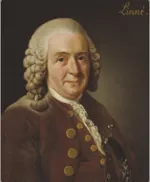
Carl Linnaeus
Check yourself
History of Classification – Scientists
- Aristotle made the first scientific classification using morphological characters; called the Father of Biology.
- Linnaeus introduced binomial nomenclature – a twoword Latin name (Genus + species), e.g. Homo sapiens; he is the Father of Taxonomy.
- R. H. Whittaker (1969) proposed the modern Five Kingdom classification.
- Two-kingdom system failed because it mixed prokaryotes with eukaryotes and plants with fungi.
- Aristotle — Father of Biology; first classification
- Linnaeus — Two Kingdoms; binomial naming; Father of Taxonomy
- Whittaker — Five Kingdom system (1969)
- Carolus Linnaeus gave the Two Kingdom system: Plantae and Animalia.
made the first scientific classification using morphological characters; called the .
Aristotle made the first scientific classification using morphological characters; called the Father of Biology.
Linnaeus introduced – a twoword Latin name (Genus + species), e.g. ; he is the .
Linnaeus introduced binomial nomenclature – a twoword Latin name (Genus + species), e.g. Homo sapiens; he is the Father of Taxonomy.
proposed the modern .
R. H. Whittaker (1969) proposed the modern Five Kingdom classification.
Two-kingdom system failed because it mixed and plants with fungi.
Two-kingdom system failed because it mixed prokaryotes with eukaryotes and plants with fungi.
gave the : Plantae and Animalia.
Carolus Linnaeus gave the Two Kingdom system: Plantae and Animalia.
Whittaker's Five Kingdoms
- Whittaker's criteria: cell structure, body organisation, nutrition, reproduction and evolutionary relationships.
- Monera are prokaryotes (bacteria); Protista are unicellular eukaryotes.
- Fungi are heterotrophic with a chitin cell wall.
- Plantae are autotrophic with a cellulose cell wall.
- Animalia cells have no cell wall, so they stay soft and flexible.
| Kingdom | Cell | Wall / Nutrition |
|---|---|---|
| Monera | Prokaryote | Wall present |
| Protista | Eukaryote, unicellular | Mixed nutrition |
| Fungi | Eukaryote | Chitin wall, heterotroph |
| Plantae | Eukaryote | Cellulose wall, autotroph |
| Animalia | Eukaryote | No wall, heterotroph |
Check yourself
Whittaker's Five Kingdoms
- Whittaker's criteria: cell structure, body organisation, nutrition, reproduction and evolutionary relationships.
- Monera are prokaryotes (bacteria); Protista are unicellular eukaryotes.
- Fungi are heterotrophic with a chitin cell wall.
- Plantae are autotrophic with a cellulose cell wall.
- Animalia cells have no cell wall, so they stay soft and flexible.
- Monera — Prokaryote — Wall present
- Protista — Eukaryote, unicellular — Mixed nutrition
- Fungi — Eukaryote — Chitin wall, heterotroph
- Plantae — Eukaryote — Cellulose wall, autotroph
- Animalia — Eukaryote — No wall, heterotroph
are prokaryotes (bacteria); are unicellular eukaryotes.
Monera are prokaryotes (bacteria); Protista are unicellular eukaryotes.
are heterotrophic with a cell wall.
Fungi are heterotrophic with a chitin cell wall.
are autotrophic with a cell wall.
Plantae are autotrophic with a cellulose cell wall.
cells have , so they stay soft and flexible.
Animalia cells have no cell wall, so they stay soft and flexible.
Smallest Organisms (Exam Favourites)
- Mycoplasma (PPLO) is the smallest organism capable of autonomous growth and reproduction.
- Mycoplasma has no cell wall and is the smallest known living cell.
- Viruses are smaller still but are non-living outside a host (need a host to reproduce).
- Order of size: bacteria > Mycoplasma/PPLO > virus.
- Bacteria are the smallest true cellular (prokaryotic) organisms.
Check yourself
Smallest Organisms (Exam Favourites)
- Mycoplasma (PPLO) is the smallest organism capable of autonomous growth and reproduction.
- Mycoplasma has no cell wall and is the smallest known living cell.
- Viruses are smaller still but are non-living outside a host (need a host to reproduce).
- Order of size: bacteria > Mycoplasma/PPLO > virus.
- Bacteria are the smallest true cellular (prokaryotic) organisms.
is the smallest organism capable of autonomous growth and reproduction.
Mycoplasma (PPLO) is the smallest organism capable of autonomous growth and reproduction.
Mycoplasma has and is the smallest known living cell.
Mycoplasma has no cell wall and is the smallest known living cell.
are smaller still but are non-living outside a host (need a host to reproduce).
Viruses are smaller still but are non-living outside a host (need a host to reproduce).
are the smallest true cellular (prokaryotic) organisms.
Bacteria are the smallest true cellular (prokaryotic) organisms.
Features of Kingdom Animalia
- All animals are multicellular eukaryotes with no cell wall.
- Animals are heterotrophic – they eat other organisms as they cannot photosynthesise.
- Stored food is mainly glycogen or fat.
- Most animals show locomotion and reproduce sexually.
- By the backbone, animals split into Invertebrates (no backbone) and Vertebrates (with backbone).
Check yourself
Features of Kingdom Animalia
- All animals are multicellular eukaryotes with no cell wall.
- Animals are heterotrophic – they eat other organisms as they cannot photosynthesise.
- Stored food is mainly glycogen or fat.
- Most animals show locomotion and reproduce sexually.
- By the backbone, animals split into Invertebrates (no backbone) and Vertebrates (with backbone).
All animals are with no cell wall.
All animals are multicellular eukaryotes with no cell wall.
Animals are – they eat other organisms as they cannot photosynthesise.
Animals are heterotrophic – they eat other organisms as they cannot photosynthesise.
Stored food is mainly .
Stored food is mainly glycogen or fat.
Most animals show and reproduce .
Most animals show locomotion and reproduce sexually.
By the backbone, animals split into (no backbone) and (with backbone).
By the backbone, animals split into Invertebrates (no backbone) and Vertebrates (with backbone).
Levels of Organisation
- Cellular level – loose cells with little division of labour, as in sponges (Porifera).
- Tissue level – similar cells form tissues, as in coelenterates (Cnidaria).
- Organ level – tissues form organs, as in Platyhelminthes (flatworms).
- Organ-system level – organs work as systems, as in annelids, arthropods, molluscs and chordates.
- Complexity rises in this order, showing an evolutionary trend.
| Level | Example group |
|---|---|
| Cellular | Porifera (sponges) |
| Tissue | Cnidaria (coelenterates) |
| Organ | Platyhelminthes |
| Organ-system | Annelids, arthropods, chordates |
Check yourself
Levels of Organisation
- Cellular level – loose cells with little division of labour, as in sponges (Porifera).
- Tissue level – similar cells form tissues, as in coelenterates (Cnidaria).
- Organ level – tissues form organs, as in Platyhelminthes (flatworms).
- Organ-system level – organs work as systems, as in annelids, arthropods, molluscs and chordates.
- Complexity rises in this order, showing an evolutionary trend.
- Cellular — Porifera (sponges)
- Tissue — Cnidaria (coelenterates)
- Organ — Platyhelminthes
- Organ-system — Annelids, arthropods, chordates
– loose cells with little division of labour, as in .
Cellular level – loose cells with little division of labour, as in sponges (Porifera).
– similar cells form tissues, as in .
Tissue level – similar cells form tissues, as in coelenterates (Cnidaria).
– tissues form organs, as in .
Organ level – tissues form organs, as in Platyhelminthes (flatworms).
Organ-system level – organs work as systems, as in .
Organ-system level – organs work as systems, as in annelids, arthropods, molluscs and chordates.
Complexity rises in this order, showing an .
Complexity rises in this order, showing an evolutionary trend.
Body Symmetry
- Asymmetrical – no plane gives equal halves, as in sponges.
- Radial symmetry – any plane through the central axis gives two identical halves.
- Radial symmetry occurs in Coelenterata, Ctenophora and adult Echinodermata.
- Bilateral symmetry – only one plane gives matching left and right halves.
- Bilateral symmetry occurs in annelids, arthropods and chordates and is more advanced.
| Symmetry | Example |
|---|---|
| Asymmetrical | Sponges |
| Radial | Coelenterata, Echinodermata |
| Bilateral | Annelids, arthropods, chordates |
Check yourself
Body Symmetry
- Asymmetrical – no plane gives equal halves, as in sponges.
- Radial symmetry – any plane through the central axis gives two identical halves.
- Radial symmetry occurs in Coelenterata, Ctenophora and adult Echinodermata.
- Bilateral symmetry – only one plane gives matching left and right halves.
- Bilateral symmetry occurs in annelids, arthropods and chordates and is more advanced.
- Asymmetrical — Sponges
- Radial — Coelenterata, Echinodermata
- Bilateral — Annelids, arthropods, chordates
– no plane gives equal halves, as in .
Asymmetrical – no plane gives equal halves, as in sponges.
– any plane through the central axis gives two identical halves.
Radial symmetry – any plane through the central axis gives two identical halves.
– only one plane gives matching left and right halves.
Bilateral symmetry – only one plane gives matching left and right halves.
Bilateral symmetry occurs in and is more advanced.
Bilateral symmetry occurs in annelids, arthropods and chordates and is more advanced.
Germ Layers – Diploblastic vs Triploblastic
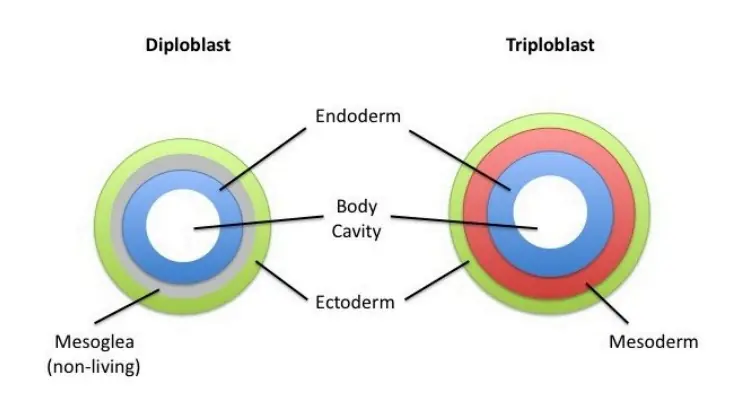
- Embryos are built from cell sheets called germ layers.
- The outer layer is ectoderm; the inner layer is endoderm.
- Diploblastic animals have two layers (ectoderm + endoderm), e.g. coelenterates.
- Triploblastic animals have a middle mesoderm as well, from flatworms up to chordates.
- Mesoderm forms muscles, skeleton, heart and internal organs, allowing complex bodies.
| Type | Layers | Example |
|---|---|---|
| Diploblastic | Ecto + Endoderm | Coelenterates |
| Triploblastic | Ecto + Meso + Endoderm | Flatworms to chordates |
Check yourself
Germ Layers – Diploblastic vs Triploblastic
- Embryos are built from cell sheets called germ layers.
- The outer layer is ectoderm; the inner layer is endoderm.
- Diploblastic animals have two layers (ectoderm + endoderm), e.g. coelenterates.
- Triploblastic animals have a middle mesoderm as well, from flatworms up to chordates.
- Mesoderm forms muscles, skeleton, heart and internal organs, allowing complex bodies.
- Diploblastic — Ecto + Endoderm — Coelenterates
- Triploblastic — Ecto + Meso + Endoderm — Flatworms to chordates
Embryos are built from cell sheets called .
Embryos are built from cell sheets called germ layers.
The outer layer is ; the inner layer is .
The outer layer is ectoderm; the inner layer is endoderm.
animals have two layers (ectoderm + endoderm), e.g. .
Diploblastic animals have two layers (ectoderm + endoderm), e.g. coelenterates.
animals have a middle as well, from flatworms up to chordates.
Triploblastic animals have a middle mesoderm as well, from flatworms up to chordates.
forms muscles, skeleton, heart and internal organs, allowing complex bodies.
Mesoderm forms muscles, skeleton, heart and internal organs, allowing complex bodies.
Body Cavity (Coelom)
- A coelom is a fluid-filled space between the body wall and the gut.
- Coelomates have a true coelom lined by mesoderm – annelids, molluscs, arthropods, echinoderms, chordates.
- Pseudocoelomates have a false cavity not lined by mesoderm, e.g. Aschelminthes (roundworms).
- Acoelomates have no body cavity, e.g. Platyhelminthes (flatworms).
- The cavity gives room for organs to grow, fold and move, so it is a key classification clue.
| Type | Coelom | Example |
|---|---|---|
| Coelomate | True, mesoderm-lined | Annelids, chordates |
| Pseudocoelomate | False cavity | Roundworms |
| Acoelomate | Absent | Flatworms |
Check yourself
Body Cavity (Coelom)
- A coelom is a fluid-filled space between the body wall and the gut.
- Coelomates have a true coelom lined by mesoderm – annelids, molluscs, arthropods, echinoderms, chordates.
- Pseudocoelomates have a false cavity not lined by mesoderm, e.g. Aschelminthes (roundworms).
- Acoelomates have no body cavity, e.g. Platyhelminthes (flatworms).
- The cavity gives room for organs to grow, fold and move, so it is a key classification clue.
- Coelomate — True, mesoderm-lined — Annelids, chordates
- Pseudocoelomate — False cavity — Roundworms
- Acoelomate — Absent — Flatworms
A is a fluid-filled space between the body wall and the gut.
A coelom is a fluid-filled space between the body wall and the gut.
have a true coelom lined by mesoderm – annelids, molluscs, arthropods, echinoderms, chordates.
Coelomates have a true coelom lined by mesoderm – annelids, molluscs, arthropods, echinoderms, chordates.
have a false cavity not lined by mesoderm, e.g. .
Pseudocoelomates have a false cavity not lined by mesoderm, e.g. Aschelminthes (roundworms).
have no body cavity, e.g. .
Acoelomates have no body cavity, e.g. Platyhelminthes (flatworms).
Invertebrate Phyla – Quick Map
- Porifera – sponges; pores and cellular level; asymmetrical.
- Coelenterata (Cnidaria) – Hydra, jellyfish, corals; tissue level; diploblastic.
- Platyhelminthes – flatworms, tapeworm, liver fluke; flat, acoelomate.
- Aschelminthes – roundworms (Ascaris); pseudocoelomate.
- Annelida – earthworm, leech; segmented body; true coelom.
- Arthropoda – insects, crabs; largest phylum; jointed legs and chitin exoskeleton.
- Mollusca – snail, octopus; soft body, often shelled; Echinodermata – starfish, spiny skin.
Check yourself
Invertebrate Phyla – Quick Map
- Porifera – sponges; pores and cellular level; asymmetrical.
- Coelenterata (Cnidaria) – Hydra, jellyfish, corals; tissue level; diploblastic.
- Platyhelminthes – flatworms, tapeworm, liver fluke; flat, acoelomate.
- Aschelminthes – roundworms (Ascaris); pseudocoelomate.
- Annelida – earthworm, leech; segmented body; true coelom.
- Arthropoda – insects, crabs; largest phylum; jointed legs and chitin exoskeleton.
- Mollusca – snail, octopus; soft body, often shelled; Echinodermata – starfish, spiny skin.
– sponges; pores and cellular level; asymmetrical.
Porifera – sponges; pores and cellular level; asymmetrical.
– Hydra, jellyfish, corals; tissue level; diploblastic.
Coelenterata (Cnidaria) – Hydra, jellyfish, corals; tissue level; diploblastic.
– flatworms, tapeworm, liver fluke; flat, acoelomate.
Platyhelminthes – flatworms, tapeworm, liver fluke; flat, acoelomate.
– roundworms (Ascaris); pseudocoelomate.
Aschelminthes – roundworms (Ascaris); pseudocoelomate.
– earthworm, leech; segmented body; true coelom.
Annelida – earthworm, leech; segmented body; true coelom.
– insects, crabs; ; jointed legs and chitin exoskeleton.
Arthropoda – insects, crabs; largest phylum; jointed legs and chitin exoskeleton.
– snail, octopus; soft body, often shelled; – starfish, spiny skin.
Mollusca – snail, octopus; soft body, often shelled; Echinodermata – starfish, spiny skin.
Vertebrate Classes – Quick Map
- Pisces (fish) – gills, fins, cold-blooded, scales.
- Amphibia – frogs, toads; live on land and water; moist skin.
- Reptilia – snakes, lizards, turtles; dry scaly skin; lay eggs on land.
- Aves (birds) – feathers, wings, beak; warm-blooded; lay eggs.
- Mammalia – hair, mammary glands; warm-blooded; mostly give birth to young.
| Class | Key feature |
|---|---|
| Pisces | Gills, fins, scales |
| Amphibia | Moist skin, dual life |
| Reptilia | Dry scaly skin |
| Aves | Feathers, beak |
| Mammalia | Hair, mammary glands |
Check yourself
Vertebrate Classes – Quick Map
- Pisces (fish) – gills, fins, cold-blooded, scales.
- Amphibia – frogs, toads; live on land and water; moist skin.
- Reptilia – snakes, lizards, turtles; dry scaly skin; lay eggs on land.
- Aves (birds) – feathers, wings, beak; warm-blooded; lay eggs.
- Mammalia – hair, mammary glands; warm-blooded; mostly give birth to young.
- Pisces — Gills, fins, scales
- Amphibia — Moist skin, dual life
- Reptilia — Dry scaly skin
- Aves — Feathers, beak
- Mammalia — Hair, mammary glands
– gills, fins, cold-blooded, scales.
Pisces (fish) – gills, fins, cold-blooded, scales.
– frogs, toads; live on land and water; moist skin.
Amphibia – frogs, toads; live on land and water; moist skin.
– snakes, lizards, turtles; dry scaly skin; lay eggs on land.
Reptilia – snakes, lizards, turtles; dry scaly skin; lay eggs on land.
– feathers, wings, beak; warm-blooded; lay eggs.
Aves (birds) – feathers, wings, beak; warm-blooded; lay eggs.
– hair, mammary glands; warm-blooded; mostly give birth to young.
Mammalia – hair, mammary glands; warm-blooded; mostly give birth to young.
Mammals – Special Facts
- Most mammals give birth to live young, but the egglaying mammals (monotremes) are exceptions.
- The Platypus (duck-billed platypus) and the Echidna (spiny anteater) lay eggs yet feed milk.
- Whales and dolphins are mammals, not fish – they breathe air with lungs.
- The Sperm whale is the largest of the toothed whales.
- The Blue whale is the largest animal ever to have lived.
Check yourself
Mammals – Special Facts
- Most mammals give birth to live young, but the egglaying mammals (monotremes) are exceptions.
- The Platypus (duck-billed platypus) and the Echidna (spiny anteater) lay eggs yet feed milk.
- Whales and dolphins are mammals, not fish – they breathe air with lungs.
- The Sperm whale is the largest of the toothed whales.
- The Blue whale is the largest animal ever to have lived.
Most mammals give birth to live young, but the are exceptions.
Most mammals give birth to live young, but the egglaying mammals (monotremes) are exceptions.
The and the lay eggs yet feed milk.
The Platypus (duck-billed platypus) and the Echidna (spiny anteater) lay eggs yet feed milk.
Whales and dolphins are , not fish – they breathe air with lungs.
Whales and dolphins are mammals, not fish – they breathe air with lungs.
The is the largest of the toothed whales.
The Sperm whale is the largest of the toothed whales.
The is the largest animal ever to have lived.
The Blue whale is the largest animal ever to have lived.
Apes and Human Relatives
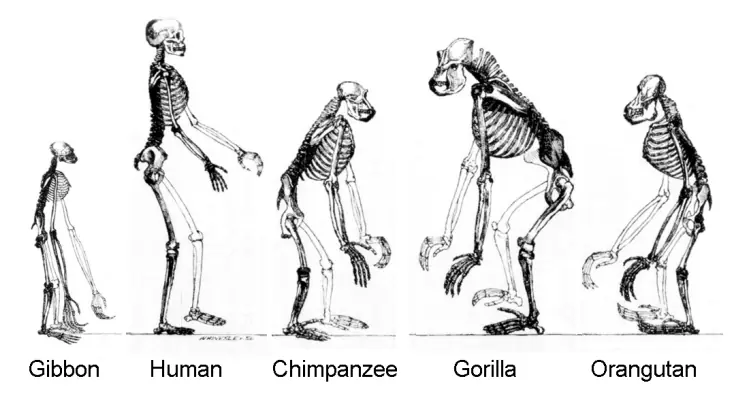
- Apes (gibbon, orangutan, gorilla, chimpanzee) have no tail, unlike monkeys.
- The Gibbon is the smallest man-like ape.
- The Gorilla is the largest living ape.
- Humans belong to the order Primates, scientific name Homo sapiens.
- Chimpanzee is the ape genetically closest to humans.
Check yourself
Apes and Human Relatives
- Apes (gibbon, orangutan, gorilla, chimpanzee) have no tail, unlike monkeys.
- The Gibbon is the smallest man-like ape.
- The Gorilla is the largest living ape.
- Humans belong to the order Primates, scientific name Homo sapiens.
- Chimpanzee is the ape genetically closest to humans.
(gibbon, orangutan, gorilla, chimpanzee) have no tail, unlike monkeys.
Apes (gibbon, orangutan, gorilla, chimpanzee) have no tail, unlike monkeys.
The is the smallest man-like ape.
The Gibbon is the smallest man-like ape.
The is the largest living ape.
The Gorilla is the largest living ape.
Humans belong to the order , scientific name .
Humans belong to the order Primates, scientific name Homo sapiens.
Insects and Useful Products
- Honey and beeswax come from the honeybee.
- Silk comes from the silkworm (Bombyx mori).
- Lac (shellac) comes from the lac insect.
- Cochineal dye is obtained from the cochineal insect.
- Pearls are NOT from insects – they come from oysters (molluscs); a common trick option.
| Product | Source insect |
|---|---|
| Honey, wax | Honeybee |
| Silk | Silkworm |
| Lac | Lac insect |
| Cochineal dye | Cochineal insect |
| Pearl (not insect) | Oyster (mollusc) |
Check yourself
Insects and Useful Products
- Honey and beeswax come from the honeybee.
- Silk comes from the silkworm (Bombyx mori).
- Lac (shellac) comes from the lac insect.
- Cochineal dye is obtained from the cochineal insect.
- Pearls are NOT from insects – they come from oysters (molluscs); a common trick option.
- Honey, wax — Honeybee
- Silk — Silkworm
- Lac — Lac insect
- Cochineal dye — Cochineal insect
- Pearl (not insect) — Oyster (mollusc)
come from the honeybee.
Honey and beeswax come from the honeybee.
comes from the silkworm (Bombyx mori).
Silk comes from the silkworm (Bombyx mori).
(shellac) comes from the lac insect.
Lac (shellac) comes from the lac insect.
is obtained from the cochineal insect.
Cochineal dye is obtained from the cochineal insect.
– they come from oysters (molluscs); a common trick option.
Pearls are NOT from insects – they come from oysters (molluscs); a common trick option.
Mosquitoes and Disease Vectors
- Female Anopheles spreads malaria and sits with its body tilted, at an angle to the surface.
- Female Culex rests with its body parallel to the surface and spreads filaria.
- Female Aedes spreads dengue, chikungunya and yellow fever.
- Only female mosquitoes bite, as they need blood to develop eggs.
- Aedes has a black-and-white striped body and bites mostly by day.
| Mosquito | Disease |
|---|---|
| Anopheles | Malaria |
| Culex | Filaria |
| Aedes | Dengue, yellow fever |
Check yourself
Mosquitoes and Disease Vectors
- Female Anopheles spreads malaria and sits with its body tilted, at an angle to the surface.
- Female Culex rests with its body parallel to the surface and spreads filaria.
- Female Aedes spreads dengue, chikungunya and yellow fever.
- Only female mosquitoes bite, as they need blood to develop eggs.
- Aedes has a black-and-white striped body and bites mostly by day.
- Anopheles — Malaria
- Culex — Filaria
- Aedes — Dengue, yellow fever
spreads malaria and sits with its body tilted, at an angle to the surface.
Female Anopheles spreads malaria and sits with its body tilted, at an angle to the surface.
rests with its body parallel to the surface and spreads filaria.
Female Culex rests with its body parallel to the surface and spreads filaria.
spreads dengue, chikungunya and yellow fever.
Female Aedes spreads dengue, chikungunya and yellow fever.
Only bite, as they need blood to develop eggs.
Only female mosquitoes bite, as they need blood to develop eggs.
Survival Adaptations
- The camel can live the longest without drinking water and is the ship of the desert.
- The kangaroo rat can survive almost entirely on metabolic water from food.
- Camels store fat (not water) in the hump for energy.
- Warm-blooded (homeothermic) animals keep a steady body temperature; cold-blooded ones change with surroundings.
- Desert animals reduce water loss through concentrated urine and dry dung.
Check yourself
Survival Adaptations
- The camel can live the longest without drinking water and is the ship of the desert.
- The kangaroo rat can survive almost entirely on metabolic water from food.
- Camels store fat (not water) in the hump for energy.
- Warm-blooded (homeothermic) animals keep a steady body temperature; cold-blooded ones change with surroundings.
- Desert animals reduce water loss through concentrated urine and dry dung.
The can live the longest without drinking water and is the ship of the desert.
The camel can live the longest without drinking water and is the ship of the desert.
The can survive almost entirely on metabolic water from food.
The kangaroo rat can survive almost entirely on metabolic water from food.
Camels store fat (not water) in the for energy.
Camels store fat (not water) in the hump for energy.
(homeothermic) animals keep a steady body temperature; ones change with surroundings.
Warm-blooded (homeothermic) animals keep a steady body temperature; cold-blooded ones change with surroundings.
All 19 chapters of Biology notes
- Cell: Structure & Function12 sections
- Biomolecules & DNA/RNA11 sections
- Plant Kingdom & Classification11 sections
- Plant Tissues & Anatomy12 sections
- Plant Physiology: Photosynthesis, Respiration & Nutrition14 sections
- Animal Kingdom, Morphology & Classification16 sections
- Nutrition & Digestive System12 sections
- Circulatory System & Body Fluids12 sections
- Respiratory System10 sections
- Excretory System12 sections
- Nervous System & Sense Organs12 sections
- Endocrine System & Hormones14 sections
- Skeletal & Muscular System12 sections
- Reproductive System & Reproductive Health12 sections
- Genetics & Evolution13 sections
- Human Health, Diseases & Immunity16 sections
- Ecology, Ecosystem & Biodiversity12 sections
- Biology in Everyday Life & Applied Biology12 sections
- Inventions, Discoveries & Scientists10 sections