Biology notes · Chapter 15 of 19
Genetics & Evolution
13 sections, 81 flashcards. Open a card to check your answer, or revise them in the app with spaced revision.
What is Genetics?
- Genetics is the branch of biology that studies heredity and variation.
- Heredity is the passing of features from parents to offspring through reproduction.
- Variation means the differences that still exist between parents and offspring; no two children are identical.
- A feature that is inherited (height, eye colour, blood group) is called a trait.
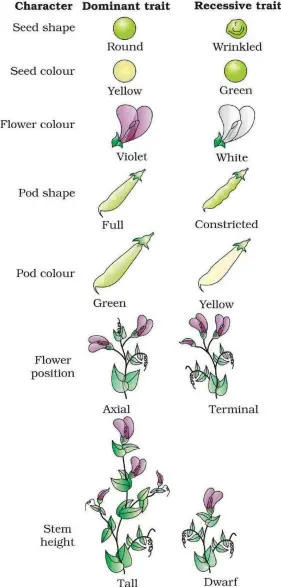
- Mendel worked on the garden pea (Pisum sativum) from 1856 to 1863.
- Pea was ideal: clear contrasting traits, easy to grow, selfpollinating (pure lines), and many offspring quickly.
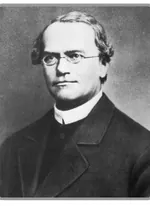
Gregor Mendel
Check yourself
What is Genetics?
- Genetics is the branch of biology that studies heredity and variation.
- Heredity is the passing of features from parents to offspring through reproduction.
- Variation means the differences that still exist between parents and offspring; no two children are identical.
- A feature that is inherited (height, eye colour, blood group) is called a trait.
- Mendel worked on the garden pea (Pisum sativum) from 1856 to 1863.
- Pea was ideal: clear contrasting traits, easy to grow, selfpollinating (pure lines), and many offspring quickly.
- Gregor Johann Mendel, an Austrian monk, is the Father of Genetics.
is the branch of biology that studies heredity and variation.
Genetics is the branch of biology that studies heredity and variation.
is the passing of features from parents to offspring through reproduction.
Heredity is the passing of features from parents to offspring through reproduction.
means the differences that still exist between parents and offspring; no two children are identical.
Variation means the differences that still exist between parents and offspring; no two children are identical.
A feature that is inherited (height, eye colour, blood group) is called a .
A feature that is inherited (height, eye colour, blood group) is called a trait.
Mendel worked on the garden pea () from 1856 to 1863.
Mendel worked on the garden pea (Pisum sativum) from 1856 to 1863.
, an Austrian monk, is the Father of Genetics.
Gregor Johann Mendel, an Austrian monk, is the Father of Genetics.
Basic Terms You Must Know
- A gene is a stretch of DNA carrying the code for one trait; it is the physical unit of heredity.
- Different versions of a gene are called alleles (e.g. tall T and dwarf t).
- A dominant allele shows even with one copy and is written in CAPITAL (T).
- A recessive allele is hidden unless both copies are present; written in small letter (t).
- Genotype is the set of alleles carried (TT, Tt, tt); phenotype is the visible feature (tall/dwarf).
- Same alleles (TT or tt) = homozygous (pure); different alleles (Tt) = heterozygous (hybrid).
- Body cells carry two copies of each gene, so they are diploid.
| Term | Meaning |
|---|---|
| Gene | DNA unit coding one trait |
| Allele | Version of a gene (T or t) |
| Dominant | Shows with one copy (T) |
| Recessive | Hidden unless both copies (t) |
| Genotype | Allele set (TT, Tt, tt) |
| Phenotype | Visible feature (tall/dwarf) |
| Homozygous | Same alleles (TT/tt) |
| Heterozygous | Different alleles (Tt) |
Check yourself
Basic Terms You Must Know
- A gene is a stretch of DNA carrying the code for one trait; it is the physical unit of heredity.
- Different versions of a gene are called alleles (e.g. tall T and dwarf t).
- A dominant allele shows even with one copy and is written in CAPITAL (T).
- A recessive allele is hidden unless both copies are present; written in small letter (t).
- Genotype is the set of alleles carried (TT, Tt, tt); phenotype is the visible feature (tall/dwarf).
- Same alleles (TT or tt) = homozygous (pure); different alleles (Tt) = heterozygous (hybrid).
- Body cells carry two copies of each gene, so they are diploid.
- Gene — DNA unit coding one trait
- Allele — Version of a gene (T or t)
- Dominant — Shows with one copy (T)
- Recessive — Hidden unless both copies (t)
- Genotype — Allele set (TT, Tt, tt)
- Phenotype — Visible feature (tall/dwarf)
- Homozygous — Same alleles (TT/tt)
- Heterozygous — Different alleles (Tt)
A is a stretch of DNA carrying the code for one trait; it is the physical unit of heredity.
A gene is a stretch of DNA carrying the code for one trait; it is the physical unit of heredity.
Different versions of a gene are called (e.g. tall T and dwarf t).
Different versions of a gene are called alleles (e.g. tall T and dwarf t).
A allele shows even with one copy and is written in CAPITAL (T).
A dominant allele shows even with one copy and is written in CAPITAL (T).
A allele is hidden unless both copies are present; written in small letter (t).
A recessive allele is hidden unless both copies are present; written in small letter (t).
is the set of alleles carried (TT, Tt, tt); is the visible feature (tall/dwarf).
Genotype is the set of alleles carried (TT, Tt, tt); phenotype is the visible feature (tall/dwarf).
Same alleles (TT or tt) = (pure); different alleles (Tt) = (hybrid).
Same alleles (TT or tt) = homozygous (pure); different alleles (Tt) = heterozygous (hybrid).
Body cells carry two copies of each gene, so they are .
Body cells carry two copies of each gene, so they are diploid.
Mendel's Monohybrid Cross
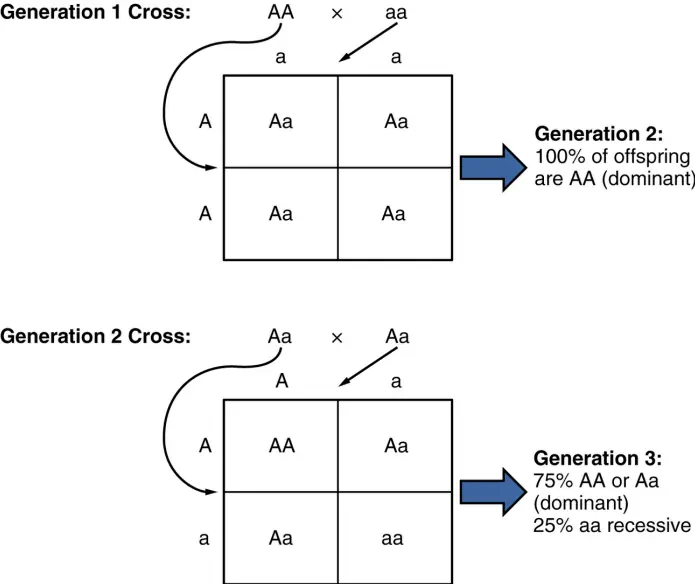
- Pure tall (TT) crossed with pure dwarf (tt) gave an all-tall F1 generation (Tt).
- Self-crossing F1 made dwarf plants reappear in F2, proving traits stay as separate units, not blends.
- Monohybrid F2 phenotype ratio is 3: 1 (3 tall: 1 dwarf).
- Monohybrid F2 genotype ratio is 1: 2: 1 (1 TT: 2 Tt: 1 tt).
- A Punnett square (by Reginald Punnett) is a grid used to predict offspring ratios.
- Generations are labelled P (parents), F1 (first offspring), F2 (F1 self-cross).
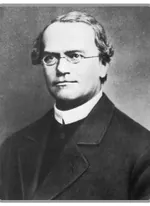
Gregor Mendel
Check yourself
Mendel's Monohybrid Cross
- Pure tall (TT) crossed with pure dwarf (tt) gave an all-tall F1 generation (Tt).
- Self-crossing F1 made dwarf plants reappear in F2, proving traits stay as separate units, not blends.
- Monohybrid F2 phenotype ratio is 3: 1 (3 tall: 1 dwarf).
- Monohybrid F2 genotype ratio is 1: 2: 1 (1 TT: 2 Tt: 1 tt).
- A Punnett square (by Reginald Punnett) is a grid used to predict offspring ratios.
- Generations are labelled P (parents), F1 (first offspring), F2 (F1 self-cross).
- A cross that follows just ONE trait is a monohybrid cross.
Pure tall (TT) crossed with pure dwarf (tt) gave an all-tall (Tt).
Pure tall (TT) crossed with pure dwarf (tt) gave an all-tall F1 generation (Tt).
Monohybrid F2 (3 tall: 1 dwarf).
Monohybrid F2 phenotype ratio is 3: 1 (3 tall: 1 dwarf).
A (by Reginald Punnett) is a grid used to predict offspring ratios.
A Punnett square (by Reginald Punnett) is a grid used to predict offspring ratios.
Generations are labelled (parents), (first offspring), (F1 self-cross).
Generations are labelled P (parents), F1 (first offspring), F2 (F1 self-cross).
A cross that follows just ONE trait is a .
A cross that follows just ONE trait is a monohybrid cross.
Mendel's Three Laws
- Law of Dominance: in a heterozygote (Tt) only the dominant allele shows.
- Law of Segregation: alleles separate during gamete formation, so each gamete gets only ONE allele.
- Segregation is also called the Law of Purity of Gametes.
- Law of Independent Assortment: alleles of different genes are inherited independently.
- A dihybrid cross (two traits) gives the F2 ratio 9: 3: 3: 1.
| Law | What it states |
|---|---|
| Dominance | Only dominant allele shows in hybrid |
| Segregation | Alleles separate into gametes |
| Independent Different genes inherited Assortment independently |
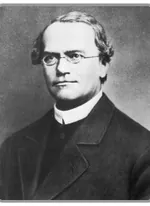
Gregor Mendel 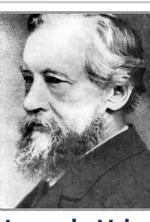
Hugo de Vries
Check yourself
Mendel's Three Laws
- Law of Dominance: in a heterozygote (Tt) only the dominant allele shows.
- Law of Segregation: alleles separate during gamete formation, so each gamete gets only ONE allele.
- Segregation is also called the Law of Purity of Gametes.
- Law of Independent Assortment: alleles of different genes are inherited independently.
- A dihybrid cross (two traits) gives the F2 ratio 9: 3: 3: 1.
- Dominance — Only dominant allele shows in hybrid
- Segregation — Alleles separate into gametes
- Independent Different genes inherited Assortment independently
- Mendel published his work in 1866, but it was ignored.
- In 1900, de Vries, Correns and von Tschermak independently rediscovered his laws.
: in a heterozygote (Tt) only the dominant allele shows.
Law of Dominance: in a heterozygote (Tt) only the dominant allele shows.
: alleles separate during gamete formation, so each gamete gets only ONE allele.
Law of Segregation: alleles separate during gamete formation, so each gamete gets only ONE allele.
: alleles of different genes are inherited independently.
Law of Independent Assortment: alleles of different genes are inherited independently.
A (two traits) gives the F2 ratio .
A dihybrid cross (two traits) gives the F2 ratio 9: 3: 3: 1.
Mendel published his work in , but it was ignored.
Mendel published his work in 1866, but it was ignored.
In , de Vries, Correns and von Tschermak independently rediscovered his laws.
In 1900, de Vries, Correns and von Tschermak independently rediscovered his laws.
Exceptions to Simple Dominance
- Incomplete dominance: neither allele fully wins, F1 is a blend (red x white flower gives pink).
- Co-dominance: both alleles express fully and separately, F1 resembles BOTH parents.
- The best example of co-dominance is the human ABO blood group (genotype IA IB gives group AB).
- Multiple alleles: a gene has more than two versions in the population (IA, IB, i).
- Polygenic inheritance: one trait controlled by three or more genes whose effects add up.
- Polygenic examples are human height and skin colour, giving a continuous range.
- In skin colour, AABBCC is darkest and aabbcc is lightest; each dominant allele adds darkness.
| Pattern | Result | Example |
|---|---|---|
| Incomplete dominance | Blended F1 | Pink flower |
| Co-dominance | Both shown | Blood group AB |
| Multiple alleles | 3+ versions | IA, IB, i |
| Polygenic | Continuous range | Skin colour, height |
Check yourself
Exceptions to Simple Dominance
- Incomplete dominance: neither allele fully wins, F1 is a blend (red x white flower gives pink).
- Co-dominance: both alleles express fully and separately, F1 resembles BOTH parents.
- The best example of co-dominance is the human ABO blood group (genotype IA IB gives group AB).
- Multiple alleles: a gene has more than two versions in the population (IA, IB, i).
- Polygenic inheritance: one trait controlled by three or more genes whose effects add up.
- Polygenic examples are human height and skin colour, giving a continuous range.
- In skin colour, AABBCC is darkest and aabbcc is lightest; each dominant allele adds darkness.
- Incomplete dominance — Blended F1 — Pink flower
- Co-dominance — Both shown — Blood group AB
- Multiple alleles — 3+ versions — IA, IB, i
- Polygenic — Continuous range — Skin colour, height
: neither allele fully wins, F1 is a blend (red x white flower gives pink).
Incomplete dominance: neither allele fully wins, F1 is a blend (red x white flower gives pink).
: both alleles express fully and separately, F1 resembles BOTH parents.
Co-dominance: both alleles express fully and separately, F1 resembles BOTH parents.
The best example of co-dominance is the human (genotype IA IB gives group AB).
The best example of co-dominance is the human ABO blood group (genotype IA IB gives group AB).
: a gene has more than two versions in the population (IA, IB, i).
Multiple alleles: a gene has more than two versions in the population (IA, IB, i).
: one trait controlled by three or more genes whose effects add up.
Polygenic inheritance: one trait controlled by three or more genes whose effects add up.
Polygenic examples are , giving a continuous range.
Polygenic examples are human height and skin colour, giving a continuous range.
ABO Blood Groups
- Blood group is controlled by gene I with three alleles: IA, IB and i.
- IA makes A sugar, IB makes B sugar, and i makes no sugar on red blood cells.
- Both IA and IB are dominant over i, but co-dominant with each other.
- There are 6 genotypes but only 4 phenotypes (A, B, AB, O).
- Group O (genotype ii) is the universal donor; group AB is the universal recipient.
| Blood Group | Genotype |
|---|---|
| A | IA IA or IA i |
| B | IB IB or IB i |
| AB | IA IB |
| O | i i |
Check yourself
ABO Blood Groups
- Blood group is controlled by gene I with three alleles: IA, IB and i.
- IA makes A sugar, IB makes B sugar, and i makes no sugar on red blood cells.
- Both IA and IB are dominant over i, but co-dominant with each other.
- There are 6 genotypes but only 4 phenotypes (A, B, AB, O).
- Group O (genotype ii) is the universal donor; group AB is the universal recipient.
- A — IA IA or IA i
- B — IB IB or IB i
- AB — IA IB
- O — i i
Blood group is controlled by gene with three alleles: IA, IB and i.
Blood group is controlled by gene I with three alleles: IA, IB and i.
, IB makes B sugar, and i makes no sugar on red blood cells.
IA makes A sugar, IB makes B sugar, and i makes no sugar on red blood cells.
Both IA and IB are , but co-dominant with each other.
Both IA and IB are dominant over i, but co-dominant with each other.
Group (genotype ii) is the universal donor; group is the universal recipient.
Group O (genotype ii) is the universal donor; group AB is the universal recipient.
Chromosomes – Where Genes Live
- Chromosomes are thread-like structures in the nucleus made of DNA plus protein.
- The name means 'coloured body', as they stain darkly in a dividing cell.
- The Chromosomal Theory of Inheritance was given by Sutton and Boveri (1902).
- Humans have 46 chromosomes = 23 pairs.
- Homologous chromosomes carry the same genes, one from each parent.
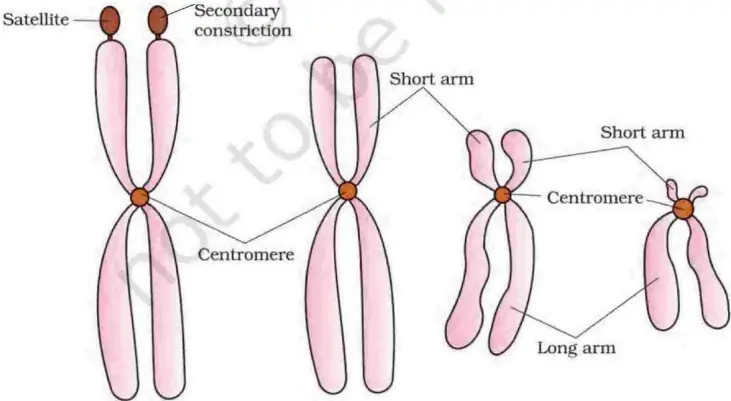
- The centromere is the constriction holding the two arms and decides chromosome shape.
- 22 pairs are autosomes; the 23rd pair (X and Y) are sex chromosomes.
| Position of centromere | Chromosome type |
|---|---|
| Middle | Metacentric |
| Slightly off-centre | Sub-metacentric |
| Near one end | Acrocentric |
| At the tip | Telocentric |
Check yourself
Chromosomes – Where Genes Live
- Chromosomes are thread-like structures in the nucleus made of DNA plus protein.
- The name means 'coloured body', as they stain darkly in a dividing cell.
- The Chromosomal Theory of Inheritance was given by Sutton and Boveri (1902).
- Humans have 46 chromosomes = 23 pairs.
- Homologous chromosomes carry the same genes, one from each parent.
- The centromere is the constriction holding the two arms and decides chromosome shape.
- 22 pairs are autosomes; the 23rd pair (X and Y) are sex chromosomes.
- Middle — Metacentric
- Slightly off-centre — Sub-metacentric
- Near one end — Acrocentric
- At the tip — Telocentric
are thread-like structures in the nucleus made of DNA plus protein.
Chromosomes are thread-like structures in the nucleus made of DNA plus protein.
carry the same genes, one from each parent.
Homologous chromosomes carry the same genes, one from each parent.
The is the constriction holding the two arms and decides chromosome shape.
The centromere is the constriction holding the two arms and decides chromosome shape.
; the 23rd pair (X and Y) are sex chromosomes.
22 pairs are autosomes; the 23rd pair (X and Y) are sex chromosomes.
Sex Determination in Humans
- Sex is decided by the 23rd pair, the sex chromosomes.
- Females are XX and males are XY.
- The mother always gives an X; eggs carry only X.
- The father decides the sex of the child by giving either an X or a Y sperm.
- X sperm + egg gives a girl (XX); Y sperm + egg gives a boy (XY).
Check yourself
Sex Determination in Humans
- Sex is decided by the 23rd pair, the sex chromosomes.
- Females are XX and males are XY.
- The mother always gives an X; eggs carry only X.
- The father decides the sex of the child by giving either an X or a Y sperm.
- X sperm + egg gives a girl (XX); Y sperm + egg gives a boy (XY).
Sex is decided by the , the sex chromosomes.
Sex is decided by the 23rd pair, the sex chromosomes.
Females are and males are .
Females are XX and males are XY.
The of the child by giving either an X or a Y sperm.
The father decides the sex of the child by giving either an X or a Y sperm.
DNA, Genetic Material & Mutation
- DNA (deoxyribonucleic acid) is the genetic material that stores hereditary information.
- Its bases pair as A–T and G–C; the sequence of bases is the genetic code.
- A mutation is a sudden change in the base sequence within a gene.
- Mutation is the ultimate source of new alleles and a major cause of large-scale diversity among organisms.
- Agents that cause mutations are called mutagens (Xrays, UV rays, certain chemicals).
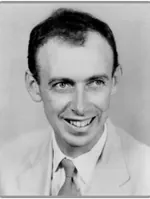
James Watson 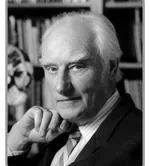
Francis Crick 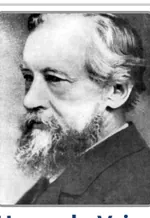
Hugo de Vries
Check yourself
DNA, Genetic Material & Mutation
- DNA (deoxyribonucleic acid) is the genetic material that stores hereditary information.
- Its bases pair as A–T and G–C; the sequence of bases is the genetic code.
- A mutation is a sudden change in the base sequence within a gene.
- Mutation is the ultimate source of new alleles and a major cause of large-scale diversity among organisms.
- Agents that cause mutations are called mutagens (Xrays, UV rays, certain chemicals).
- DNA is a double helix, modelled by Watson and Crick (1953).
- Hugo de Vries proposed the Mutation Theory of evolution.
(deoxyribonucleic acid) is the genetic material that stores hereditary information.
DNA (deoxyribonucleic acid) is the genetic material that stores hereditary information.
Its bases pair as ; the sequence of bases is the genetic code.
Its bases pair as A–T and G–C; the sequence of bases is the genetic code.
A is a sudden change in the base sequence within a gene.
A mutation is a sudden change in the base sequence within a gene.
Mutation is the ultimate source of new alleles and a major cause of among organisms.
Mutation is the ultimate source of new alleles and a major cause of large-scale diversity among organisms.
Agents that cause mutations are called (Xrays, UV rays, certain chemicals).
Agents that cause mutations are called mutagens (Xrays, UV rays, certain chemicals).
DNA is a , modelled by Watson and Crick (1953).
DNA is a double helix, modelled by Watson and Crick (1953).
proposed the Mutation Theory of evolution.
Hugo de Vries proposed the Mutation Theory of evolution.
Genetic Disorders
- Genetic disorders are diseases caused by faulty genes or chromosomes, passed to offspring.
- Haemophilia (failure of blood clotting) is an X-linked recessive disorder.
- Colour blindness (red-green) is also X-linked recessive, commoner in males.
- Sickle-cell anaemia and thalassaemia are gene-based blood disorders.
- Down's syndrome is caused by an extra chromosome 21 (47 chromosomes).
- Infectious diseases like cholera, typhoid, malaria and AIDS are NOT genetic diseases.
| Disease | Genetic? |
|---|---|
| Haemophilia | Yes |
| Colour blindness | Yes |
| Down's syndrome | Yes |
| Sickle-cell anaemia | Yes |
| Cholera / Malaria | No |
Check yourself
Genetic Disorders
- Genetic disorders are diseases caused by faulty genes or chromosomes, passed to offspring.
- Haemophilia (failure of blood clotting) is an X-linked recessive disorder.
- Colour blindness (red-green) is also X-linked recessive, commoner in males.
- Sickle-cell anaemia and thalassaemia are gene-based blood disorders.
- Down's syndrome is caused by an extra chromosome 21 (47 chromosomes).
- Infectious diseases like cholera, typhoid, malaria and AIDS are NOT genetic diseases.
- Haemophilia — Yes
- Colour blindness — Yes
- Down's syndrome — Yes
- Sickle-cell anaemia — Yes
- Cholera / Malaria — No
are diseases caused by faulty genes or chromosomes, passed to offspring.
Genetic disorders are diseases caused by faulty genes or chromosomes, passed to offspring.
(failure of blood clotting) is an X-linked recessive disorder.
Haemophilia (failure of blood clotting) is an X-linked recessive disorder.
(red-green) is also X-linked recessive, commoner in males.
Colour blindness (red-green) is also X-linked recessive, commoner in males.
is caused by an extra chromosome 21 (47 chromosomes).
Down's syndrome is caused by an extra chromosome 21 (47 chromosomes).
Genetic Engineering & Biotechnology
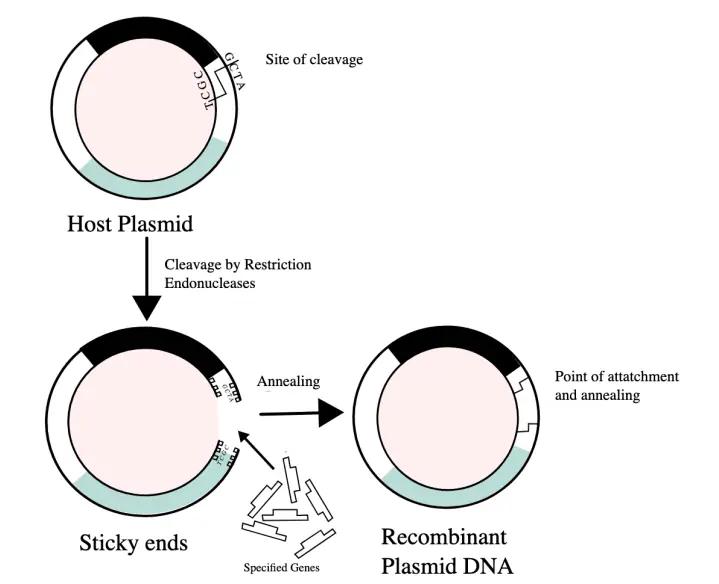
- Genetic engineering is the deliberate alteration of an organism's DNA to give new traits.
- It is also called recombinant DNA (rDNA) technology.
- Restriction enzymes act as molecular scissors that cut DNA at specific sites.
- DNA ligase joins DNA pieces together (molecular glue).
- A vector carries the desired gene into the host cell; bacterial plasmids are common vectors.
- Genetically engineered bacteria now produce human insulin (humulin).
- GM crops like Bt cotton are products of genetic engineering.
Check yourself
Genetic Engineering & Biotechnology
- Genetic engineering is the deliberate alteration of an organism's DNA to give new traits.
- It is also called recombinant DNA (rDNA) technology.
- Restriction enzymes act as molecular scissors that cut DNA at specific sites.
- DNA ligase joins DNA pieces together (molecular glue).
- A vector carries the desired gene into the host cell; bacterial plasmids are common vectors.
- Genetically engineered bacteria now produce human insulin (humulin).
- GM crops like Bt cotton are products of genetic engineering.
is the deliberate alteration of an organism's DNA to give new traits.
Genetic engineering is the deliberate alteration of an organism's DNA to give new traits.
act as molecular scissors that cut DNA at specific sites.
Restriction enzymes act as molecular scissors that cut DNA at specific sites.
joins DNA pieces together (molecular glue).
DNA ligase joins DNA pieces together (molecular glue).
A carries the desired gene into the host cell; bacterial are common vectors.
A vector carries the desired gene into the host cell; bacterial plasmids are common vectors.
Genetically engineered bacteria now produce (humulin).
Genetically engineered bacteria now produce human insulin (humulin).
like Bt cotton are products of genetic engineering.
GM crops like Bt cotton are products of genetic engineering.
Theories of Evolution
- Evolution is the slow change in living organisms over generations to form new species.
- Lamarck proposed Inheritance of Acquired Characters (use and disuse of organs).
- Darwin wrote the book 'On the Origin of Species' (1859).
- Modern Darwinism (Neo-Darwinism) combines natural selection with genetics and mutation.
| Scientist | Theory / Contribution |
|---|---|
| Lamarck | Inheritance of acquired characters |
| Darwin | Natural selection (Origin of Species) |
| de Vries | Mutation theory |
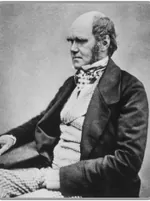
Charles Darwin 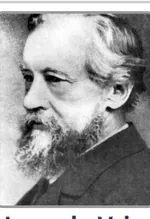
Hugo de Vries
Check yourself
Theories of Evolution
- Evolution is the slow change in living organisms over generations to form new species.
- Lamarck proposed Inheritance of Acquired Characters (use and disuse of organs).
- Darwin wrote the book 'On the Origin of Species' (1859).
- Modern Darwinism (Neo-Darwinism) combines natural selection with genetics and mutation.
- Lamarck — Inheritance of acquired characters
- Darwin — Natural selection (Origin of Species)
- de Vries — Mutation theory
- Charles Darwin proposed Natural Selection, the 'survival of the fittest'.
- Hugo de Vries proposed evolution by sudden mutations.
is the slow change in living organisms over generations to form new species.
Evolution is the slow change in living organisms over generations to form new species.
proposed Inheritance of Acquired Characters (use and disuse of organs).
Lamarck proposed Inheritance of Acquired Characters (use and disuse of organs).
proposed Natural Selection, the 'survival of the fittest'.
Charles Darwin proposed Natural Selection, the 'survival of the fittest'.
proposed evolution by sudden mutations.
Hugo de Vries proposed evolution by sudden mutations.
Evidence & Origin of Life
- Fossils are preserved remains of ancient organisms and the best evidence of evolution.
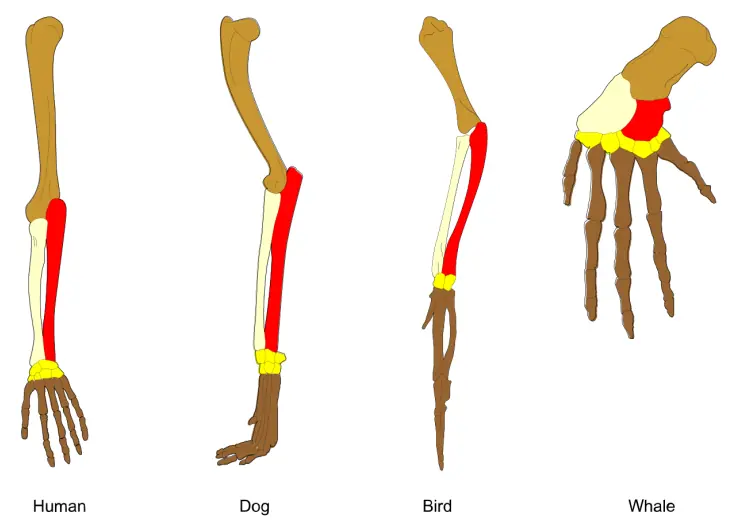
- Homologous organs have the same structure but different functions (human arm, bat wing) and show common ancestry.
- Analogous organs have different structure but the same function (bird wing, insect wing).
- Vestigial organs (appendix, ear muscles in humans) are reduced, useless remnants from ancestors.
- Oparin and Haldane proposed life arose from chemicals in the early ocean (chemical evolution).
- The Miller–Urey experiment showed organic molecules can form from simple gases.
| Organ type | Structure | Function |
|---|---|---|
| Homologous | Same | Different |
| Analogous | Different | Same |
| Vestigial | Reduced | Lost / useless |
Check yourself
Evidence & Origin of Life
- Fossils are preserved remains of ancient organisms and the best evidence of evolution.
- Homologous organs have the same structure but different functions (human arm, bat wing) and show common ancestry.
- Analogous organs have different structure but the same function (bird wing, insect wing).
- Vestigial organs (appendix, ear muscles in humans) are reduced, useless remnants from ancestors.
- Oparin and Haldane proposed life arose from chemicals in the early ocean (chemical evolution).
- The Miller–Urey experiment showed organic molecules can form from simple gases.
- Homologous — Same — Different
- Analogous — Different — Same
- Vestigial — Reduced — Lost / useless
are preserved remains of ancient organisms and the best evidence of evolution.
Fossils are preserved remains of ancient organisms and the best evidence of evolution.
have the same structure but different functions (human arm, bat wing) and show common ancestry.
Homologous organs have the same structure but different functions (human arm, bat wing) and show common ancestry.
have different structure but the same function (bird wing, insect wing).
Analogous organs have different structure but the same function (bird wing, insect wing).
(appendix, ear muscles in humans) are reduced, useless remnants from ancestors.
Vestigial organs (appendix, ear muscles in humans) are reduced, useless remnants from ancestors.
proposed life arose from chemicals in the early ocean (chemical evolution).
Oparin and Haldane proposed life arose from chemicals in the early ocean (chemical evolution).
The showed organic molecules can form from simple gases.
The Miller–Urey experiment showed organic molecules can form from simple gases.
All 19 chapters of Biology notes
- Cell: Structure & Function12 sections
- Biomolecules & DNA/RNA11 sections
- Plant Kingdom & Classification11 sections
- Plant Tissues & Anatomy12 sections
- Plant Physiology: Photosynthesis, Respiration & Nutrition14 sections
- Animal Kingdom, Morphology & Classification16 sections
- Nutrition & Digestive System12 sections
- Circulatory System & Body Fluids12 sections
- Respiratory System10 sections
- Excretory System12 sections
- Nervous System & Sense Organs12 sections
- Endocrine System & Hormones14 sections
- Skeletal & Muscular System12 sections
- Reproductive System & Reproductive Health12 sections
- Genetics & Evolution13 sections
- Human Health, Diseases & Immunity16 sections
- Ecology, Ecosystem & Biodiversity12 sections
- Biology in Everyday Life & Applied Biology12 sections
- Inventions, Discoveries & Scientists10 sections