Biology notes · Chapter 4 of 19
Plant Tissues & Anatomy
12 sections, 70 flashcards. Open a card to check your answer, or revise them in the app with spaced revision.
What is a Tissue?
- A tissue is a group of similar cells working together to do one common function.
- The body order in plants is cell → tissue → organ (root, stem, leaf) → whole plant.
- Plants are fixed in one place, so they build internal equipment from cells: pipes, packing and support rods.
- The study of the internal structure of a plant is called anatomy.
- Plant tissues fall into two broad families: meristematic (dividing) and permanent (fixed-job) tissue.
Check yourself
What is a Tissue?
- A tissue is a group of similar cells working together to do one common function.
- The body order in plants is cell → tissue → organ (root, stem, leaf) → whole plant.
- Plants are fixed in one place, so they build internal equipment from cells: pipes, packing and support rods.
- The study of the internal structure of a plant is called anatomy.
- Plant tissues fall into two broad families: meristematic (dividing) and permanent (fixed-job) tissue.
A is a group of similar cells working together to do one common function.
A tissue is a group of similar cells working together to do one common function.
The study of the internal structure of a plant is called .
The study of the internal structure of a plant is called anatomy.
Plant tissues fall into two broad families: (dividing) and (fixed-job) tissue.
Plant tissues fall into two broad families: meristematic (dividing) and permanent (fixed-job) tissue.
History – Classifying Plants by Tissue
- Early botanists grouped plants only by outward looks like flower colour and leaf shape.
- The deeper clue is whether a plant has vascular tissue (xylem and phloem).
- A. P. de Candolle (Swiss, ~1813) first classified plants by presence or absence of vascular tissue.
- He named two groups: Vasculares (with vascular bundles, e.g. ferns, seed plants).
- And Cellulares (without vascular bundles, e.g. algae, mosses).
- Later systems (Bentham & Hooker, Engler & Prantl) used many features; de Candolle was the first to use vascular tissue.
Check yourself
History – Classifying Plants by Tissue
- Early botanists grouped plants only by outward looks like flower colour and leaf shape.
- The deeper clue is whether a plant has vascular tissue (xylem and phloem).
- A. P. de Candolle (Swiss, ~1813) first classified plants by presence or absence of vascular tissue.
- He named two groups: Vasculares (with vascular bundles, e.g. ferns, seed plants).
- And Cellulares (without vascular bundles, e.g. algae, mosses).
- Later systems (Bentham & Hooker, Engler & Prantl) used many features; de Candolle was the first to use vascular tissue.
The deeper clue is whether a plant has (xylem and phloem).
The deeper clue is whether a plant has vascular tissue (xylem and phloem).
(Swiss, ~1813) first classified plants by presence or absence of vascular tissue.
A. P. de Candolle (Swiss, ~1813) first classified plants by presence or absence of vascular tissue.
He named two groups: (with vascular bundles, e.g. ferns, seed plants).
He named two groups: Vasculares (with vascular bundles, e.g. ferns, seed plants).
And (without vascular bundles, e.g. algae, mosses).
And Cellulares (without vascular bundles, e.g. algae, mosses).
Later systems (Bentham & Hooker, Engler & Prantl) used many features; .
Later systems (Bentham & Hooker, Engler & Prantl) used many features; de Candolle was the first to use vascular tissue.
Meristematic Tissue – the Growth Zones
- Meristem = small, thin-walled cells that keep dividing to make new cells; the plant's cell factory.
- Plants grow only at special spots, not all over at once.
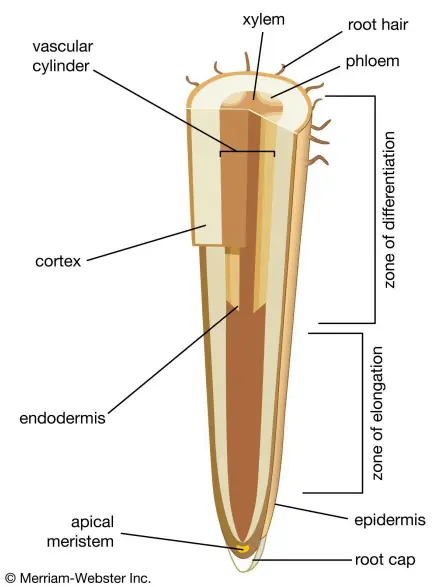
- Apical meristem sits at root tips and shoot tips and causes length-wise primary growth.
- Intercalary meristem lies between mature tissues (base of grass leaves) and regrows grazed/mown parts.
- Apical and intercalary are primary meristems; the sidelocated one is the secondary meristem.
- Lateral (secondary) meristem is cylindrical and causes thickness, i.e. secondary growth.
- An axillary bud is left in the leaf axil and can grow into a branch or flower.
| Meristem | Location | Function |
|---|---|---|
| Apical | Root tip, shoot tip | Increases length (primary growth) |
| Intercalary | Base of grass leaves/internodes | Regrows grazed/cut parts |
| Lateral | Sides of stem & root | Increases thickness (secondary growth) |
Check yourself
Meristematic Tissue – the Growth Zones
- Meristem = small, thin-walled cells that keep dividing to make new cells; the plant's cell factory.
- Plants grow only at special spots, not all over at once.
- Apical meristem sits at root tips and shoot tips and causes length-wise primary growth.
- Intercalary meristem lies between mature tissues (base of grass leaves) and regrows grazed/mown parts.
- Apical and intercalary are primary meristems; the sidelocated one is the secondary meristem.
- Lateral (secondary) meristem is cylindrical and causes thickness, i.e. secondary growth.
- An axillary bud is left in the leaf axil and can grow into a branch or flower.
- Apical — Root tip, shoot tip — Increases length (primary growth)
- Intercalary — Base of grass leaves/internodes — Regrows grazed/cut parts
- Lateral — Sides of stem & root — Increases thickness (secondary growth)
= small, thin-walled cells that keep dividing to make new cells; the plant's cell factory.
Meristem = small, thin-walled cells that keep dividing to make new cells; the plant's cell factory.
sits at root tips and shoot tips and causes length-wise .
Apical meristem sits at root tips and shoot tips and causes length-wise primary growth.
lies between mature tissues (base of grass leaves) and regrows grazed/mown parts.
Intercalary meristem lies between mature tissues (base of grass leaves) and regrows grazed/mown parts.
Apical and intercalary are ; the sidelocated one is the secondary meristem.
Apical and intercalary are primary meristems; the sidelocated one is the secondary meristem.
is cylindrical and causes thickness, i.e. .
Lateral (secondary) meristem is cylindrical and causes thickness, i.e. secondary growth.
An is left in the leaf axil and can grow into a branch or flower.
An axillary bud is left in the leaf axil and can grow into a branch or flower.
Lateral Meristem & Secondary Growth
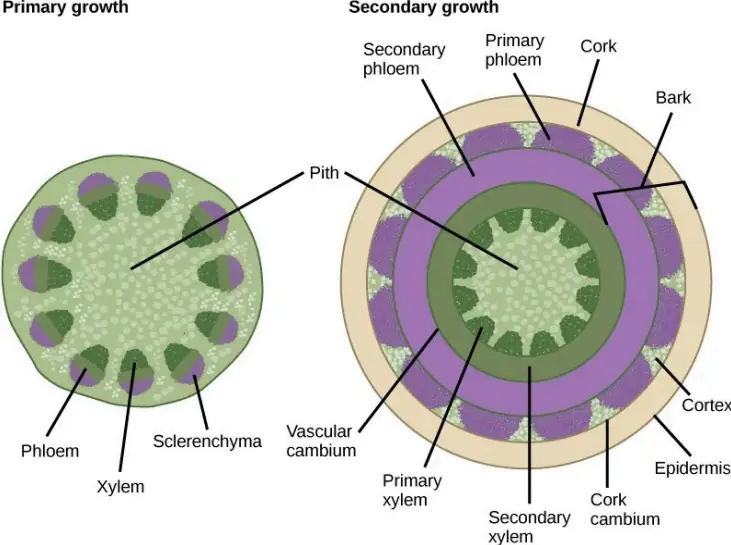
- The lateral meristem has two examples: vascular cambium and cork cambium.
- Vascular cambium sits between xylem and phloem.
- It makes new xylem on the inner side and new phloem on the outer side each year.
- This thickening produces the annual rings seen in a cut tree trunk.
- Cork cambium (phellogen) forms the protective bark (cork) on the outside of woody stems and roots.
Check yourself
Lateral Meristem & Secondary Growth
- The lateral meristem has two examples: vascular cambium and cork cambium.
- Vascular cambium sits between xylem and phloem.
- It makes new xylem on the inner side and new phloem on the outer side each year.
- This thickening produces the annual rings seen in a cut tree trunk.
- Cork cambium (phellogen) forms the protective bark (cork) on the outside of woody stems and roots.
The lateral meristem has two examples: and .
The lateral meristem has two examples: vascular cambium and cork cambium.
sits between xylem and phloem.
Vascular cambium sits between xylem and phloem.
It makes new and new each year.
It makes new xylem on the inner side and new phloem on the outer side each year.
This thickening produces the seen in a cut tree trunk.
This thickening produces the annual rings seen in a cut tree trunk.
forms the protective bark (cork) on the outside of woody stems and roots.
Cork cambium (phellogen) forms the protective bark (cork) on the outside of woody stems and roots.
Permanent Tissue – Simple vs Complex
- Permanent tissue = mature, specialised cells that have lost the ability to divide.
- They are the finished products of the plant's cell factory, each doing one fixed job for life.
- Simple permanent tissue = made of only one type of cell.
- Its three kinds are parenchyma, collenchyma and sclerenchyma.
- Complex permanent tissue = made of more than one type of cell cooperating.
- Its two kinds are xylem and phloem, which together form a vascular bundle.
- Memory trick: simple = single cell type, complex = combination of cell types.
Check yourself
Permanent Tissue – Simple vs Complex
- Permanent tissue = mature, specialised cells that have lost the ability to divide.
- They are the finished products of the plant's cell factory, each doing one fixed job for life.
- Simple permanent tissue = made of only one type of cell.
- Its three kinds are parenchyma, collenchyma and sclerenchyma.
- Complex permanent tissue = made of more than one type of cell cooperating.
- Its two kinds are xylem and phloem, which together form a vascular bundle.
- Memory trick: simple = single cell type, complex = combination of cell types.
= mature, specialised cells that have lost the ability to divide.
Permanent tissue = mature, specialised cells that have lost the ability to divide.
= made of only one type of cell.
Simple permanent tissue = made of only one type of cell.
= made of more than one type of cell cooperating.
Complex permanent tissue = made of more than one type of cell cooperating.
Its two kinds are , which together form a vascular bundle.
Its two kinds are xylem and phloem, which together form a vascular bundle.
Sclerenchyma
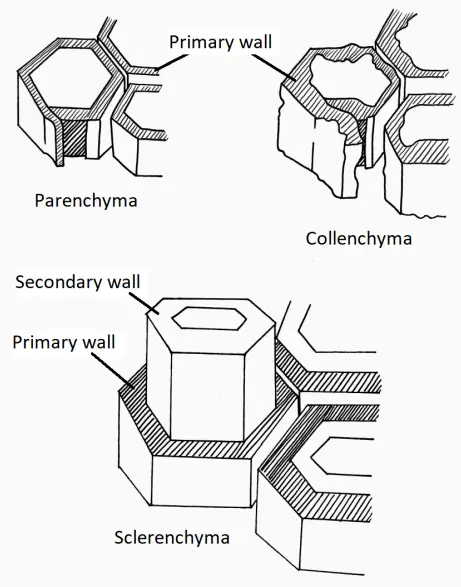
- Parenchyma: living, thin cellulose walls, isodiametric; does photosynthesis, storage and secretion.
- It forms the bulk of cortex, pith and fleshy fruit parts.
- Chlorenchyma = parenchyma full of chloroplasts (green leaf mesophyll, does photosynthesis).
- Aerenchyma = parenchyma with big air spaces in water plants; helps them float.
- Collenchyma: living cells thickened at the corners with cellulose and pectin; gives flexible support (e.g. celery strings).
- Sclerenchyma: dead cells with thick lignified walls and narrow lumen; gives rigid strength.
- Sclerenchyma comes as long fibres (jute, hemp for rope) and stone-like sclereids (grit in pear).
- Exam tip: parenchyma and collenchyma are living; sclerenchyma is dead.
| Tissue | Living/Dead | Wall & Role |
|---|---|---|
| Parenchyma | Living | Thin cellulose; storage, photosynthesis |
| Collenchyma | Living | Corner-thickened; flexible support |
| Sclerenchyma | Dead | Thick lignin; rigid strength |
Check yourself
Sclerenchyma
- Parenchyma: living, thin cellulose walls, isodiametric; does photosynthesis, storage and secretion.
- It forms the bulk of cortex, pith and fleshy fruit parts.
- Chlorenchyma = parenchyma full of chloroplasts (green leaf mesophyll, does photosynthesis).
- Aerenchyma = parenchyma with big air spaces in water plants; helps them float.
- Collenchyma: living cells thickened at the corners with cellulose and pectin; gives flexible support (e.g. celery strings).
- Sclerenchyma: dead cells with thick lignified walls and narrow lumen; gives rigid strength.
- Sclerenchyma comes as long fibres (jute, hemp for rope) and stone-like sclereids (grit in pear).
- Exam tip: parenchyma and collenchyma are living; sclerenchyma is dead.
- Parenchyma — Living — Thin cellulose; storage, photosynthesis
- Collenchyma — Living — Corner-thickened; flexible support
- Sclerenchyma — Dead — Thick lignin; rigid strength
: living, thin cellulose walls, isodiametric; does photosynthesis, storage and secretion.
Parenchyma: living, thin cellulose walls, isodiametric; does photosynthesis, storage and secretion.
= parenchyma full of chloroplasts (green leaf mesophyll, does photosynthesis).
Chlorenchyma = parenchyma full of chloroplasts (green leaf mesophyll, does photosynthesis).
= parenchyma with big air spaces in water plants; helps them float.
Aerenchyma = parenchyma with big air spaces in water plants; helps them float.
: living cells thickened at the corners with cellulose and pectin; gives flexible support (e.g. celery strings).
Collenchyma: living cells thickened at the corners with cellulose and pectin; gives flexible support (e.g. celery strings).
: dead cells with thick lignified walls and narrow lumen; gives rigid strength.
Sclerenchyma: dead cells with thick lignified walls and narrow lumen; gives rigid strength.
Sclerenchyma comes as long (jute, hemp for rope) and stone-like (grit in pear).
Sclerenchyma comes as long fibres (jute, hemp for rope) and stone-like sclereids (grit in pear).
Xylem – Water Pipeline
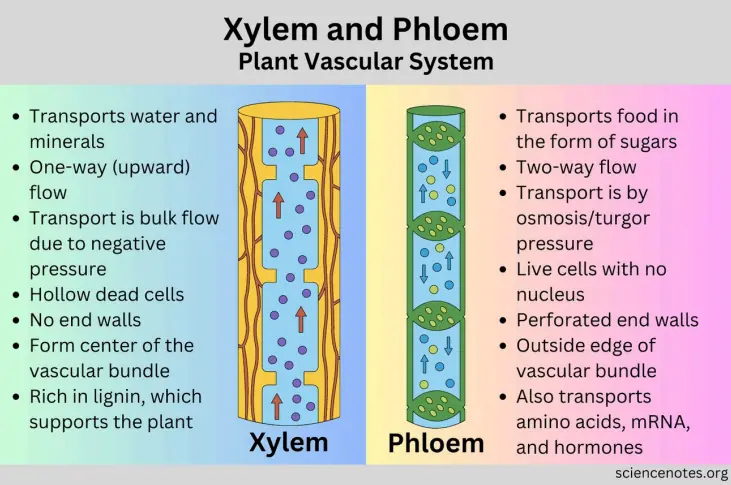
- Xylem carries water and dissolved minerals upward from roots to stem and leaves.
- It also adds mechanical strength. Memory aid: in "X"ylem, water goes up.
- Xylem has four elements: tracheids, vessels, xylem fibres and xylem parenchyma.
- Tracheids: long, dead, lignified tubes with tapering ends; present in all higher plants.
- Vessels: wide, dead tubes with perforated end-walls for fast water flow; typical of angiosperms.
- Xylem fibres give support; xylem parenchyma (only living element) stores food.
- Three of the four xylem elements are dead; only xylem parenchyma is living.
| Xylem element | Living/Dead | Role |
|---|---|---|
| Tracheid | Dead | Conducts water |
| Vessel | Dead | Conducts water fast |
| Xylem fibre | Dead | Support |
| Xylem parenchyma | Living | Food storage |
Check yourself
Xylem – Water Pipeline
- Xylem carries water and dissolved minerals upward from roots to stem and leaves.
- It also adds mechanical strength. Memory aid: in "X"ylem, water goes up.
- Xylem has four elements: tracheids, vessels, xylem fibres and xylem parenchyma.
- Tracheids: long, dead, lignified tubes with tapering ends; present in all higher plants.
- Vessels: wide, dead tubes with perforated end-walls for fast water flow; typical of angiosperms.
- Xylem fibres give support; xylem parenchyma (only living element) stores food.
- Three of the four xylem elements are dead; only xylem parenchyma is living.
- Tracheid — Dead — Conducts water
- Vessel — Dead — Conducts water fast
- Xylem fibre — Dead — Support
- Xylem parenchyma — Living — Food storage
carries water and dissolved minerals from roots to stem and leaves.
Xylem carries water and dissolved minerals upward from roots to stem and leaves.
It also adds mechanical strength. Memory aid: in "X"ylem, water goes .
It also adds mechanical strength. Memory aid: in "X"ylem, water goes up.
: long, dead, lignified tubes with tapering ends; present in all higher plants.
Tracheids: long, dead, lignified tubes with tapering ends; present in all higher plants.
: wide, dead tubes with perforated end-walls for fast water flow; typical of angiosperms.
Vessels: wide, dead tubes with perforated end-walls for fast water flow; typical of angiosperms.
give support; (only living element) stores food.
Xylem fibres give support; xylem parenchyma (only living element) stores food.
Three of the four xylem elements are ; only xylem parenchyma is living.
Three of the four xylem elements are dead; only xylem parenchyma is living.
Phloem – Food Pipeline
- Phloem carries food (sugar made in leaves) to all parts of the plant; this transport is translocation.
- Food can move both up and down in the phloem, unlike one-way xylem.
- Phloem has four parts: sieve tubes, companion cells, phloem fibres and phloem parenchyma.
- Sieve tubes: living tube cells with sieve-plate ends that conduct food.
- Companion cells control the activity of sieve tubes.
- Phloem fibres are the only dead part of phloem; all other phloem cells are living.
| Feature | Xylem | Phloem |
|---|---|---|
| Carries | Water & minerals | Food (sugars) |
| Direction | Upward only | Up and down |
| Mostly | Dead cells | Living cells |
Check yourself
Phloem – Food Pipeline
- Phloem carries food (sugar made in leaves) to all parts of the plant; this transport is translocation.
- Food can move both up and down in the phloem, unlike one-way xylem.
- Phloem has four parts: sieve tubes, companion cells, phloem fibres and phloem parenchyma.
- Sieve tubes: living tube cells with sieve-plate ends that conduct food.
- Companion cells control the activity of sieve tubes.
- Phloem fibres are the only dead part of phloem; all other phloem cells are living.
- Carries — Water & minerals — Food (sugars)
- Direction — Upward only — Up and down
- Mostly — Dead cells — Living cells
carries food (sugar made in leaves) to all parts of the plant; this transport is .
Phloem carries food (sugar made in leaves) to all parts of the plant; this transport is translocation.
Food can move in the phloem, unlike one-way xylem.
Food can move both up and down in the phloem, unlike one-way xylem.
: living tube cells with sieve-plate ends that conduct food.
Sieve tubes: living tube cells with sieve-plate ends that conduct food.
control the activity of sieve tubes.
Companion cells control the activity of sieve tubes.
are the only dead part of phloem; all other phloem cells are living.
Phloem fibres are the only dead part of phloem; all other phloem cells are living.
Tissue Systems & Plant Body Plan
- All plant tissues are grouped into three tissue systems.
- Epidermal (dermal) system: the outer protective layer with epidermis, stomata, root hairs.
- Stomata are tiny leaf pores guarded by guard cells for gas exchange and transpiration.
- Ground tissue system: all tissue except dermal and vascular; mainly parenchyma for storage and support.
- Vascular (conducting) system: the xylem and phloem bundles.
- A waxy waterproof layer called the cuticle covers the epidermis of aerial parts to cut water loss.
Check yourself
Tissue Systems & Plant Body Plan
- All plant tissues are grouped into three tissue systems.
- Epidermal (dermal) system: the outer protective layer with epidermis, stomata, root hairs.
- Stomata are tiny leaf pores guarded by guard cells for gas exchange and transpiration.
- Ground tissue system: all tissue except dermal and vascular; mainly parenchyma for storage and support.
- Vascular (conducting) system: the xylem and phloem bundles.
- A waxy waterproof layer called the cuticle covers the epidermis of aerial parts to cut water loss.
All plant tissues are grouped into three .
All plant tissues are grouped into three tissue systems.
: the outer protective layer with epidermis, stomata, root hairs.
Epidermal (dermal) system: the outer protective layer with epidermis, stomata, root hairs.
are tiny leaf pores guarded by for gas exchange and transpiration.
Stomata are tiny leaf pores guarded by guard cells for gas exchange and transpiration.
: all tissue except dermal and vascular; mainly parenchyma for storage and support.
Ground tissue system: all tissue except dermal and vascular; mainly parenchyma for storage and support.
A waxy waterproof layer called the covers the epidermis of aerial parts to cut water loss.
A waxy waterproof layer called the cuticle covers the epidermis of aerial parts to cut water loss.
Dicot vs Monocot Anatomy
- Vascular bundles are arranged differently in the two flowering-plant groups.
- In a dicot stem the bundles form a ring; in a monocot stem they are scattered.
- Dicot bundles are open (have cambium, so secondary growth occurs); monocot bundles are closed (no cambium).
- Annual rings and wood form only where cambium exists (mostly dicots and trees).
- Dicot leaves show reticulate (net) venation; monocot leaves show parallel venation.
| Feature | Dicot stem | Monocot stem |
|---|---|---|
| Bundle arrangement | Ring | Scattered |
| Cambium | Present (open) | Absent (closed) |
| Secondary growth | Yes | No |
Check yourself
Dicot vs Monocot Anatomy
- Vascular bundles are arranged differently in the two flowering-plant groups.
- In a dicot stem the bundles form a ring; in a monocot stem they are scattered.
- Dicot bundles are open (have cambium, so secondary growth occurs); monocot bundles are closed (no cambium).
- Annual rings and wood form only where cambium exists (mostly dicots and trees).
- Dicot leaves show reticulate (net) venation; monocot leaves show parallel venation.
- Bundle arrangement — Ring — Scattered
- Cambium — Present (open) — Absent (closed)
- Secondary growth — Yes — No
are arranged differently in the two flowering-plant groups.
Vascular bundles are arranged differently in the two flowering-plant groups.
In a the bundles form a ring; in a they are scattered.
In a dicot stem the bundles form a ring; in a monocot stem they are scattered.
Dicot bundles are (have cambium, so secondary growth occurs); monocot bundles are (no cambium).
Dicot bundles are open (have cambium, so secondary growth occurs); monocot bundles are closed (no cambium).
and wood form only where cambium exists (mostly dicots and trees).
Annual rings and wood form only where cambium exists (mostly dicots and trees).
Dicot leaves show ; monocot leaves show .
Dicot leaves show reticulate (net) venation; monocot leaves show parallel venation.
Stem vs Root & Stem Modifications
- A stem bears nodes, internodes, buds and leaves; a root has none of these and bears root hairs.
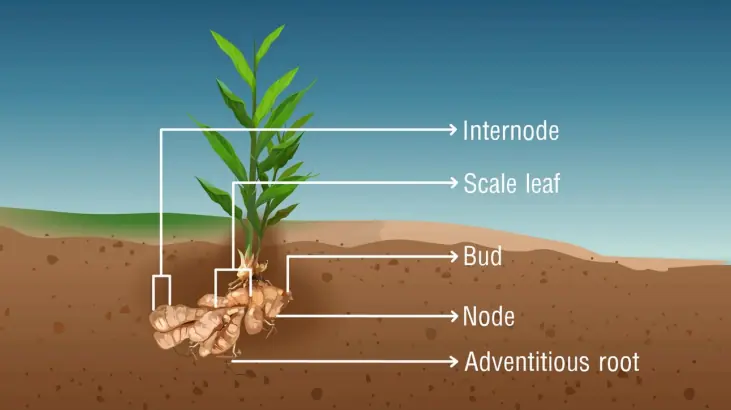
- Ginger is a stem (rhizome), not a root, because it has nodes, scale leaves and buds.
- Stems carry water and minerals up (via xylem) and distribute food to all parts (via phloem).
- Underground stems: rhizome (ginger, turmeric), tuber (potato), bulb (onion), corm (colocasia).
- Buds are normally found in the leaf axil and at stem/shoot tips, confirming a structure is a stem.
- Stems also help in support, storage and (when green) photosynthesis.
Check yourself
Stem vs Root & Stem Modifications
- A stem bears nodes, internodes, buds and leaves; a root has none of these and bears root hairs.
- Ginger is a stem (rhizome), not a root, because it has nodes, scale leaves and buds.
- Stems carry water and minerals up (via xylem) and distribute food to all parts (via phloem).
- Underground stems: rhizome (ginger, turmeric), tuber (potato), bulb (onion), corm (colocasia).
- Buds are normally found in the leaf axil and at stem/shoot tips, confirming a structure is a stem.
- Stems also help in support, storage and (when green) photosynthesis.
A bears nodes, internodes, buds and leaves; a has none of these and bears root hairs.
A stem bears nodes, internodes, buds and leaves; a root has none of these and bears root hairs.
: rhizome (ginger, turmeric), tuber (potato), bulb (onion), corm (colocasia).
Underground stems: rhizome (ginger, turmeric), tuber (potato), bulb (onion), corm (colocasia).
Buds are normally found in the , confirming a structure is a stem.
Buds are normally found in the leaf axil and at stem/shoot tips, confirming a structure is a stem.
Edible Plant Parts (Quick Facts)
- In mango the part we eat is the fleshy mesocarp (the juicy middle layer of the fruit).
- Edible part of potato = stem tuber; ginger = rhizome (stem); onion = bulb (modified leaves).
- Edible part of carrot and radish = root; cabbage = leaves; cauliflower = flower.
- Edible part of apple and pear = swollen fleshy thalamus (false fruit), with gritty sclereids in pear.
- These food and fleshy stores are mostly parenchyma tissue.
| Plant | Edible part |
|---|---|
| Mango | Mesocarp (fruit pulp) |
| Potato | Stem tuber |
| Ginger | Rhizome (stem) |
| Carrot/Radish | Root |
| Onion | Bulb (leaves) |
Check yourself
Edible Plant Parts (Quick Facts)
- In mango the part we eat is the fleshy mesocarp (the juicy middle layer of the fruit).
- Edible part of potato = stem tuber; ginger = rhizome (stem); onion = bulb (modified leaves).
- Edible part of carrot and radish = root; cabbage = leaves; cauliflower = flower.
- Edible part of apple and pear = swollen fleshy thalamus (false fruit), with gritty sclereids in pear.
- These food and fleshy stores are mostly parenchyma tissue.
- Mango — Mesocarp (fruit pulp)
- Potato — Stem tuber
- Ginger — Rhizome (stem)
- Carrot/Radish — Root
- Onion — Bulb (leaves)
In the part we eat is the fleshy (the juicy middle layer of the fruit).
In mango the part we eat is the fleshy mesocarp (the juicy middle layer of the fruit).
Edible part of = stem tuber; = rhizome (stem); = bulb (modified leaves).
Edible part of potato = stem tuber; ginger = rhizome (stem); onion = bulb (modified leaves).
Edible part of = root; = leaves; = flower.
Edible part of carrot and radish = root; cabbage = leaves; cauliflower = flower.
Edible part of = swollen fleshy thalamus (false fruit), with gritty sclereids in pear.
Edible part of apple and pear = swollen fleshy thalamus (false fruit), with gritty sclereids in pear.
These food and fleshy stores are mostly tissue.
These food and fleshy stores are mostly parenchyma tissue.
All 19 chapters of Biology notes
- Cell: Structure & Function12 sections
- Biomolecules & DNA/RNA11 sections
- Plant Kingdom & Classification11 sections
- Plant Tissues & Anatomy12 sections
- Plant Physiology: Photosynthesis, Respiration & Nutrition14 sections
- Animal Kingdom, Morphology & Classification16 sections
- Nutrition & Digestive System12 sections
- Circulatory System & Body Fluids12 sections
- Respiratory System10 sections
- Excretory System12 sections
- Nervous System & Sense Organs12 sections
- Endocrine System & Hormones14 sections
- Skeletal & Muscular System12 sections
- Reproductive System & Reproductive Health12 sections
- Genetics & Evolution13 sections
- Human Health, Diseases & Immunity16 sections
- Ecology, Ecosystem & Biodiversity12 sections
- Biology in Everyday Life & Applied Biology12 sections
- Inventions, Discoveries & Scientists10 sections