Biology notes · Chapter 11 of 19
Nervous System & Sense Organs
12 sections, 87 flashcards. Open a card to check your answer, or revise them in the app with spaced revision.
What the Nervous System Does
- The nervous system is the body's high-speed control and communication network.
- It carries messages as electrical impulses through living wires called neurons.
- It always does three jobs in order: receive, process, respond.
- It receives input from sense organs (eyes, ears, skin, nose, tongue).
- It processes input in the brain and spinal cord and makes a decision.
- It responds by ordering muscles to move or glands to secrete.
- It is faster than the hormonal (chemical) system, which is slow but longer-lasting.
| Feature | Nervous System | Hormonal System |
|---|---|---|
| Messenger | Electrical impulse | Chemical hormone |
| Path | Neurons | Blood |
| Speed | Very fast | Slow |
| Effect | Short-lived | Long-lasting |
Check yourself
What the Nervous System Does
- The nervous system is the body's high-speed control and communication network.
- It carries messages as electrical impulses through living wires called neurons.
- It always does three jobs in order: receive, process, respond.
- It receives input from sense organs (eyes, ears, skin, nose, tongue).
- It processes input in the brain and spinal cord and makes a decision.
- It responds by ordering muscles to move or glands to secrete.
- It is faster than the hormonal (chemical) system, which is slow but longer-lasting.
- Messenger — Electrical impulse — Chemical hormone
- Path — Neurons — Blood
- Speed — Very fast — Slow
- Effect — Short-lived — Long-lasting
It carries messages as through living wires called neurons.
It carries messages as electrical impulses through living wires called neurons.
It always does three jobs in order: .
It always does three jobs in order: receive, process, respond.
It receives input from (eyes, ears, skin, nose, tongue).
It receives input from sense organs (eyes, ears, skin, nose, tongue).
It processes input in the and makes a decision.
It processes input in the brain and spinal cord and makes a decision.
It is faster than the , which is slow but longer-lasting.
It is faster than the hormonal (chemical) system, which is slow but longer-lasting.
The Neuron – Structure
- The neuron (nerve cell) is the basic working unit of the nervous system.
- Dendrites are short branched fibres that carry the impulse towards the cell body.
- Dendrites contain dark-staining particles called Nissl's granules.
- The cell body (cyton) holds the nucleus and keeps the cell alive.
- The axon is one long fibre that carries the impulse away from the cell body.
- The axon tip ends in a synaptic knob holding vesicles of neurotransmitters.
- Bare gaps in the sheath are the nodes of Ranvier, where the impulse jumps to go faster.
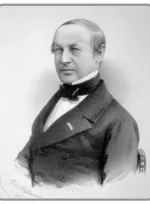
Theodor Schwann
Check yourself
The Neuron – Structure
- The neuron (nerve cell) is the basic working unit of the nervous system.
- Dendrites are short branched fibres that carry the impulse towards the cell body.
- Dendrites contain dark-staining particles called Nissl's granules.
- The cell body (cyton) holds the nucleus and keeps the cell alive.
- The axon is one long fibre that carries the impulse away from the cell body.
- The axon tip ends in a synaptic knob holding vesicles of neurotransmitters.
- Bare gaps in the sheath are the nodes of Ranvier, where the impulse jumps to go faster.
- The myelin sheath is a fatty insulating cover made by Schwann cells that speeds the impulse.
The is the basic working unit of the nervous system.
The neuron (nerve cell) is the basic working unit of the nervous system.
are short branched fibres that carry the impulse towards the cell body.
Dendrites are short branched fibres that carry the impulse towards the cell body.
Dendrites contain dark-staining particles called .
Dendrites contain dark-staining particles called Nissl's granules.
The holds the nucleus and keeps the cell alive.
The cell body (cyton) holds the nucleus and keeps the cell alive.
The is one long fibre that carries the impulse away from the cell body.
The axon is one long fibre that carries the impulse away from the cell body.
The axon tip ends in a holding vesicles of neurotransmitters.
The axon tip ends in a synaptic knob holding vesicles of neurotransmitters.
Bare gaps in the sheath are the , where the impulse jumps to go faster.
Bare gaps in the sheath are the nodes of Ranvier, where the impulse jumps to go faster.
The is a fatty insulating cover made by that speeds the impulse.
The myelin sheath is a fatty insulating cover made by Schwann cells that speeds the impulse.
Types of Neurons
- Axons are of two kinds: myelinated (spinal and cranial nerves) and non-myelinated.
- Neurons are also classified by the number of fibres from the cell body.
- Multipolar neurons have one axon and many dendrites (cerebral cortex).
- Bipolar neurons have one axon and one dendrite (retina of the eye).
- Unipolar neurons have one axon and no dendrite (embryonic stage).
| Type | Axon / Dendrites | Found in |
|---|---|---|
| Multipolar | 1 axon, many dendrites | Cerebral cortex |
| Bipolar | 1 axon, 1 dendrite | Retina of eye |
| Unipolar | 1 axon, no dendrite | Embryonic stage |
Check yourself
Types of Neurons
- Axons are of two kinds: myelinated (spinal and cranial nerves) and non-myelinated.
- Neurons are also classified by the number of fibres from the cell body.
- Multipolar neurons have one axon and many dendrites (cerebral cortex).
- Bipolar neurons have one axon and one dendrite (retina of the eye).
- Unipolar neurons have one axon and no dendrite (embryonic stage).
- Multipolar — 1 axon, many dendrites — Cerebral cortex
- Bipolar — 1 axon, 1 dendrite — Retina of eye
- Unipolar — 1 axon, no dendrite — Embryonic stage
Axons are of two kinds: (spinal and cranial nerves) and .
Axons are of two kinds: myelinated (spinal and cranial nerves) and non-myelinated.
neurons have one axon and many dendrites (cerebral cortex).
Multipolar neurons have one axon and many dendrites (cerebral cortex).
neurons have one axon and one dendrite (retina of the eye).
Bipolar neurons have one axon and one dendrite (retina of the eye).
neurons have one axon and no dendrite (embryonic stage).
Unipolar neurons have one axon and no dendrite (embryonic stage).
The Synapse
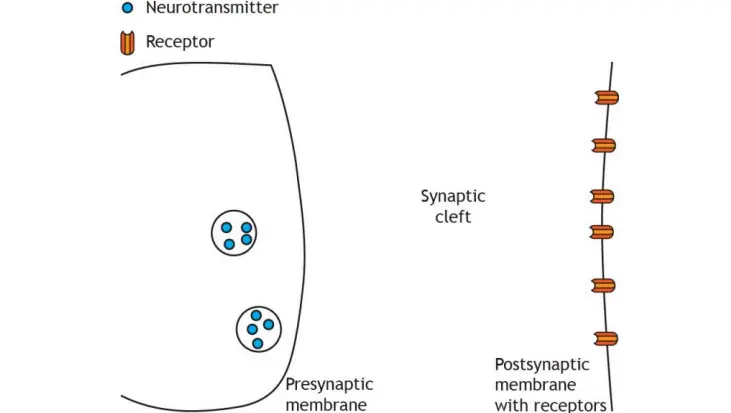
- The synapse is the junction where one neuron passes its message to the next.
- It is formed by the pre-synaptic (sender) and postsynaptic (receiver) membranes.
- The tiny gap between them is the synaptic cleft.
- In an electrical synapse, current flows directly across; it is faster but rare in humans.
- In a chemical synapse, the sender releases neurotransmitters across the cleft.
- Chemical synapses are the common type in the human body.
| Type | Mechanism | Speed / Frequency |
|---|---|---|
| Electrical | Direct current flow | Faster, rare |
| Chemical | Neurotransmitters | Slower, common |
Check yourself
The Synapse
- The synapse is the junction where one neuron passes its message to the next.
- It is formed by the pre-synaptic (sender) and postsynaptic (receiver) membranes.
- The tiny gap between them is the synaptic cleft.
- In an electrical synapse, current flows directly across; it is faster but rare in humans.
- In a chemical synapse, the sender releases neurotransmitters across the cleft.
- Chemical synapses are the common type in the human body.
- Electrical — Direct current flow — Faster, rare
- Chemical — Neurotransmitters — Slower, common
The is the junction where one neuron passes its message to the next.
The synapse is the junction where one neuron passes its message to the next.
It is formed by the (sender) and (receiver) membranes.
It is formed by the pre-synaptic (sender) and postsynaptic (receiver) membranes.
The tiny gap between them is the .
The tiny gap between them is the synaptic cleft.
In an , current flows directly across; it is faster but rare in humans.
In an electrical synapse, current flows directly across; it is faster but rare in humans.
In a , the sender releases across the cleft.
In a chemical synapse, the sender releases neurotransmitters across the cleft.
Chemical synapses are the in the human body.
Chemical synapses are the common type in the human body.
Organisation of the Nervous System
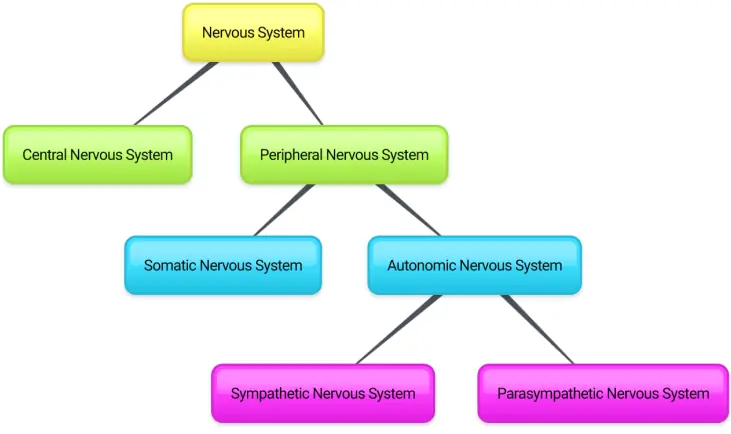
- The central nervous system (CNS) is the brain and spinal cord – the control room.
- The peripheral nervous system (PNS) is all nerves branching from the CNS.
- The PNS includes cranial nerves (from brain) and spinal nerves (from spinal cord).
- The autonomic nervous system (ANS) controls involuntary organs automatically.
- The sympathetic part drives fight-or-flight (speeds heart) in emergencies.
- The parasympathetic part drives rest-and-digest (slows heart, aids digestion).
- Afferent (sensory) fibres carry input to the CNS; efferent (motor) fibres carry output away.
- Humans have 12 pairs of cranial nerves and 31 pairs of spinal nerves.
| Division | Made of | Role |
|---|---|---|
| CNS | Brain + spinal cord | Processing, decisions |
| PNS | Cranial + spinal nerves | Connects CNS to body |
| ANS | Sympathetic + parasympathetic | Involuntary control |
Check yourself
Organisation of the Nervous System
- The central nervous system (CNS) is the brain and spinal cord – the control room.
- The peripheral nervous system (PNS) is all nerves branching from the CNS.
- The PNS includes cranial nerves (from brain) and spinal nerves (from spinal cord).
- The autonomic nervous system (ANS) controls involuntary organs automatically.
- The sympathetic part drives fight-or-flight (speeds heart) in emergencies.
- The parasympathetic part drives rest-and-digest (slows heart, aids digestion).
- Afferent (sensory) fibres carry input to the CNS; efferent (motor) fibres carry output away.
- Humans have 12 pairs of cranial nerves and 31 pairs of spinal nerves.
- CNS — Brain + spinal cord — Processing, decisions
- PNS — Cranial + spinal nerves — Connects CNS to body
- ANS — Sympathetic + parasympathetic — Involuntary control
The is the brain and spinal cord – the control room.
The central nervous system (CNS) is the brain and spinal cord – the control room.
The PNS includes (from brain) and (from spinal cord).
The PNS includes cranial nerves (from brain) and spinal nerves (from spinal cord).
The controls involuntary organs automatically.
The autonomic nervous system (ANS) controls involuntary organs automatically.
The part drives fight-or-flight (speeds heart) in emergencies.
The sympathetic part drives fight-or-flight (speeds heart) in emergencies.
The part drives rest-and-digest (slows heart, aids digestion).
The parasympathetic part drives rest-and-digest (slows heart, aids digestion).
fibres carry input to the CNS; fibres carry output away.
Afferent (sensory) fibres carry input to the CNS; efferent (motor) fibres carry output away.
Humans have 12 pairs of cranial nerves and .
Humans have 12 pairs of cranial nerves and 31 pairs of spinal nerves.
The Brain – Protection
- The brain is the body's main computer where most decisions are made.
- It is enclosed in a bony box called the cranium (brain box) of the skull.
- It is wrapped in three membranes together called the meninges.
- From outside in, the meninges are dura mater, arachnoid, pia mater.
- The pia mater is the delicate innermost layer touching the brain.
- Inflammation of these membranes is the disease meningitis.
- Fluid between the layers (cerebrospinal fluid) cushions the brain from shock.
| Meninges layer | Position | Texture |
|---|---|---|
| Dura mater | Outer | Tough |
| Arachnoid | Middle | Web-like |
| Pia mater | Inner | Delicate |
Check yourself
The Brain – Protection
- The brain is the body's main computer where most decisions are made.
- It is enclosed in a bony box called the cranium (brain box) of the skull.
- It is wrapped in three membranes together called the meninges.
- From outside in, the meninges are dura mater, arachnoid, pia mater.
- The pia mater is the delicate innermost layer touching the brain.
- Inflammation of these membranes is the disease meningitis.
- Fluid between the layers (cerebrospinal fluid) cushions the brain from shock.
- Dura mater — Outer — Tough
- Arachnoid — Middle — Web-like
- Pia mater — Inner — Delicate
It is enclosed in a bony box called the (brain box) of the skull.
It is enclosed in a bony box called the cranium (brain box) of the skull.
It is wrapped in three membranes together called the .
It is wrapped in three membranes together called the meninges.
The is the delicate innermost layer touching the brain.
The pia mater is the delicate innermost layer touching the brain.
Inflammation of these membranes is the disease .
Inflammation of these membranes is the disease meningitis.
Fluid between the layers () cushions the brain from shock.
Fluid between the layers (cerebrospinal fluid) cushions the brain from shock.
Parts of the Brain
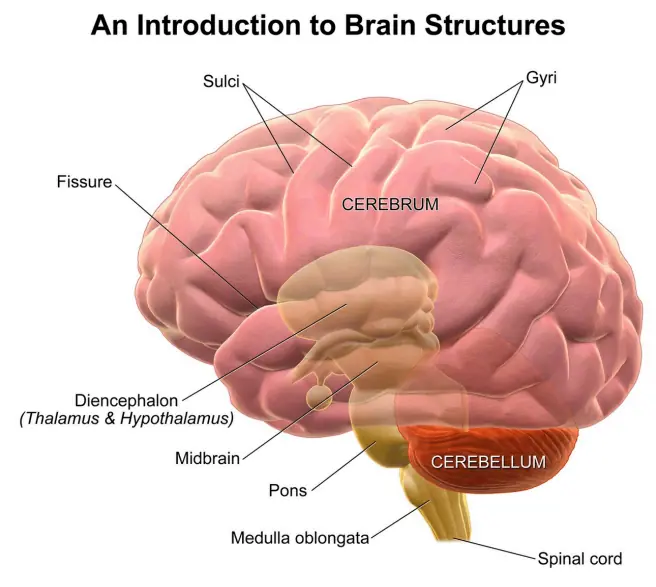
- The brain has three major parts: forebrain, midbrain, hindbrain.
- The cerebrum (forebrain) is the largest part; it controls intelligence, memory and voluntary action.
- The thalamus and hypothalamus lie in the forebrain; the hypothalamus regulates body temperature, hunger and thirst.
- The cerebellum (hindbrain) controls balance, posture and coordination of muscles.
- The medulla oblongata (hindbrain) controls heartbeat, breathing and blood pressure (involuntary vital actions).
- The pons connects brain parts and helps regulate breathing.
- The midbrain and hindbrain together form the brain stem.
| Brain part | Region | Main function |
|---|---|---|
| Cerebrum | Forebrain | Thinking, memory, voluntary acts |
| Hypothalamus | Forebrain | Temperature, hunger, thirst |
| Cerebellum | Hindbrain | Balance, coordination |
| Medulla | Hindbrain | Heartbeat, breathing |
Check yourself
Parts of the Brain
- The brain has three major parts: forebrain, midbrain, hindbrain.
- The cerebrum (forebrain) is the largest part; it controls intelligence, memory and voluntary action.
- The thalamus and hypothalamus lie in the forebrain; the hypothalamus regulates body temperature, hunger and thirst.
- The cerebellum (hindbrain) controls balance, posture and coordination of muscles.
- The medulla oblongata (hindbrain) controls heartbeat, breathing and blood pressure (involuntary vital actions).
- The pons connects brain parts and helps regulate breathing.
- The midbrain and hindbrain together form the brain stem.
- Cerebrum — Forebrain — Thinking, memory, voluntary acts
- Hypothalamus — Forebrain — Temperature, hunger, thirst
- Cerebellum — Hindbrain — Balance, coordination
- Medulla — Hindbrain — Heartbeat, breathing
The (forebrain) is the largest part; it controls intelligence, memory and voluntary action.
The cerebrum (forebrain) is the largest part; it controls intelligence, memory and voluntary action.
The lie in the forebrain; the regulates body temperature, hunger and thirst.
The thalamus and hypothalamus lie in the forebrain; the hypothalamus regulates body temperature, hunger and thirst.
The (hindbrain) controls balance, posture and coordination of muscles.
The cerebellum (hindbrain) controls balance, posture and coordination of muscles.
The (hindbrain) controls heartbeat, breathing and blood pressure (involuntary vital actions).
The medulla oblongata (hindbrain) controls heartbeat, breathing and blood pressure (involuntary vital actions).
The connects brain parts and helps regulate breathing.
The pons connects brain parts and helps regulate breathing.
The midbrain and hindbrain together form the .
The midbrain and hindbrain together form the brain stem.
Spinal Cord & Reflex Action
- The spinal cord runs inside the backbone and links the brain to body nerves.
- It is protected by the vertebral column and the meninges.
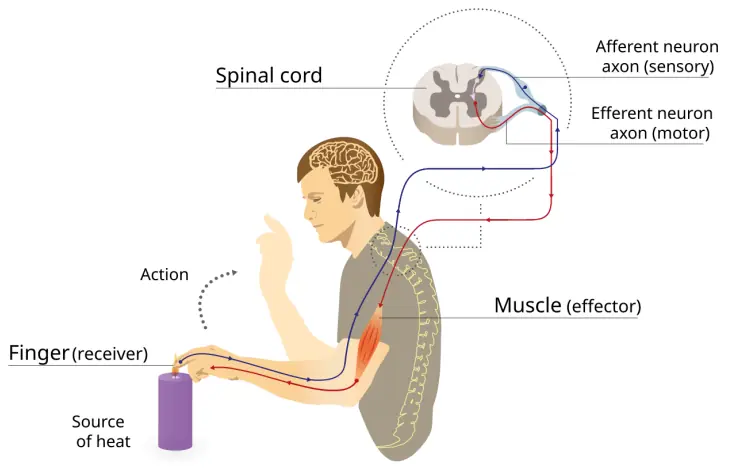
- A reflex action is a sudden, automatic response to a stimulus, like pulling the hand off a hot object.
- The pathway of a reflex is the reflex arc.
- The spinal cord is the governing centre of reflex action, not the brain.
- The arc runs: receptor to sensory neuron to spinal cord to motor neuron to effector (muscle).
- Reflexes are fast because they bypass the brain.
- Tetraplegia (quadriplegia) is paralysis of all four limbs due to spinal cord injury in the neck region.
Check yourself
Spinal Cord & Reflex Action
- The spinal cord runs inside the backbone and links the brain to body nerves.
- It is protected by the vertebral column and the meninges.
- A reflex action is a sudden, automatic response to a stimulus, like pulling the hand off a hot object.
- The pathway of a reflex is the reflex arc.
- The spinal cord is the governing centre of reflex action, not the brain.
- The arc runs: receptor to sensory neuron to spinal cord to motor neuron to effector (muscle).
- Reflexes are fast because they bypass the brain.
- Tetraplegia (quadriplegia) is paralysis of all four limbs due to spinal cord injury in the neck region.
The runs inside the backbone and links the brain to body nerves.
The spinal cord runs inside the backbone and links the brain to body nerves.
It is protected by the and the meninges.
It is protected by the vertebral column and the meninges.
A is a sudden, automatic response to a stimulus, like pulling the hand off a hot object.
A reflex action is a sudden, automatic response to a stimulus, like pulling the hand off a hot object.
The pathway of a reflex is the .
The pathway of a reflex is the reflex arc.
The is the governing centre of reflex action, not the brain.
The spinal cord is the governing centre of reflex action, not the brain.
The arc runs: receptor to to spinal cord to to effector (muscle).
The arc runs: receptor to sensory neuron to spinal cord to motor neuron to effector (muscle).
is paralysis of all four limbs due to spinal cord injury in the neck region.
Tetraplegia (quadriplegia) is paralysis of all four limbs due to spinal cord injury in the neck region.
The Eye
- The cornea is the transparent front through which light enters.
- The iris is the coloured part that controls the size of the pupil.
- The lens focuses light onto the retina at the back.
- The retina holds light-sensitive cells: rods (dim light) and cones (colour).
- The optic nerve carries signals from the retina to the brain.
- Lack of vitamin A causes night blindness.
- The Ishihara test is used to detect colour blindness.
| Part | Function |
|---|---|
| Cornea | Light entry |
| Iris / Pupil | Controls light amount |
| Lens | Focuses light |
| Retina | Detects image |
| Optic nerve | Carries signal to brain |
Check yourself
The Eye
- The cornea is the transparent front through which light enters.
- The iris is the coloured part that controls the size of the pupil.
- The lens focuses light onto the retina at the back.
- The retina holds light-sensitive cells: rods (dim light) and cones (colour).
- The optic nerve carries signals from the retina to the brain.
- Lack of vitamin A causes night blindness.
- The Ishihara test is used to detect colour blindness.
- Cornea — Light entry
- Iris / Pupil — Controls light amount
- Lens — Focuses light
- Retina — Detects image
- Optic nerve — Carries signal to brain
The is the transparent front through which light enters.
The cornea is the transparent front through which light enters.
The is the coloured part that controls the size of the .
The iris is the coloured part that controls the size of the pupil.
The focuses light onto the at the back.
The lens focuses light onto the retina at the back.
The holds light-sensitive cells: (dim light) and (colour).
The retina holds light-sensitive cells: rods (dim light) and cones (colour).
The carries signals from the retina to the brain.
The optic nerve carries signals from the retina to the brain.
Lack of vitamin A causes .
Lack of vitamin A causes night blindness.
The is used to detect .
The Ishihara test is used to detect colour blindness.
The Ear
- The ear is the organ for hearing and balance.
- The outer ear (pinna) collects sound waves.
- The eardrum (tympanum) vibrates when sound hits it.
- Three middle-ear bones – malleus, incus, stapes – amplify and pass vibrations.
- The cochlea in the inner ear converts vibrations into nerve signals.
- The semicircular canals help maintain body balance.
- The auditory nerve carries sound signals to the brain.
| Region | Key structures | Role |
|---|---|---|
| Outer | Pinna, ear canal | Collect sound |
| Middle | Eardrum, ear bones | Amplify sound |
| Inner | Cochlea, semicircular canals | Hearing, balance |
Check yourself
The Ear
- The ear is the organ for hearing and balance.
- The outer ear (pinna) collects sound waves.
- The eardrum (tympanum) vibrates when sound hits it.
- Three middle-ear bones – malleus, incus, stapes – amplify and pass vibrations.
- The cochlea in the inner ear converts vibrations into nerve signals.
- The semicircular canals help maintain body balance.
- The auditory nerve carries sound signals to the brain.
- Outer — Pinna, ear canal — Collect sound
- Middle — Eardrum, ear bones — Amplify sound
- Inner — Cochlea, semicircular canals — Hearing, balance
The ear is the organ for and .
The ear is the organ for hearing and balance.
The collects sound waves.
The outer ear (pinna) collects sound waves.
The vibrates when sound hits it.
The eardrum (tympanum) vibrates when sound hits it.
Three middle-ear bones – – amplify and pass vibrations.
Three middle-ear bones – malleus, incus, stapes – amplify and pass vibrations.
The in the inner ear converts vibrations into nerve signals.
The cochlea in the inner ear converts vibrations into nerve signals.
The help maintain body balance.
The semicircular canals help maintain body balance.
The carries sound signals to the brain.
The auditory nerve carries sound signals to the brain.
The Tongue, Skin & Nose
- The tongue detects taste through taste buds.
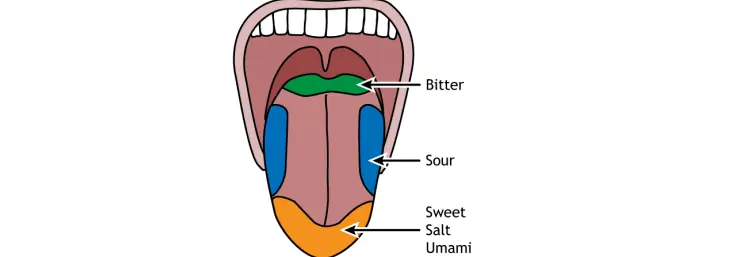
- The five basic tastes are sweet, sour, salty, bitter and umami.
- Spicy and pungent are NOT tastes – they are pain/heat sensations.
- The back of the tongue is most sensitive to bitter taste.
- The skin senses touch, pressure, pain and temperature.
- The nose detects smell using olfactory receptors.
- The brain (cerebral cortex) itself feels no pain when pricked – it has no pain receptors.
| Sense organ | Sense |
|---|---|
| Eye | Sight |
| Ear | Hearing, balance |
| Tongue | Taste |
| Nose | Smell |
| Skin | Touch, pain, temperature |
Check yourself
The Tongue, Skin & Nose
- The tongue detects taste through taste buds.
- The five basic tastes are sweet, sour, salty, bitter and umami.
- Spicy and pungent are NOT tastes – they are pain/heat sensations.
- The back of the tongue is most sensitive to bitter taste.
- The skin senses touch, pressure, pain and temperature.
- The nose detects smell using olfactory receptors.
- The brain (cerebral cortex) itself feels no pain when pricked – it has no pain receptors.
- Eye — Sight
- Ear — Hearing, balance
- Tongue — Taste
- Nose — Smell
- Skin — Touch, pain, temperature
The tongue detects taste through .
The tongue detects taste through taste buds.
The is most sensitive to taste.
The back of the tongue is most sensitive to bitter taste.
The senses touch, pressure, pain and temperature.
The skin senses touch, pressure, pain and temperature.
The detects smell using .
The nose detects smell using olfactory receptors.
The itself feels no pain when pricked – it has no pain receptors.
The brain (cerebral cortex) itself feels no pain when pricked – it has no pain receptors.
Common Disorders & Exam Facts
- Cerebral palsy is a brain disorder affecting movement, found generally in children.
- Meningitis is inflammation of the meninges (brain membranes).
- Tetraplegia means paralysis of all four limbs.
- Night blindness is caused by deficiency of vitamin A.
- Body temperature is regulated by the hypothalamus.
- Heartbeat and breathing are controlled by the medulla oblongata.
- Input (sensory) and output (motor) nerves meet at the spinal cord / synapse.
- Among animals, the tree shrew / small mammals have the largest brain relative to body size.
Check yourself
Common Disorders & Exam Facts
- Cerebral palsy is a brain disorder affecting movement, found generally in children.
- Meningitis is inflammation of the meninges (brain membranes).
- Tetraplegia means paralysis of all four limbs.
- Night blindness is caused by deficiency of vitamin A.
- Body temperature is regulated by the hypothalamus.
- Heartbeat and breathing are controlled by the medulla oblongata.
- Input (sensory) and output (motor) nerves meet at the spinal cord / synapse.
- Among animals, the tree shrew / small mammals have the largest brain relative to body size.
is a brain disorder affecting movement, found generally in .
Cerebral palsy is a brain disorder affecting movement, found generally in children.
is inflammation of the meninges (brain membranes).
Meningitis is inflammation of the meninges (brain membranes).
means paralysis of all four limbs.
Tetraplegia means paralysis of all four limbs.
is caused by deficiency of .
Night blindness is caused by deficiency of vitamin A.
Body temperature is regulated by the .
Body temperature is regulated by the hypothalamus.
Heartbeat and breathing are controlled by the .
Heartbeat and breathing are controlled by the medulla oblongata.
Input (sensory) and output (motor) nerves meet at the .
Input (sensory) and output (motor) nerves meet at the spinal cord / synapse.
Among animals, the / small mammals have the largest brain relative to body size.
Among animals, the tree shrew / small mammals have the largest brain relative to body size.
All 19 chapters of Biology notes
- Cell: Structure & Function12 sections
- Biomolecules & DNA/RNA11 sections
- Plant Kingdom & Classification11 sections
- Plant Tissues & Anatomy12 sections
- Plant Physiology: Photosynthesis, Respiration & Nutrition14 sections
- Animal Kingdom, Morphology & Classification16 sections
- Nutrition & Digestive System12 sections
- Circulatory System & Body Fluids12 sections
- Respiratory System10 sections
- Excretory System12 sections
- Nervous System & Sense Organs12 sections
- Endocrine System & Hormones14 sections
- Skeletal & Muscular System12 sections
- Reproductive System & Reproductive Health12 sections
- Genetics & Evolution13 sections
- Human Health, Diseases & Immunity16 sections
- Ecology, Ecosystem & Biodiversity12 sections
- Biology in Everyday Life & Applied Biology12 sections
- Inventions, Discoveries & Scientists10 sections