Biology notes · Chapter 3 of 19
Plant Kingdom & Classification
11 sections, 71 flashcards. Open a card to check your answer, or revise them in the app with spaced revision.
Plant Kingdom & Classification Basics
- The Plant Kingdom is scientifically named Plantae and includes every plant from pond-scum to giant trees.
- Classification means sorting organisms into groups based on shared features for easy study and naming.
- Almost all plants are autotrophs – they make their own food by photosynthesis using sunlight.
- In binomial nomenclature each plant gets a genus + species name, e.g. mango = Mangifera indica.
- R. H. Whittaker (1969) proposed the Five Kingdom classification, in which plants form kingdom Plantae.
- Plant kingdom order, simplest to advanced: Algae → Bryophytes → Pteridophytes → Gymnosperms → Angiosperms.
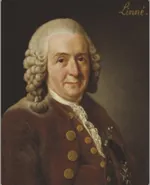
Carl Linnaeus
Check yourself
Plant Kingdom & Classification Basics
- The Plant Kingdom is scientifically named Plantae and includes every plant from pond-scum to giant trees.
- Classification means sorting organisms into groups based on shared features for easy study and naming.
- Almost all plants are autotrophs – they make their own food by photosynthesis using sunlight.
- In binomial nomenclature each plant gets a genus + species name, e.g. mango = Mangifera indica.
- R. H. Whittaker (1969) proposed the Five Kingdom classification, in which plants form kingdom Plantae.
- Plant kingdom order, simplest to advanced: Algae → Bryophytes → Pteridophytes → Gymnosperms → Angiosperms.
- Carolus Linnaeus is the Father of Taxonomy; he gave the two-name (binomial) naming system.
The Plant Kingdom is scientifically named and includes every plant from pond-scum to giant trees.
The Plant Kingdom is scientifically named Plantae and includes every plant from pond-scum to giant trees.
means sorting organisms into groups based on shared features for easy study and naming.
Classification means sorting organisms into groups based on shared features for easy study and naming.
Almost all plants are – they make their own food by photosynthesis using sunlight.
Almost all plants are autotrophs – they make their own food by photosynthesis using sunlight.
In each plant gets a genus + species name, e.g. mango = Mangifera indica.
In binomial nomenclature each plant gets a genus + species name, e.g. mango = Mangifera indica.
proposed the Five Kingdom classification, in which plants form kingdom Plantae.
R. H. Whittaker (1969) proposed the Five Kingdom classification, in which plants form kingdom Plantae.
is the Father of Taxonomy; he gave the two-name (binomial) naming system.
Carolus Linnaeus is the Father of Taxonomy; he gave the two-name (binomial) naming system.
The Five Plant Groups Compared
- Algae: simple, water-living, chlorophyll-bearing; body is a thallus with no true root, stem or leaf.
- Bryophytes (moss, Marchantia): the amphibians of plants – live on land but need water to reproduce.
- Pteridophytes (ferns): first plants with true roots, stem, leaves and a vascular system, but no seeds.
- Gymnosperms: seed plants with naked seeds not enclosed in a fruit (gymnos = naked, sperma = seed).
- Angiosperms: flowering plants with seeds enclosed in a fruit; largest and most advanced group.
| Group | Vascular? | Seed/Flower |
|---|---|---|
| Algae | No | No seed, no flower |
| Bryophytes | No | No seed, no flower |
| Pteridophytes | Yes | No seed, no flower |
| Gymnosperms | Yes | Naked seed, no flower |
| Angiosperms | Yes | Seed in fruit, flowers |
Check yourself
The Five Plant Groups Compared
- Algae: simple, water-living, chlorophyll-bearing; body is a thallus with no true root, stem or leaf.
- Bryophytes (moss, Marchantia): the amphibians of plants – live on land but need water to reproduce.
- Pteridophytes (ferns): first plants with true roots, stem, leaves and a vascular system, but no seeds.
- Gymnosperms: seed plants with naked seeds not enclosed in a fruit (gymnos = naked, sperma = seed).
- Angiosperms: flowering plants with seeds enclosed in a fruit; largest and most advanced group.
- Algae — No — No seed, no flower
- Bryophytes — No — No seed, no flower
- Pteridophytes — Yes — No seed, no flower
- Gymnosperms — Yes — Naked seed, no flower
- Angiosperms — Yes — Seed in fruit, flowers
: simple, water-living, chlorophyll-bearing; body is a thallus with no true root, stem or leaf.
Algae: simple, water-living, chlorophyll-bearing; body is a thallus with no true root, stem or leaf.
(moss, Marchantia): the amphibians of plants – live on land but need water to reproduce.
Bryophytes (moss, Marchantia): the amphibians of plants – live on land but need water to reproduce.
(ferns): first plants with true roots, stem, leaves and a vascular system, but no seeds.
Pteridophytes (ferns): first plants with true roots, stem, leaves and a vascular system, but no seeds.
: seed plants with naked seeds not enclosed in a fruit (gymnos = naked, sperma = seed).
Gymnosperms: seed plants with naked seeds not enclosed in a fruit (gymnos = naked, sperma = seed).
: flowering plants with seeds enclosed in a fruit; largest and most advanced group.
Angiosperms: flowering plants with seeds enclosed in a fruit; largest and most advanced group.
Algae and Bryophytes in Detail
- Algae are classed by pigment colour into green, brown and red types.
- Chlorophyceae = green algae (Spirogyra); Phaeophyceae = brown algae (seaweeds).
- Rhodophyceae = red algae found in deeper sea water.
- Bryophytes cling to soil by thread-like rhizoids, which are not true roots.
- Their male organ is the antheridium and female organ is the flask-shaped archegonium.
- Sperm must swim through water to reach the egg, so bryophytes depend on moisture to reproduce.
| Algae class | Colour | Example |
|---|---|---|
| Chlorophyceae | Green | Spirogyra |
| Phaeophyceae | Brown | Seaweeds |
| Rhodophyceae | Red | Red algae |
Check yourself
Algae and Bryophytes in Detail
- Algae are classed by pigment colour into green, brown and red types.
- Chlorophyceae = green algae (Spirogyra); Phaeophyceae = brown algae (seaweeds).
- Rhodophyceae = red algae found in deeper sea water.
- Bryophytes cling to soil by thread-like rhizoids, which are not true roots.
- Their male organ is the antheridium and female organ is the flask-shaped archegonium.
- Sperm must swim through water to reach the egg, so bryophytes depend on moisture to reproduce.
- Chlorophyceae — Green — Spirogyra
- Phaeophyceae — Brown — Seaweeds
- Rhodophyceae — Red — Red algae
Algae are classed by into green, brown and red types.
Algae are classed by pigment colour into green, brown and red types.
= green algae (Spirogyra); = brown algae (seaweeds).
Chlorophyceae = green algae (Spirogyra); Phaeophyceae = brown algae (seaweeds).
= red algae found in deeper sea water.
Rhodophyceae = red algae found in deeper sea water.
Bryophytes cling to soil by thread-like , which are not true roots.
Bryophytes cling to soil by thread-like rhizoids, which are not true roots.
Their male organ is the and female organ is the flask-shaped archegonium.
Their male organ is the antheridium and female organ is the flask-shaped archegonium.
to reach the egg, so bryophytes depend on moisture to reproduce.
Sperm must swim through water to reach the egg, so bryophytes depend on moisture to reproduce.
Gymnosperms – Naked-Seed Plants
- Gymnosperms bear naked seeds not enclosed inside any fruit.
- Common examples: Pine, Fir, Spruce, Cedar, Larch, Cypress, Cycas and the redwood Sequoia.
- Most are conifers – cone-bearing hill plants with needlelike leaves.
- Their needle leaves have small surface and thick cuticle to reduce water loss.
- Sequoia (redwood) is among the tallest and most massive plants on Earth.
- Pine, Fir, Spruce, Cedar, Larch and Cypress are famous timber-yielding conifers of India's hills.
Check yourself
Gymnosperms – Naked-Seed Plants
- Gymnosperms bear naked seeds not enclosed inside any fruit.
- Common examples: Pine, Fir, Spruce, Cedar, Larch, Cypress, Cycas and the redwood Sequoia.
- Most are conifers – cone-bearing hill plants with needlelike leaves.
- Their needle leaves have small surface and thick cuticle to reduce water loss.
- Sequoia (redwood) is among the tallest and most massive plants on Earth.
- Pine, Fir, Spruce, Cedar, Larch and Cypress are famous timber-yielding conifers of India's hills.
Gymnosperms bear not enclosed inside any fruit.
Gymnosperms bear naked seeds not enclosed inside any fruit.
Most are – cone-bearing hill plants with needlelike leaves.
Most are conifers – cone-bearing hill plants with needlelike leaves.
Their have small surface and thick cuticle to reduce water loss.
Their needle leaves have small surface and thick cuticle to reduce water loss.
(redwood) is among the tallest and most massive plants on Earth.
Sequoia (redwood) is among the tallest and most massive plants on Earth.
Pine, Fir, Spruce, Cedar, Larch and Cypress are famous of India's hills.
Pine, Fir, Spruce, Cedar, Larch and Cypress are famous timber-yielding conifers of India's hills.
Angiosperms – Dicots vs Monocots
- A cotyledon is the seed-leaf that stores and supplies food to the young sprouting plant.
- The number of cotyledons splits flowering plants into dicots and monocots.
- Dicots have two cotyledons (gram, pea, mango); a gram seed splits into two halves.
- Monocots have one cotyledon (wheat, maize, rice, onion); a wheat grain stays in one piece.
- Dicot floral parts are in fours or fives; monocot floral parts are in threes.
| Feature | Dicot | Monocot |
|---|---|---|
| Cotyledons | Two | One |
| Leaf veins | Reticulate (net) | Parallel |
| Root | Tap root | Fibrous |
| Floral parts | 4 or 5 | 3 |
Check yourself
Angiosperms – Dicots vs Monocots
- A cotyledon is the seed-leaf that stores and supplies food to the young sprouting plant.
- The number of cotyledons splits flowering plants into dicots and monocots.
- Dicots have two cotyledons (gram, pea, mango); a gram seed splits into two halves.
- Monocots have one cotyledon (wheat, maize, rice, onion); a wheat grain stays in one piece.
- Dicot floral parts are in fours or fives; monocot floral parts are in threes.
- Cotyledons — Two — One
- Leaf veins — Reticulate (net) — Parallel
- Root — Tap root — Fibrous
- Floral parts — 4 or 5 — 3
A is the seed-leaf that stores and supplies food to the young sprouting plant.
A cotyledon is the seed-leaf that stores and supplies food to the young sprouting plant.
The splits flowering plants into dicots and monocots.
The number of cotyledons splits flowering plants into dicots and monocots.
have two cotyledons (gram, pea, mango); a gram seed splits into two halves.
Dicots have two cotyledons (gram, pea, mango); a gram seed splits into two halves.
have one cotyledon (wheat, maize, rice, onion); a wheat grain stays in one piece.
Monocots have one cotyledon (wheat, maize, rice, onion); a wheat grain stays in one piece.
Dicot floral parts are in ; monocot floral parts are in threes.
Dicot floral parts are in fours or fives; monocot floral parts are in threes.
The Root System
- Roots absorb water and minerals, anchor the plant firmly, and store reserve food.
- A tap root is one main thick root with branches (carrot, mustard), found in dicots.
- A fibrous root is a cluster of many thin equal roots (wheat, grass), found in monocots.
- Adventitious roots grow from places other than the radicle, e.g. banyan prop roots, maize stilt roots.
- Root hairs are fine outgrowths above the tip that actually absorb water and minerals.
- The root cap is a thimble-like cover that protects the tender root tip in hard soil.
| Root type | Found in | Example |
|---|---|---|
| Tap root | Dicots | Carrot, mustard |
| Fibrous root | Monocots | Wheat, grass |
| Adventitious | Special cases | Banyan, maize |
Check yourself
The Root System
- Roots absorb water and minerals, anchor the plant firmly, and store reserve food.
- A tap root is one main thick root with branches (carrot, mustard), found in dicots.
- A fibrous root is a cluster of many thin equal roots (wheat, grass), found in monocots.
- Adventitious roots grow from places other than the radicle, e.g. banyan prop roots, maize stilt roots.
- Root hairs are fine outgrowths above the tip that actually absorb water and minerals.
- The root cap is a thimble-like cover that protects the tender root tip in hard soil.
- Tap root — Dicots — Carrot, mustard
- Fibrous root — Monocots — Wheat, grass
- Adventitious — Special cases — Banyan, maize
Roots , anchor the plant firmly, and store reserve food.
Roots absorb water and minerals, anchor the plant firmly, and store reserve food.
A is one main thick root with branches (carrot, mustard), found in dicots.
A tap root is one main thick root with branches (carrot, mustard), found in dicots.
A is a cluster of many thin equal roots (wheat, grass), found in monocots.
A fibrous root is a cluster of many thin equal roots (wheat, grass), found in monocots.
grow from places other than the radicle, e.g. banyan prop roots, maize stilt roots.
Adventitious roots grow from places other than the radicle, e.g. banyan prop roots, maize stilt roots.
are fine outgrowths above the tip that actually absorb water and minerals.
Root hairs are fine outgrowths above the tip that actually absorb water and minerals.
The is a thimble-like cover that protects the tender root tip in hard soil.
The root cap is a thimble-like cover that protects the tender root tip in hard soil.
The Stem
- The stem is the upright (ascending) part that bears leaves, flowers and fruits; it grows from the plumule.
- Its main jobs are to hold up the plant and conduct water and food.
- A node is the point where a leaf attaches; the internode is the gap between two nodes.
- A bud is a tiny compressed, undeveloped (embryonic) shoot that can grow into a branch or flower.
- A terminal bud sits at the stem tip; an axillary bud sits in the leaf axil (armpit).
- Nodes, internodes and buds distinguish a stem from a root; potato and ginger are modified stems.
Check yourself
The Stem
- The stem is the upright (ascending) part that bears leaves, flowers and fruits; it grows from the plumule.
- Its main jobs are to hold up the plant and conduct water and food.
- A node is the point where a leaf attaches; the internode is the gap between two nodes.
- A bud is a tiny compressed, undeveloped (embryonic) shoot that can grow into a branch or flower.
- A terminal bud sits at the stem tip; an axillary bud sits in the leaf axil (armpit).
- Nodes, internodes and buds distinguish a stem from a root; potato and ginger are modified stems.
The stem is the upright (ascending) part that bears leaves, flowers and fruits; it grows from the .
The stem is the upright (ascending) part that bears leaves, flowers and fruits; it grows from the plumule.
Its main jobs are to and conduct water and food.
Its main jobs are to hold up the plant and conduct water and food.
A is the point where a leaf attaches; the internode is the gap between two nodes.
A node is the point where a leaf attaches; the internode is the gap between two nodes.
A is a tiny compressed, undeveloped (embryonic) shoot that can grow into a branch or flower.
A bud is a tiny compressed, undeveloped (embryonic) shoot that can grow into a branch or flower.
A sits at the stem tip; an axillary bud sits in the leaf axil (armpit).
A terminal bud sits at the stem tip; an axillary bud sits in the leaf axil (armpit).
distinguish a stem from a root; potato and ginger are modified stems.
Nodes, internodes and buds distinguish a stem from a root; potato and ginger are modified stems.
The Leaf – Food Factory
- The leaf is a flat green lateral outgrowth of the stem and the main site of photosynthesis.
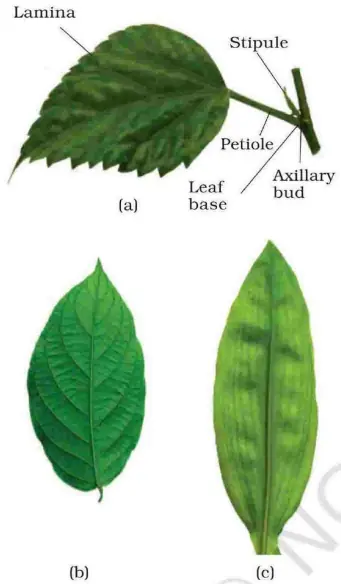
- Three parts of a typical leaf: the leaf base, petiole (stalk) and lamina (blade).
- The petiole holds the blade in light and lets it flutter, cooling it and supplying fresh air.
- The lamina is the broad green blade carrying veins, where most food-making happens.
- The central prominent main vein of the lamina is the midrib.
- Venation is the arrangement of veins – reticulate in dicots, parallel in monocots.
Check yourself
The Leaf – Food Factory
- The leaf is a flat green lateral outgrowth of the stem and the main site of photosynthesis.
- Three parts of a typical leaf: the leaf base, petiole (stalk) and lamina (blade).
- The petiole holds the blade in light and lets it flutter, cooling it and supplying fresh air.
- The lamina is the broad green blade carrying veins, where most food-making happens.
- The central prominent main vein of the lamina is the midrib.
- Venation is the arrangement of veins – reticulate in dicots, parallel in monocots.
The leaf is a flat green lateral outgrowth of the stem and the main site of .
The leaf is a flat green lateral outgrowth of the stem and the main site of photosynthesis.
The holds the blade in light and lets it flutter, cooling it and supplying fresh air.
The petiole holds the blade in light and lets it flutter, cooling it and supplying fresh air.
The is the broad green blade carrying veins, where most food-making happens.
The lamina is the broad green blade carrying veins, where most food-making happens.
The central prominent main vein of the lamina is the .
The central prominent main vein of the lamina is the midrib.
is the arrangement of veins – reticulate in dicots, parallel in monocots.
Venation is the arrangement of veins – reticulate in dicots, parallel in monocots.
True vs False Fruits & Plant Products
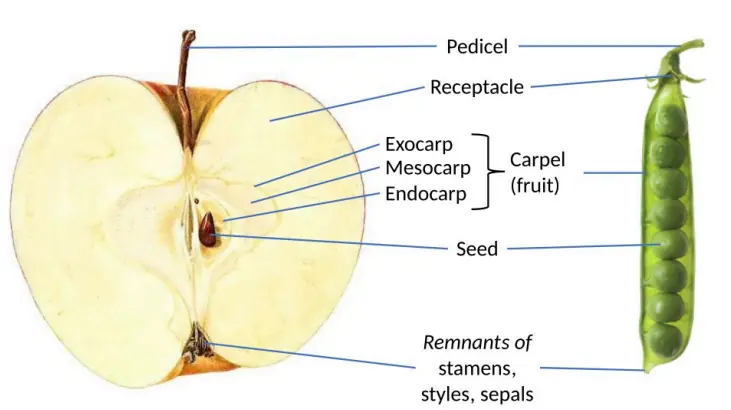
- A true fruit develops only from the ovary after fertilisation (mango, tomato).
- A false fruit develops from a part other than the ovary, like the thalamus – apple, pear, cashew.
- Clove is a spice obtained from the dried flower bud of the clove plant.
- Quinine, an anti-malarial drug, is obtained from the bark of the Cinchona plant.
- Tapa cloth is made from the bark of plants of the mulberry family (Moraceae).
- Plants give us food, fodder, fuel, fibre and medicine from various parts.
| Product | Source plant | Plant part |
|---|---|---|
| Clove | Clove tree | Flower bud |
| Quinine | Cinchona | Bark |
| Saffron | Crocus | Stigma |
| Tapa cloth | Mulberry (Moraceae) | Bark |
Check yourself
True vs False Fruits & Plant Products
- A true fruit develops only from the ovary after fertilisation (mango, tomato).
- A false fruit develops from a part other than the ovary, like the thalamus – apple, pear, cashew.
- Clove is a spice obtained from the dried flower bud of the clove plant.
- Quinine, an anti-malarial drug, is obtained from the bark of the Cinchona plant.
- Tapa cloth is made from the bark of plants of the mulberry family (Moraceae).
- Plants give us food, fodder, fuel, fibre and medicine from various parts.
- Clove — Clove tree — Flower bud
- Quinine — Cinchona — Bark
- Saffron — Crocus — Stigma
- Tapa cloth — Mulberry (Moraceae) — Bark
A develops only from the ovary after fertilisation (mango, tomato).
A true fruit develops only from the ovary after fertilisation (mango, tomato).
A develops from a part other than the ovary, like the thalamus – apple, pear, cashew.
A false fruit develops from a part other than the ovary, like the thalamus – apple, pear, cashew.
is a spice obtained from the dried flower bud of the clove plant.
Clove is a spice obtained from the dried flower bud of the clove plant.
, an anti-malarial drug, is obtained from the bark of the Cinchona plant.
Quinine, an anti-malarial drug, is obtained from the bark of the Cinchona plant.
is made from the bark of plants of the mulberry family (Moraceae).
Tapa cloth is made from the bark of plants of the mulberry family (Moraceae).
Fungi, Lichens & Spore-formers
- Fungi lack chlorophyll, so they cannot make their own food and are heterotrophic.
- Fungi reproduce by spore formation, as do bacteria, algae, ferns and mosses.
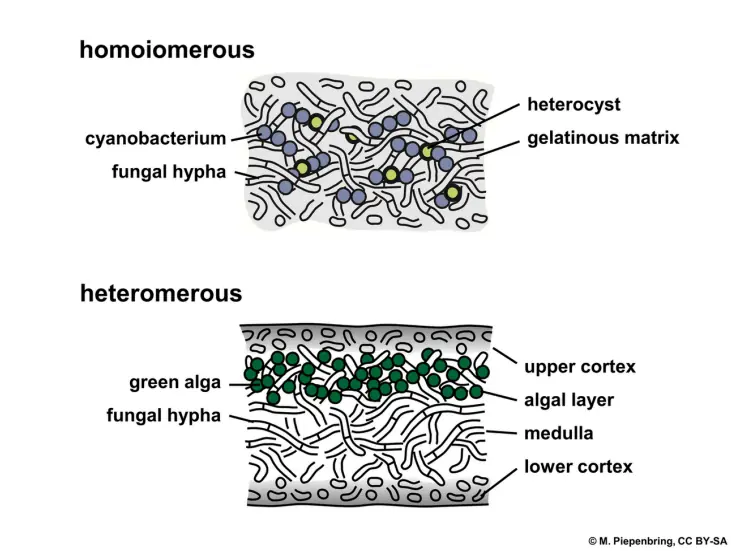
- A lichen is a symbiosis of a chlorophyll-containing alga with a fungus.
- In a lichen the alga makes food while the fungus gives shelter, water and minerals.
- Lichens are sensitive indicators of air pollution and do not grow in polluted air.
Carl Linnaeus
Check yourself
Fungi, Lichens & Spore-formers
- Fungi lack chlorophyll, so they cannot make their own food and are heterotrophic.
- Fungi reproduce by spore formation, as do bacteria, algae, ferns and mosses.
- A lichen is a symbiosis of a chlorophyll-containing alga with a fungus.
- In a lichen the alga makes food while the fungus gives shelter, water and minerals.
- Lichens are sensitive indicators of air pollution and do not grow in polluted air.
- Carl Linnaeus / vascular tissue: A. W. Eichler and others used vascular tissue features to classify plants.
lack chlorophyll, so they cannot make their own food and are heterotrophic.
Fungi lack chlorophyll, so they cannot make their own food and are heterotrophic.
Fungi reproduce by , as do bacteria, algae, ferns and mosses.
Fungi reproduce by spore formation, as do bacteria, algae, ferns and mosses.
A is a symbiosis of a chlorophyll-containing alga with a fungus.
A lichen is a symbiosis of a chlorophyll-containing alga with a fungus.
In a lichen the while the fungus gives shelter, water and minerals.
In a lichen the alga makes food while the fungus gives shelter, water and minerals.
Lichens are sensitive and do not grow in polluted air.
Lichens are sensitive indicators of air pollution and do not grow in polluted air.
: A. W. Eichler and others used vascular tissue features to classify plants.
Carl Linnaeus / vascular tissue: A. W. Eichler and others used vascular tissue features to classify plants.
Insectivorous Plants & Special Adaptations
- Insectivorous plants trap and digest insects to get nitrogen from nitrogen-poor soils.
- Examples include Pitcher plant (Nepenthes), Venus flytrap, Drosera (sundew) and Utricularia.
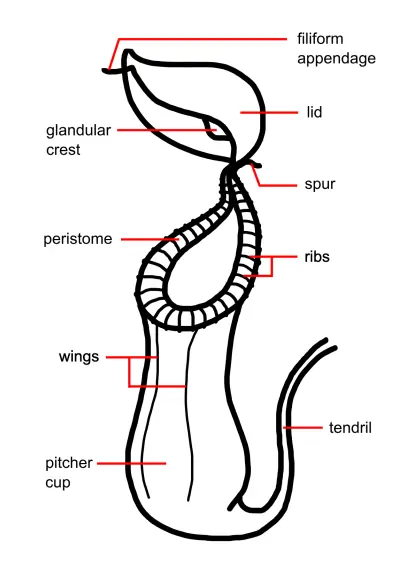
- The pitcher plant has a modified leaf shaped like a jug to trap insects.
- These plants are still green and photosynthetic – they only supplement nitrogen by eating insects.
- Parasitic plants like Cuscuta (dodder) take food from a host plant instead.
- Such traps are examples of leaf modification for special functions.
Check yourself
Insectivorous Plants & Special Adaptations
- Insectivorous plants trap and digest insects to get nitrogen from nitrogen-poor soils.
- Examples include Pitcher plant (Nepenthes), Venus flytrap, Drosera (sundew) and Utricularia.
- The pitcher plant has a modified leaf shaped like a jug to trap insects.
- These plants are still green and photosynthetic – they only supplement nitrogen by eating insects.
- Parasitic plants like Cuscuta (dodder) take food from a host plant instead.
- Such traps are examples of leaf modification for special functions.
trap and digest insects to get nitrogen from nitrogen-poor soils.
Insectivorous plants trap and digest insects to get nitrogen from nitrogen-poor soils.
The has a modified leaf shaped like a jug to trap insects.
The pitcher plant has a modified leaf shaped like a jug to trap insects.
These plants are still – they only supplement nitrogen by eating insects.
These plants are still green and photosynthetic – they only supplement nitrogen by eating insects.
like Cuscuta (dodder) take food from a host plant instead.
Parasitic plants like Cuscuta (dodder) take food from a host plant instead.
Such traps are examples of for special functions.
Such traps are examples of leaf modification for special functions.
All 19 chapters of Biology notes
- Cell: Structure & Function12 sections
- Biomolecules & DNA/RNA11 sections
- Plant Kingdom & Classification11 sections
- Plant Tissues & Anatomy12 sections
- Plant Physiology: Photosynthesis, Respiration & Nutrition14 sections
- Animal Kingdom, Morphology & Classification16 sections
- Nutrition & Digestive System12 sections
- Circulatory System & Body Fluids12 sections
- Respiratory System10 sections
- Excretory System12 sections
- Nervous System & Sense Organs12 sections
- Endocrine System & Hormones14 sections
- Skeletal & Muscular System12 sections
- Reproductive System & Reproductive Health12 sections
- Genetics & Evolution13 sections
- Human Health, Diseases & Immunity16 sections
- Ecology, Ecosystem & Biodiversity12 sections
- Biology in Everyday Life & Applied Biology12 sections
- Inventions, Discoveries & Scientists10 sections