Biology notes · Chapter 12 of 19
Endocrine System & Hormones
14 sections, 80 flashcards. Open a card to check your answer, or revise them in the app with spaced revision.
Two Control Systems of the Body
- The body has two coordination systems that make all organs work together at the right time.
- The nervous system sends fast electrical signals along nerves; the effect is instant but short-lasting.
- The endocrine system sends slow chemical signals through the blood; the effect is delayed but long-lasting and reaches distant organs.
- A useful analogy: nervous = phone call (instant, ends at once); endocrine = letter (slow, travels far, lasts long).
- Exam point: nervous = fast and short; endocrine = slow but long-lasting.
| Feature | Nervous | Endocrine |
|---|---|---|
| Signal | Electrical | Chemical (hormone) |
| Pathway | Nerves | Blood |
| Speed | Fast | Slow |
| Effect | Short-lasting | Long-lasting |
Check yourself
Two Control Systems of the Body
- The body has two coordination systems that make all organs work together at the right time.
- The nervous system sends fast electrical signals along nerves; the effect is instant but short-lasting.
- The endocrine system sends slow chemical signals through the blood; the effect is delayed but long-lasting and reaches distant organs.
- A useful analogy: nervous = phone call (instant, ends at once); endocrine = letter (slow, travels far, lasts long).
- Exam point: nervous = fast and short; endocrine = slow but long-lasting.
- Signal — Electrical — Chemical (hormone)
- Pathway — Nerves — Blood
- Speed — Fast — Slow
- Effect — Short-lasting — Long-lasting
The body has that make all organs work together at the right time.
The body has two coordination systems that make all organs work together at the right time.
The sends fast electrical signals along nerves; the effect is instant but short-lasting.
The nervous system sends fast electrical signals along nerves; the effect is instant but short-lasting.
The sends slow chemical signals through the blood; the effect is delayed but long-lasting and reaches distant organs.
The endocrine system sends slow chemical signals through the blood; the effect is delayed but long-lasting and reaches distant organs.
A useful analogy: nervous = (instant, ends at once); endocrine = (slow, travels far, lasts long).
A useful analogy: nervous = phone call (instant, ends at once); endocrine = letter (slow, travels far, lasts long).
Exam point: nervous = ; endocrine = .
Exam point: nervous = fast and short; endocrine = slow but long-lasting.
What is a Hormone?
- NCERT defines a hormone as a non-nutrient chemical that acts as an inter-cellular messenger.
- Hormones are produced in trace (tiny) amounts, yet are extremely powerful.
- "Non-nutrient" means a hormone is not food and gives no energy - it only carries an instruction.
- A hormone acts only on its target organ or target cells, which have matching receptors.
- Hormones are poured directly into the blood, which carries them throughout the body.
Check yourself
What is a Hormone?
- NCERT defines a hormone as a non-nutrient chemical that acts as an inter-cellular messenger.
- Hormones are produced in trace (tiny) amounts, yet are extremely powerful.
- "Non-nutrient" means a hormone is not food and gives no energy - it only carries an instruction.
- A hormone acts only on its target organ or target cells, which have matching receptors.
- Hormones are poured directly into the blood, which carries them throughout the body.
NCERT defines a hormone as a that acts as an inter-cellular messenger.
NCERT defines a hormone as a non-nutrient chemical that acts as an inter-cellular messenger.
Hormones are produced in , yet are extremely powerful.
Hormones are produced in trace (tiny) amounts, yet are extremely powerful.
"Non-nutrient" means a hormone is - it only carries an instruction.
"Non-nutrient" means a hormone is not food and gives no energy - it only carries an instruction.
A hormone acts only on its , which have matching receptors.
A hormone acts only on its target organ or target cells, which have matching receptors.
Hormones are , which carries them throughout the body.
Hormones are poured directly into the blood, which carries them throughout the body.
Glands - Exocrine vs Endocrine
- A gland is a cell or organ that makes and releases a useful substance (a secretion).
- Exocrine glands release products through tubes called ducts (e.g. salivary, sweat, oil, mammary, tear glands).
- Endocrine glands have no ducts; they are ductless glands that pour hormones directly into blood.
- Memory hook: Exo = exit through a tube; Endo = enters the blood directly.
- The pancreas is a composite (mixed) gland - exocrine part makes digestive juice, endocrine part makes insulin and glucagon.
| Feature | Exocrine | Endocrine |
|---|---|---|
| Duct | Has ducts | Ductless |
| Releases into | Surface/cavity | Blood |
| Product | Enzymes, sweat, milk | Hormones |
| Example | Salivary gland | Thyroid gland |
Check yourself
Glands - Exocrine vs Endocrine
- A gland is a cell or organ that makes and releases a useful substance (a secretion).
- Exocrine glands release products through tubes called ducts (e.g. salivary, sweat, oil, mammary, tear glands).
- Endocrine glands have no ducts; they are ductless glands that pour hormones directly into blood.
- Memory hook: Exo = exit through a tube; Endo = enters the blood directly.
- The pancreas is a composite (mixed) gland - exocrine part makes digestive juice, endocrine part makes insulin and glucagon.
- Duct — Has ducts — Ductless
- Releases into — Surface/cavity — Blood
- Product — Enzymes, sweat, milk — Hormones
- Example — Salivary gland — Thyroid gland
A is a cell or organ that makes and releases a useful substance (a secretion).
A gland is a cell or organ that makes and releases a useful substance (a secretion).
release products through tubes called (e.g. salivary, sweat, oil, mammary, tear glands).
Exocrine glands release products through tubes called ducts (e.g. salivary, sweat, oil, mammary, tear glands).
have no ducts; they are that pour hormones directly into blood.
Endocrine glands have no ducts; they are ductless glands that pour hormones directly into blood.
The - exocrine part makes digestive juice, endocrine part makes insulin and glucagon.
The pancreas is a composite (mixed) gland - exocrine part makes digestive juice, endocrine part makes insulin and glucagon.
Hypothalamus - Top Control Centre
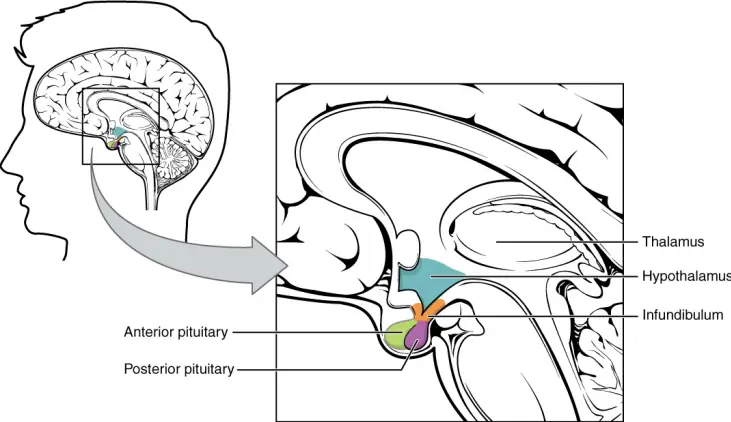
- The hypothalamus is a small region at the base of the brain that links the brain to the endocrine system.
- It regulates body temperature, hunger, thirst, sleep and emotions.
- It directly controls the pituitary gland using releasing and inhibiting hormones.
- Releasing hormones tell the pituitary to secrete; inhibiting hormones tell it to stop.
- Example: GnRH stimulates release of gonadotrophins; somatostatin inhibits growth hormone.
Check yourself
Hypothalamus - Top Control Centre
- The hypothalamus is a small region at the base of the brain that links the brain to the endocrine system.
- It regulates body temperature, hunger, thirst, sleep and emotions.
- It directly controls the pituitary gland using releasing and inhibiting hormones.
- Releasing hormones tell the pituitary to secrete; inhibiting hormones tell it to stop.
- Example: GnRH stimulates release of gonadotrophins; somatostatin inhibits growth hormone.
The is a small region at the base of the brain that links the brain to the endocrine system.
The hypothalamus is a small region at the base of the brain that links the brain to the endocrine system.
It directly controls the using releasing and inhibiting hormones.
It directly controls the pituitary gland using releasing and inhibiting hormones.
tell the pituitary to secrete; tell it to stop.
Releasing hormones tell the pituitary to secrete; inhibiting hormones tell it to stop.
Example: stimulates release of gonadotrophins; inhibits growth hormone.
Example: GnRH stimulates release of gonadotrophins; somatostatin inhibits growth hormone.
Pituitary Gland - The Master Gland
- The pituitary is a pea-sized gland sitting in a bony pocket called the sella turcica, located in the brain.
- It is called the master gland because its hormones control many other endocrine glands.
- It has two parts: anterior (adenohypophysis) and posterior (neurohypophysis).
- The anterior pituitary makes six hormones: GH, PRL, TSH, ACTH, LH and FSH.
- The posterior pituitary makes nothing itself - it only stores and releases oxytocin and vasopressin (ADH).
- Pars intermedia makes MSH (controls skin pigment); in humans it is nearly merged with the anterior part.
Check yourself
Pituitary Gland - The Master Gland
- The pituitary is a pea-sized gland sitting in a bony pocket called the sella turcica, located in the brain.
- It is called the master gland because its hormones control many other endocrine glands.
- It has two parts: anterior (adenohypophysis) and posterior (neurohypophysis).
- The anterior pituitary makes six hormones: GH, PRL, TSH, ACTH, LH and FSH.
- The posterior pituitary makes nothing itself - it only stores and releases oxytocin and vasopressin (ADH).
- Pars intermedia makes MSH (controls skin pigment); in humans it is nearly merged with the anterior part.
The is a pea-sized gland sitting in a bony pocket called the , located in the brain.
The pituitary is a pea-sized gland sitting in a bony pocket called the sella turcica, located in the brain.
It is called the because its hormones control many other endocrine glands.
It is called the master gland because its hormones control many other endocrine glands.
It has two parts: and .
It has two parts: anterior (adenohypophysis) and posterior (neurohypophysis).
The - it only stores and releases oxytocin and vasopressin (ADH).
The posterior pituitary makes nothing itself - it only stores and releases oxytocin and vasopressin (ADH).
makes MSH (controls skin pigment); in humans it is nearly merged with the anterior part.
Pars intermedia makes MSH (controls skin pigment); in humans it is nearly merged with the anterior part.
Anterior Pituitary Hormones
- GH (Growth Hormone) controls growth of body tissues.
- Too much GH in children causes gigantism; too little causes pituitary dwarfism.
- Excess GH in an adult causes acromegaly (enlarged face, jaw and hands).
- TSH tells the thyroid to make thyroxine; ACTH tells the adrenal cortex to make glucocorticoids.
- LH and FSH (gonadotrophins) control the gonads - sperm/androgens in males, ovulation/follicle growth in females.
- PRL (Prolactin) develops mammary glands and triggers milk formation.
| Hormone | Main function |
|---|---|
| GH | Body growth |
| PRL | Milk formation |
| TSH | Stimulates thyroid |
| ACTH | Stimulates adrenal cortex |
| LH/FSH | Control gonads |
Check yourself
Anterior Pituitary Hormones
- GH (Growth Hormone) controls growth of body tissues.
- Too much GH in children causes gigantism; too little causes pituitary dwarfism.
- Excess GH in an adult causes acromegaly (enlarged face, jaw and hands).
- TSH tells the thyroid to make thyroxine; ACTH tells the adrenal cortex to make glucocorticoids.
- LH and FSH (gonadotrophins) control the gonads - sperm/androgens in males, ovulation/follicle growth in females.
- PRL (Prolactin) develops mammary glands and triggers milk formation.
- GH — Body growth
- PRL — Milk formation
- TSH — Stimulates thyroid
- ACTH — Stimulates adrenal cortex
- LH/FSH — Control gonads
controls growth of body tissues.
GH (Growth Hormone) controls growth of body tissues.
Too much GH in children causes ; too little causes .
Too much GH in children causes gigantism; too little causes pituitary dwarfism.
Excess GH in an adult causes (enlarged face, jaw and hands).
Excess GH in an adult causes acromegaly (enlarged face, jaw and hands).
tells the thyroid to make thyroxine; tells the adrenal cortex to make glucocorticoids.
TSH tells the thyroid to make thyroxine; ACTH tells the adrenal cortex to make glucocorticoids.
control the gonads - sperm/androgens in males, ovulation/follicle growth in females.
LH and FSH (gonadotrophins) control the gonads - sperm/androgens in males, ovulation/follicle growth in females.
develops mammary glands and triggers milk formation.
PRL (Prolactin) develops mammary glands and triggers milk formation.
Posterior Pituitary Hormones
- Both hormones are actually made by the hypothalamus and only stored here.
- Oxytocin causes uterine contraction during birth and milk ejection.
- Vasopressin / ADH makes the kidney reabsorb water, so it is anti-diuretic.
- Shortage of ADH causes diabetes insipidus (excess dilute urine).
- Memory aid: oxytocin = birth and milk; ADH = saves water.
Check yourself
Posterior Pituitary Hormones
- Both hormones are actually made by the hypothalamus and only stored here.
- Oxytocin causes uterine contraction during birth and milk ejection.
- Vasopressin / ADH makes the kidney reabsorb water, so it is anti-diuretic.
- Shortage of ADH causes diabetes insipidus (excess dilute urine).
- Memory aid: oxytocin = birth and milk; ADH = saves water.
Both hormones are actually and only stored here.
Both hormones are actually made by the hypothalamus and only stored here.
causes uterine contraction during birth and milk ejection.
Oxytocin causes uterine contraction during birth and milk ejection.
makes the kidney reabsorb water, so it is .
Vasopressin / ADH makes the kidney reabsorb water, so it is anti-diuretic.
Shortage of ADH causes (excess dilute urine).
Shortage of ADH causes diabetes insipidus (excess dilute urine).
Pineal Gland
- The pineal gland is a tiny gland located in the brain.
- It secretes the hormone melatonin.
- Melatonin regulates the body's 24-hour (diurnal) rhythms like the sleep-wake cycle.
- It is often called the sleep hormone because it rises in darkness and falls in daylight.
- Think of it as the body's internal clock-keeper.
Check yourself
Pineal Gland
- The pineal gland is a tiny gland located in the brain.
- It secretes the hormone melatonin.
- Melatonin regulates the body's 24-hour (diurnal) rhythms like the sleep-wake cycle.
- It is often called the sleep hormone because it rises in darkness and falls in daylight.
- Think of it as the body's internal clock-keeper.
The is a tiny gland located in the brain.
The pineal gland is a tiny gland located in the brain.
It secretes the hormone .
It secretes the hormone melatonin.
Melatonin regulates the body's like the sleep-wake cycle.
Melatonin regulates the body's 24-hour (diurnal) rhythms like the sleep-wake cycle.
It is often called the because it rises in darkness and falls in daylight.
It is often called the sleep hormone because it rises in darkness and falls in daylight.
Thyroid Gland
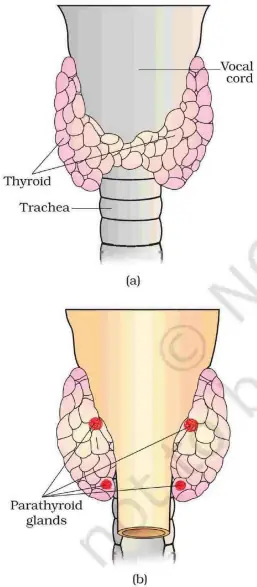
- The thyroid is a butterfly-shaped gland with two lobes beside the trachea, joined by the isthmus.
- It makes thyroxine (T4) and triiodothyronine (T3), both of which need the element iodine.
- These hormones control the Basal Metabolic Rate (BMR) and support red blood cell formation.
- Iodine deficiency causes hypothyroidism and goitre (swollen neck) - reason we use iodised salt.
- Too little thyroid hormone in a baby causes cretinism (stunted growth, low IQ).
- The thyroid also makes thyrocalcitonin (TCT), which lowers blood calcium.
| Disorder | Cause |
|---|---|
| Goitre | Iodine deficiency (hypothyroid) |
| Cretinism | Low thyroid in infants |
| Hyperthyroidism | Excess thyroid hormone |
Check yourself
Thyroid Gland
- The thyroid is a butterfly-shaped gland with two lobes beside the trachea, joined by the isthmus.
- It makes thyroxine (T4) and triiodothyronine (T3), both of which need the element iodine.
- These hormones control the Basal Metabolic Rate (BMR) and support red blood cell formation.
- Iodine deficiency causes hypothyroidism and goitre (swollen neck) - reason we use iodised salt.
- Too little thyroid hormone in a baby causes cretinism (stunted growth, low IQ).
- The thyroid also makes thyrocalcitonin (TCT), which lowers blood calcium.
- Goitre — Iodine deficiency (hypothyroid)
- Cretinism — Low thyroid in infants
- Hyperthyroidism — Excess thyroid hormone
The is a butterfly-shaped gland with two lobes beside the trachea, joined by the .
The thyroid is a butterfly-shaped gland with two lobes beside the trachea, joined by the isthmus.
It makes thyroxine (T4) and triiodothyronine (T3), both of which need the element .
It makes thyroxine (T4) and triiodothyronine (T3), both of which need the element iodine.
These hormones control the and support red blood cell formation.
These hormones control the Basal Metabolic Rate (BMR) and support red blood cell formation.
Iodine deficiency causes (swollen neck) - reason we use iodised salt.
Iodine deficiency causes hypothyroidism and goitre (swollen neck) - reason we use iodised salt.
Too little thyroid hormone in a baby causes (stunted growth, low IQ).
Too little thyroid hormone in a baby causes cretinism (stunted growth, low IQ).
The thyroid also makes , which lowers blood calcium.
The thyroid also makes thyrocalcitonin (TCT), which lowers blood calcium.
Parathyroid Gland & Calcium Balance
- There are four parathyroid glands, embedded on the back of the thyroid lobes.
- They secrete parathyroid hormone (PTH), a peptide hormone.
- PTH raises blood calcium (Ca2+), doing the opposite of thyrocalcitonin (TCT).
- Memory aid: PTH pushes calcium UP; TCT brings it DOWN.
- Together they keep blood calcium steady - called calcium homeostasis.
- Calcium is needed for bones, muscle contraction, nerve signals and blood clotting.
| Hormone | Effect on Ca2+ |
|---|---|
| PTH | Raises (UP) |
| TCT (Calcitonin) | Lowers (DOWN) |
Check yourself
Parathyroid Gland & Calcium Balance
- There are four parathyroid glands, embedded on the back of the thyroid lobes.
- They secrete parathyroid hormone (PTH), a peptide hormone.
- PTH raises blood calcium (Ca2+), doing the opposite of thyrocalcitonin (TCT).
- Memory aid: PTH pushes calcium UP; TCT brings it DOWN.
- Together they keep blood calcium steady - called calcium homeostasis.
- Calcium is needed for bones, muscle contraction, nerve signals and blood clotting.
- PTH — Raises (UP)
- TCT (Calcitonin) — Lowers (DOWN)
There are , embedded on the back of the thyroid lobes.
There are four parathyroid glands, embedded on the back of the thyroid lobes.
PTH , doing the opposite of thyrocalcitonin (TCT).
PTH raises blood calcium (Ca2+), doing the opposite of thyrocalcitonin (TCT).
Together they keep blood calcium steady - called .
Together they keep blood calcium steady - called calcium homeostasis.
Thymus & Adrenal Glands
- The thymus lies in the chest behind the breastbone and secretes thymosin, which develops immunity (T-cells).
- The adrenal glands sit on top of each kidney and have two parts: cortex and medulla.
- The adrenal medulla secretes adrenaline and noradrenaline - the emergency "fight-or-flight" hormones.
- Adrenaline raises heart rate, blood pressure and blood glucose during stress or fear.
- The adrenal cortex secretes glucocorticoids (e.g. cortisol) and mineralocorticoids (e.g. aldosterone).
- Aldosterone controls salt and water balance; cortisol manages stress and metabolism.
| Part | Hormone | Role |
|---|---|---|
| Medulla | Adrenaline | Fight-or-flight |
| Cortex | Cortisol | Stress/metabolism |
| Cortex | Aldosterone | Salt-water balance |
Check yourself
Thymus & Adrenal Glands
- The thymus lies in the chest behind the breastbone and secretes thymosin, which develops immunity (T-cells).
- The adrenal glands sit on top of each kidney and have two parts: cortex and medulla.
- The adrenal medulla secretes adrenaline and noradrenaline - the emergency "fight-or-flight" hormones.
- Adrenaline raises heart rate, blood pressure and blood glucose during stress or fear.
- The adrenal cortex secretes glucocorticoids (e.g. cortisol) and mineralocorticoids (e.g. aldosterone).
- Aldosterone controls salt and water balance; cortisol manages stress and metabolism.
- Medulla — Adrenaline — Fight-or-flight
- Cortex — Cortisol — Stress/metabolism
- Cortex — Aldosterone — Salt-water balance
The lies in the chest behind the breastbone and secretes , which develops immunity (T-cells).
The thymus lies in the chest behind the breastbone and secretes thymosin, which develops immunity (T-cells).
The sit on top of each kidney and have two parts: cortex and medulla.
The adrenal glands sit on top of each kidney and have two parts: cortex and medulla.
The secretes - the emergency "fight-or-flight" hormones.
The adrenal medulla secretes adrenaline and noradrenaline - the emergency "fight-or-flight" hormones.
The secretes glucocorticoids (e.g. cortisol) and mineralocorticoids (e.g. aldosterone).
The adrenal cortex secretes glucocorticoids (e.g. cortisol) and mineralocorticoids (e.g. aldosterone).
Aldosterone controls ; cortisol manages stress and metabolism.
Aldosterone controls salt and water balance; cortisol manages stress and metabolism.
Pancreas - Islets of Langerhans
- The endocrine part of the pancreas is the Islets of Langerhans.
- Beta cells secrete insulin, which lowers blood glucose by helping cells absorb it.
- Alpha cells secrete glucagon, which raises blood glucose.
- Insulin and glucagon together maintain blood sugar homeostasis.
- Lack of insulin causes diabetes mellitus (high blood glucose, sugar in urine).
- Blood glucose is commonly expressed in mg/dL (milligrams per decilitre); normal fasting is about 70- 110 mg/dL.
| Cell | Hormone | Effect on glucose |
|---|---|---|
| Beta cell | Insulin | Lowers |
| Alpha cell | Glucagon | Raises |
Check yourself
Pancreas - Islets of Langerhans
- The endocrine part of the pancreas is the Islets of Langerhans.
- Beta cells secrete insulin, which lowers blood glucose by helping cells absorb it.
- Alpha cells secrete glucagon, which raises blood glucose.
- Insulin and glucagon together maintain blood sugar homeostasis.
- Lack of insulin causes diabetes mellitus (high blood glucose, sugar in urine).
- Blood glucose is commonly expressed in mg/dL (milligrams per decilitre); normal fasting is about 70- 110 mg/dL.
- Beta cell — Insulin — Lowers
- Alpha cell — Glucagon — Raises
The endocrine part of the pancreas is the .
The endocrine part of the pancreas is the Islets of Langerhans.
secrete , which lowers blood glucose by helping cells absorb it.
Beta cells secrete insulin, which lowers blood glucose by helping cells absorb it.
secrete , which raises blood glucose.
Alpha cells secrete glucagon, which raises blood glucose.
Insulin and glucagon together maintain .
Insulin and glucagon together maintain blood sugar homeostasis.
Lack of insulin causes (high blood glucose, sugar in urine).
Lack of insulin causes diabetes mellitus (high blood glucose, sugar in urine).
Blood glucose is commonly expressed in ; normal fasting is about 70- 110 mg/dL.
Blood glucose is commonly expressed in mg/dL (milligrams per decilitre); normal fasting is about 70- 110 mg/dL.
Gonads - Sex Hormones
- The testes (in males) secrete testosterone, the main male sex hormone (androgen).
- Testosterone controls male secondary characters like beard, deep voice and sperm production.
- The ovaries (in females) secrete estrogen and progesterone.
- Estrogen develops female secondary characters; progesterone maintains pregnancy.
- After menopause, the ovaries stop producing estrogen and progesterone.
- Gonads are controlled by the pituitary gonadotrophins LH and FSH.
| Gland | Hormone | Type |
|---|---|---|
| Testes | Testosterone | Male |
| Ovaries | Estrogen | Female |
| Ovaries | Progesterone | Female |
Check yourself
Gonads - Sex Hormones
- The testes (in males) secrete testosterone, the main male sex hormone (androgen).
- Testosterone controls male secondary characters like beard, deep voice and sperm production.
- The ovaries (in females) secrete estrogen and progesterone.
- Estrogen develops female secondary characters; progesterone maintains pregnancy.
- After menopause, the ovaries stop producing estrogen and progesterone.
- Gonads are controlled by the pituitary gonadotrophins LH and FSH.
- Testes — Testosterone — Male
- Ovaries — Estrogen — Female
- Ovaries — Progesterone — Female
The secrete , the main male sex hormone (androgen).
The testes (in males) secrete testosterone, the main male sex hormone (androgen).
The ovaries (in females) secrete .
The ovaries (in females) secrete estrogen and progesterone.
develops female secondary characters; maintains pregnancy.
Estrogen develops female secondary characters; progesterone maintains pregnancy.
After , the ovaries stop producing .
After menopause, the ovaries stop producing estrogen and progesterone.
Gonads are controlled by the pituitary gonadotrophins .
Gonads are controlled by the pituitary gonadotrophins LH and FSH.
Hormonal Disorders - Quick Revision
- Diabetes mellitus - insulin deficiency, high blood sugar (pancreas).
- Goitre / cretinism - iodine/thyroxine deficiency (thyroid).
- Gigantism, dwarfism, acromegaly - growth hormone imbalance (pituitary).
- Diabetes insipidus - ADH deficiency (posterior pituitary).
- Tetany - low calcium from low PTH (parathyroid).
| Disorder | Hormone/Gland |
|---|---|
| Diabetes mellitus | Insulin / Pancreas |
| Goitre | Thyroxine / Thyroid |
| Gigantism | GH / Pituitary |
| Diabetes insipidus | ADH / Pituitary |
| Tetany | PTH / Parathyroid |
Check yourself
Hormonal Disorders - Quick Revision
- Diabetes mellitus - insulin deficiency, high blood sugar (pancreas).
- Goitre / cretinism - iodine/thyroxine deficiency (thyroid).
- Gigantism, dwarfism, acromegaly - growth hormone imbalance (pituitary).
- Diabetes insipidus - ADH deficiency (posterior pituitary).
- Tetany - low calcium from low PTH (parathyroid).
- Diabetes mellitus — Insulin / Pancreas
- Goitre — Thyroxine / Thyroid
- Gigantism — GH / Pituitary
- Diabetes insipidus — ADH / Pituitary
- Tetany — PTH / Parathyroid
- insulin deficiency, high blood sugar (pancreas).
Diabetes mellitus - insulin deficiency, high blood sugar (pancreas).
- iodine/thyroxine deficiency (thyroid).
Goitre / cretinism - iodine/thyroxine deficiency (thyroid).
- ADH deficiency (posterior pituitary).
Diabetes insipidus - ADH deficiency (posterior pituitary).
- low calcium from low PTH (parathyroid).
Tetany - low calcium from low PTH (parathyroid).
All 19 chapters of Biology notes
- Cell: Structure & Function12 sections
- Biomolecules & DNA/RNA11 sections
- Plant Kingdom & Classification11 sections
- Plant Tissues & Anatomy12 sections
- Plant Physiology: Photosynthesis, Respiration & Nutrition14 sections
- Animal Kingdom, Morphology & Classification16 sections
- Nutrition & Digestive System12 sections
- Circulatory System & Body Fluids12 sections
- Respiratory System10 sections
- Excretory System12 sections
- Nervous System & Sense Organs12 sections
- Endocrine System & Hormones14 sections
- Skeletal & Muscular System12 sections
- Reproductive System & Reproductive Health12 sections
- Genetics & Evolution13 sections
- Human Health, Diseases & Immunity16 sections
- Ecology, Ecosystem & Biodiversity12 sections
- Biology in Everyday Life & Applied Biology12 sections
- Inventions, Discoveries & Scientists10 sections