Biology notes · Chapter 2 of 19
Biomolecules & DNA/RNA
11 sections, 71 flashcards. Open a card to check your answer, or revise them in the app with spaced revision.
What are Biomolecules?
- A biomolecule is any carbon-based chemical made by a living cell.
- Carbon is the backbone of life because each atom forms four bonds and links into long chains.
- Very large biomolecules are called macromolecules ('macro' = large).
- A polymer is a long chain made by joining many small repeating units called monomers.
- NCERT lists only three macromolecules in living systems: proteins, nucleic acids and polysaccharides – all are polymers.
- Lipids (fats) are NOT true macromolecules; they are smaller but separate out with big molecules because they sit in membranes.
- A homopolymer uses one type of monomer repeated; a heteropolymer uses many different monomers.
| Biomolecule | Monomer (building block) |
|---|---|
| Carbohydrate (polysaccharide) | Simple sugars (e.g. glucose) |
| Protein | Amino acids (20 types) |
| Nucleic acid (DNA/RNA) | Nucleotides |
| Lipid (fat) | Fatty acids + glycerol |
Check yourself
What are Biomolecules?
- A biomolecule is any carbon-based chemical made by a living cell.
- Carbon is the backbone of life because each atom forms four bonds and links into long chains.
- Very large biomolecules are called macromolecules ('macro' = large).
- A polymer is a long chain made by joining many small repeating units called monomers.
- NCERT lists only three macromolecules in living systems: proteins, nucleic acids and polysaccharides – all are polymers.
- Lipids (fats) are NOT true macromolecules; they are smaller but separate out with big molecules because they sit in membranes.
- A homopolymer uses one type of monomer repeated; a heteropolymer uses many different monomers.
- Carbohydrate (polysaccharide) — Simple sugars (e.g. glucose)
- Protein — Amino acids (20 types)
- Nucleic acid (DNA/RNA) — Nucleotides
- Lipid (fat) — Fatty acids + glycerol
A is any carbon-based chemical made by a living cell.
A biomolecule is any carbon-based chemical made by a living cell.
is the backbone of life because each atom forms and links into long chains.
Carbon is the backbone of life because each atom forms four bonds and links into long chains.
Very large biomolecules are called ('macro' = large).
Very large biomolecules are called macromolecules ('macro' = large).
A is a long chain made by joining many small repeating units called .
A polymer is a long chain made by joining many small repeating units called monomers.
NCERT lists only in living systems: proteins, nucleic acids and polysaccharides – all are polymers.
NCERT lists only three macromolecules in living systems: proteins, nucleic acids and polysaccharides – all are polymers.
; they are smaller but separate out with big molecules because they sit in membranes.
Lipids (fats) are NOT true macromolecules; they are smaller but separate out with big molecules because they sit in membranes.
A uses one type of monomer repeated; a uses many different monomers.
A homopolymer uses one type of monomer repeated; a heteropolymer uses many different monomers.
Elements in the Living Body
- Living bodies are made mostly of a few major elements with smaller amounts of trace elements.
- The four most abundant elements in the human body are oxygen, carbon, hydrogen and nitrogen.
- Bulk minerals like calcium, potassium and sodium are present in larger amounts than trace metals.
- Iron (Fe) is a trace element but vital – it is the metal at the centre of haemoglobin.
- Copper (Cu) and iron are needed only in tiny (micro) amounts compared to sodium and potassium.
- Increasing order of amount (typical 70 kg man): Copper < Iron < Potassium < Sodium.
| Element | Amount in body |
|---|---|
| Sodium (Na) | Bulk mineral (more) |
| Potassium (K) | Bulk mineral |
| Iron (Fe) | Trace (less) |
| Copper (Cu) | Trace (least) |
Check yourself
Elements in the Living Body
- Living bodies are made mostly of a few major elements with smaller amounts of trace elements.
- The four most abundant elements in the human body are oxygen, carbon, hydrogen and nitrogen.
- Bulk minerals like calcium, potassium and sodium are present in larger amounts than trace metals.
- Iron (Fe) is a trace element but vital – it is the metal at the centre of haemoglobin.
- Copper (Cu) and iron are needed only in tiny (micro) amounts compared to sodium and potassium.
- Increasing order of amount (typical 70 kg man): Copper < Iron < Potassium < Sodium.
- Sodium (Na) — Bulk mineral (more)
- Potassium (K) — Bulk mineral
- Iron (Fe) — Trace (less)
- Copper (Cu) — Trace (least)
Living bodies are made mostly of a few with smaller amounts of trace elements.
Living bodies are made mostly of a few major elements with smaller amounts of trace elements.
The four most abundant elements in the human body are .
The four most abundant elements in the human body are oxygen, carbon, hydrogen and nitrogen.
Bulk minerals like are present in larger amounts than trace metals.
Bulk minerals like calcium, potassium and sodium are present in larger amounts than trace metals.
is a trace element but vital – it is the metal at the centre of .
Iron (Fe) is a trace element but vital – it is the metal at the centre of haemoglobin.
and iron are needed only in tiny (micro) amounts compared to sodium and potassium.
Copper (Cu) and iron are needed only in tiny (micro) amounts compared to sodium and potassium.
Increasing order of amount (typical 70 kg man): .
Increasing order of amount (typical 70 kg man): Copper < Iron < Potassium < Sodium.
Carbohydrates & Polysaccharides
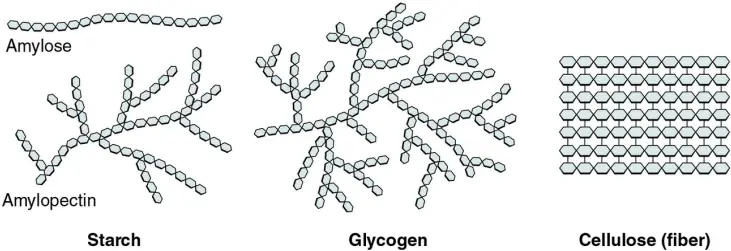
- Carbohydrates are the body's sugars and starches – quick fuel and stored fuel.
- The smallest unit is a simple sugar like glucose; many joined together form a polysaccharide.
- Starch is the storage carbohydrate in plants (e.g. rice, potato).
- Glycogen is the storage carbohydrate in animals (stored in liver and muscle).
- Cellulose is a polysaccharide that builds the tough plant cell wall.
- Chitin forms the exoskeleton of arthropods like insects, crabs and prawns.
| Polysaccharide | Role | Found in |
|---|---|---|
| Starch | Energy store | Plants |
| Glycogen | Energy store | Animals (liver/muscle) |
| Cellulose | Structure | Plant cell wall |
| Chitin | Structure | Arthropod shell |
Check yourself
Carbohydrates & Polysaccharides
- Carbohydrates are the body's sugars and starches – quick fuel and stored fuel.
- The smallest unit is a simple sugar like glucose; many joined together form a polysaccharide.
- Starch is the storage carbohydrate in plants (e.g. rice, potato).
- Glycogen is the storage carbohydrate in animals (stored in liver and muscle).
- Cellulose is a polysaccharide that builds the tough plant cell wall.
- Chitin forms the exoskeleton of arthropods like insects, crabs and prawns.
- Starch — Energy store — Plants
- Glycogen — Energy store — Animals (liver/muscle)
- Cellulose — Structure — Plant cell wall
- Chitin — Structure — Arthropod shell
are the body's sugars and starches – quick fuel and stored fuel.
Carbohydrates are the body's sugars and starches – quick fuel and stored fuel.
The smallest unit is a ; many joined together form a .
The smallest unit is a simple sugar like glucose; many joined together form a polysaccharide.
is the storage carbohydrate in (e.g. rice, potato).
Starch is the storage carbohydrate in plants (e.g. rice, potato).
is the storage carbohydrate in (stored in liver and muscle).
Glycogen is the storage carbohydrate in animals (stored in liver and muscle).
is a polysaccharide that builds the tough .
Cellulose is a polysaccharide that builds the tough plant cell wall.
forms the of arthropods like insects, crabs and prawns.
Chitin forms the exoskeleton of arthropods like insects, crabs and prawns.
Proteins – Workhorses of the Cell
- A protein is a polymer (long chain) of amino acids.
- There are 20 types of amino acids, so a protein is a heteropolymer.
- Their order is like alphabets making words – sequence decides which protein it is.
- The first amino acid is the N-terminal, the last is the Cterminal.
- Collagen is the most abundant protein in the animal world (skin, bone, connective tissue).
- RuBisCO is the most abundant protein in the whole biosphere (works in photosynthesis).
- Biuret test: NaOH + copper sulphate gives a violet/purple colour if protein is present.
Check yourself
Proteins – Workhorses of the Cell
- A protein is a polymer (long chain) of amino acids.
- There are 20 types of amino acids, so a protein is a heteropolymer.
- Their order is like alphabets making words – sequence decides which protein it is.
- The first amino acid is the N-terminal, the last is the Cterminal.
- Collagen is the most abundant protein in the animal world (skin, bone, connective tissue).
- RuBisCO is the most abundant protein in the whole biosphere (works in photosynthesis).
- Biuret test: NaOH + copper sulphate gives a violet/purple colour if protein is present.
A is a polymer (long chain) of .
A protein is a polymer (long chain) of amino acids.
There are , so a protein is a .
There are 20 types of amino acids, so a protein is a heteropolymer.
The first amino acid is the , the last is the .
The first amino acid is the N-terminal, the last is the Cterminal.
is the most abundant protein in the (skin, bone, connective tissue).
Collagen is the most abundant protein in the animal world (skin, bone, connective tissue).
is the most abundant protein in the whole (works in photosynthesis).
RuBisCO is the most abundant protein in the whole biosphere (works in photosynthesis).
: NaOH + copper sulphate gives a if protein is present.
Biuret test: NaOH + copper sulphate gives a violet/purple colour if protein is present.
Essential vs Non-essential Amino Acids
- Essential amino acids cannot be made by the body and must come from the diet.
- Non-essential amino acids can be made by the body itself.
- Protein-rich foods supply essential amino acids: milk, eggs, fish, meat, pulses (dal), soyabean.
- Egg and milk are 'complete' foods because they contain all essential amino acids.
- Examples of amino acids: alanine, cysteine, proline, tryptophan, lysine.
| Type | Source | Example food |
|---|---|---|
| Essential | Diet only | Egg, milk, soyabean |
| Non-essential | Body makes it | Synthesised internally |
Check yourself
Essential vs Non-essential Amino Acids
- Essential amino acids cannot be made by the body and must come from the diet.
- Non-essential amino acids can be made by the body itself.
- Protein-rich foods supply essential amino acids: milk, eggs, fish, meat, pulses (dal), soyabean.
- Egg and milk are 'complete' foods because they contain all essential amino acids.
- Examples of amino acids: alanine, cysteine, proline, tryptophan, lysine.
- Essential — Diet only — Egg, milk, soyabean
- Non-essential — Body makes it — Synthesised internally
cannot be made by the body and must come from the diet.
Essential amino acids cannot be made by the body and must come from the diet.
and milk are 'complete' foods because they contain .
Egg and milk are 'complete' foods because they contain all essential amino acids.
Four Levels of Protein Structure
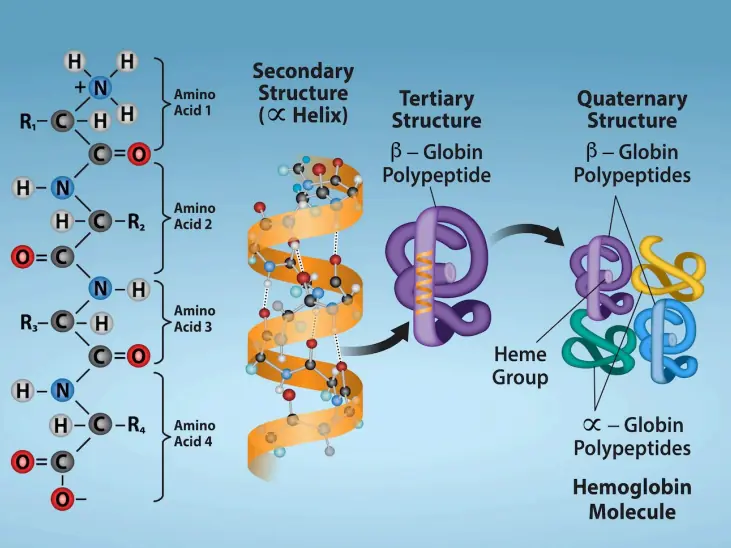
- Primary structure = the exact sequence (order) of amino acids in the chain.
- Secondary structure = the chain coils into a helix or folds into a beta-pleated sheet.
- In proteins only right-handed helices occur.
- Tertiary structure = the whole chain folds like a hollow woollen ball into a 3-D shape.
- Tertiary structure is essential for the biological activity of a protein.
- Quaternary structure = two or more folded chains join into one working unit.
- Haemoglobin (four chains) is the classic example of quaternary structure.
| Level | What it means |
|---|---|
| Primary | Sequence of amino acids |
| Secondary | Helix / beta-sheet |
| Tertiary | Full 3-D folded shape |
| Quaternary | Several chains joined |
Check yourself
Four Levels of Protein Structure
- Primary structure = the exact sequence (order) of amino acids in the chain.
- Secondary structure = the chain coils into a helix or folds into a beta-pleated sheet.
- In proteins only right-handed helices occur.
- Tertiary structure = the whole chain folds like a hollow woollen ball into a 3-D shape.
- Tertiary structure is essential for the biological activity of a protein.
- Quaternary structure = two or more folded chains join into one working unit.
- Haemoglobin (four chains) is the classic example of quaternary structure.
- Primary — Sequence of amino acids
- Secondary — Helix / beta-sheet
- Tertiary — Full 3-D folded shape
- Quaternary — Several chains joined
= the exact sequence (order) of amino acids in the chain.
Primary structure = the exact sequence (order) of amino acids in the chain.
= the chain coils into a or folds into a .
Secondary structure = the chain coils into a helix or folds into a beta-pleated sheet.
= the whole chain folds like a hollow woollen ball into a 3-D shape.
Tertiary structure = the whole chain folds like a hollow woollen ball into a 3-D shape.
= two or more folded chains join into one working unit.
Quaternary structure = two or more folded chains join into one working unit.
(four chains) is the classic example of quaternary structure.
Haemoglobin (four chains) is the classic example of quaternary structure.
Enzymes – Biological Catalysts
- A catalyst speeds up a reaction but is not used up; an enzyme is a biological catalyst.
- Almost all enzymes are proteins; a few RNA enzymes exist, called ribozymes.
- The active site is a pocket where the substrate fits like a key in a lock.
- Enzymes act at the site where they are produced and work at very high speed.
- Most enzymes are denatured (damaged) above ~40°C.
- Exception: thermophilic organisms from hot springs have heat-stable enzymes (stable at 80–90°C).
- Activity depends on temperature, pH and substrate concentration, each with an optimum value.
| Factor | Effect |
|---|---|
| Temperature | Optimum near 40°C; denatures if higher |
| pH | Each enzyme has an optimum pH |
| Substrate conc. | Rate rises then levels off |
Check yourself
Enzymes – Biological Catalysts
- A catalyst speeds up a reaction but is not used up; an enzyme is a biological catalyst.
- Almost all enzymes are proteins; a few RNA enzymes exist, called ribozymes.
- The active site is a pocket where the substrate fits like a key in a lock.
- Enzymes act at the site where they are produced and work at very high speed.
- Most enzymes are denatured (damaged) above ~40°C.
- Exception: thermophilic organisms from hot springs have heat-stable enzymes (stable at 80–90°C).
- Activity depends on temperature, pH and substrate concentration, each with an optimum value.
- Temperature — Optimum near 40°C; denatures if higher
- pH — Each enzyme has an optimum pH
- Substrate conc. — Rate rises then levels off
A speeds up a reaction but is not used up; an is a biological catalyst.
A catalyst speeds up a reaction but is not used up; an enzyme is a biological catalyst.
Almost all enzymes are ; a few RNA enzymes exist, called .
Almost all enzymes are proteins; a few RNA enzymes exist, called ribozymes.
The is a pocket where the fits like a key in a lock.
The active site is a pocket where the substrate fits like a key in a lock.
Enzymes act at the and work at very high speed.
Enzymes act at the site where they are produced and work at very high speed.
Exception: organisms from hot springs have heat-stable enzymes (stable at 80–90°C).
Exception: thermophilic organisms from hot springs have heat-stable enzymes (stable at 80–90°C).
Nucleic Acids – DNA & RNA
- Nucleic acids are the instruction manuals of life that store and pass on genetic information.
- A nucleic acid is a polymer of nucleotides.
- Each nucleotide = a nitrogen base + a sugar + a phosphate group.
- The two nucleic acids are DNA (deoxyribonucleic acid) and RNA (ribonucleic acid).
- DNA stores the master genetic code; RNA helps read the code and make proteins.
- The sugar is deoxyribose in DNA and ribose in RNA.
| Feature | DNA | RNA |
|---|---|---|
| Strands | Double | Single (usually) |
| Sugar | Deoxyribose | Ribose |
| Bases | A, T, G, C | A, U, G, C |
| Role | Stores genes | Makes protein |
Check yourself
Nucleic Acids – DNA & RNA
- Nucleic acids are the instruction manuals of life that store and pass on genetic information.
- A nucleic acid is a polymer of nucleotides.
- Each nucleotide = a nitrogen base + a sugar + a phosphate group.
- The two nucleic acids are DNA (deoxyribonucleic acid) and RNA (ribonucleic acid).
- DNA stores the master genetic code; RNA helps read the code and make proteins.
- The sugar is deoxyribose in DNA and ribose in RNA.
- Strands — Double — Single (usually)
- Sugar — Deoxyribose — Ribose
- Bases — A, T, G, C — A, U, G, C
- Role — Stores genes — Makes protein
are the instruction manuals of life that store and pass on genetic information.
Nucleic acids are the instruction manuals of life that store and pass on genetic information.
Each = a nitrogen base + a sugar + a phosphate group.
Each nucleotide = a nitrogen base + a sugar + a phosphate group.
The two nucleic acids are (deoxyribonucleic acid) and (ribonucleic acid).
The two nucleic acids are DNA (deoxyribonucleic acid) and RNA (ribonucleic acid).
DNA stores the master genetic code; RNA helps .
DNA stores the master genetic code; RNA helps read the code and make proteins.
The sugar is and .
The sugar is deoxyribose in DNA and ribose in RNA.
Nitrogen Bases & Base Pairing
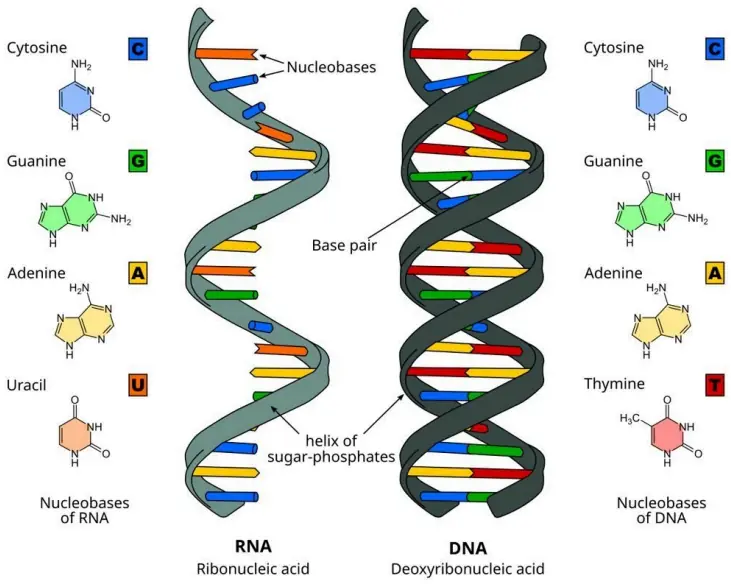
- There are four bases in DNA: Adenine (A), Thymine (T), Guanine (G), Cytosine (C).
- In RNA, Thymine is replaced by Uracil (U).
- Purines are double-ring bases: Adenine and Guanine.
- Pyrimidines are single-ring bases: Cytosine, Thymine, Uracil.
- Base-pairing rule: A pairs with T (A–U in RNA) and G pairs with C.
- Pairs are held by hydrogen bonds across the two strands.
| Class | Bases | Rings |
|---|---|---|
| Purine | Adenine, Guanine | Two |
| Pyrimidine | Cytosine, Thymine, Uracil | One |
Check yourself
Nitrogen Bases & Base Pairing
- There are four bases in DNA: Adenine (A), Thymine (T), Guanine (G), Cytosine (C).
- In RNA, Thymine is replaced by Uracil (U).
- Purines are double-ring bases: Adenine and Guanine.
- Pyrimidines are single-ring bases: Cytosine, Thymine, Uracil.
- Base-pairing rule: A pairs with T (A–U in RNA) and G pairs with C.
- Pairs are held by hydrogen bonds across the two strands.
- Purine — Adenine, Guanine — Two
- Pyrimidine — Cytosine, Thymine, Uracil — One
There are : Adenine (A), Thymine (T), Guanine (G), Cytosine (C).
There are four bases in DNA: Adenine (A), Thymine (T), Guanine (G), Cytosine (C).
are double-ring bases: .
Purines are double-ring bases: Adenine and Guanine.
are single-ring bases: .
Pyrimidines are single-ring bases: Cytosine, Thymine, Uracil.
Base-pairing rule: (A–U in RNA) and .
Base-pairing rule: A pairs with T (A–U in RNA) and G pairs with C.
Pairs are held by across the two strands.
Pairs are held by hydrogen bonds across the two strands.
Structure of DNA & Key Discoveries
- DNA has a double-helix shape – two strands twisted like a spiral ladder.
- Chargaff's rule: amount of A = T and amount of G = C.
- The two strands are antiparallel (run in opposite directions).
- Har Gobind Khorana helped synthesise/decode the genetic code; DNA was first synthesised in vitro by Arthur Kornberg.
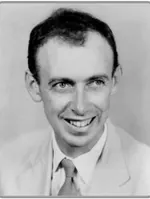
James Watson 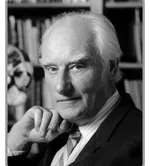
Francis Crick 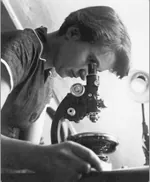
Rosalind Franklin
Check yourself
Structure of DNA & Key Discoveries
- DNA has a double-helix shape – two strands twisted like a spiral ladder.
- Chargaff's rule: amount of A = T and amount of G = C.
- The two strands are antiparallel (run in opposite directions).
- Har Gobind Khorana helped synthesise/decode the genetic code; DNA was first synthesised in vitro by Arthur Kornberg.
- The double-helix model of DNA was proposed by Watson and Crick (1953).
- Their model used the X-ray data of Rosalind Franklin and Maurice Wilkins.
DNA has a shape – two strands twisted like a spiral ladder.
DNA has a double-helix shape – two strands twisted like a spiral ladder.
: amount of A = T and amount of G = C.
Chargaff's rule: amount of A = T and amount of G = C.
The two strands are (run in opposite directions).
The two strands are antiparallel (run in opposite directions).
helped synthesise/decode the genetic code; DNA was first synthesised in vitro by .
Har Gobind Khorana helped synthesise/decode the genetic code; DNA was first synthesised in vitro by Arthur Kornberg.
The was proposed by (1953).
The double-helix model of DNA was proposed by Watson and Crick (1953).
Their model used the X-ray data of and Maurice Wilkins.
Their model used the X-ray data of Rosalind Franklin and Maurice Wilkins.
Types of RNA, Codons & Protein Synthesis
- mRNA = messenger RNA; it carries the code from DNA to the ribosome.
- tRNA = transfer RNA; it brings the correct amino acid to the ribosome.
- rRNA = ribosomal RNA; it forms part of the ribosome (the protein factory).
- A codon is a group of three bases that codes for one amino acid.
- Transcription = DNA copied into mRNA; translation = mRNA read to build protein.
- Stop (non-sense) codons – UAA, UAG, UGA – code for no amino acid and end the chain.
- AUG is the start codon (also codes for methionine).
| RNA type | Function |
|---|---|
| mRNA | Carries genetic message |
| tRNA | Brings amino acids |
| rRNA | Forms the ribosome |
Check yourself
Types of RNA, Codons & Protein Synthesis
- mRNA = messenger RNA; it carries the code from DNA to the ribosome.
- tRNA = transfer RNA; it brings the correct amino acid to the ribosome.
- rRNA = ribosomal RNA; it forms part of the ribosome (the protein factory).
- A codon is a group of three bases that codes for one amino acid.
- Transcription = DNA copied into mRNA; translation = mRNA read to build protein.
- Stop (non-sense) codons – UAA, UAG, UGA – code for no amino acid and end the chain.
- AUG is the start codon (also codes for methionine).
- mRNA — Carries genetic message
- tRNA — Brings amino acids
- rRNA — Forms the ribosome
= messenger RNA; it carries the code from DNA to the ribosome.
mRNA = messenger RNA; it carries the code from DNA to the ribosome.
= transfer RNA; it brings the correct amino acid to the ribosome.
tRNA = transfer RNA; it brings the correct amino acid to the ribosome.
= ribosomal RNA; it forms part of the ribosome (the protein factory).
rRNA = ribosomal RNA; it forms part of the ribosome (the protein factory).
A is a group of that codes for one amino acid.
A codon is a group of three bases that codes for one amino acid.
= DNA copied into mRNA; = mRNA read to build protein.
Transcription = DNA copied into mRNA; translation = mRNA read to build protein.
– UAA, UAG, UGA – code for no amino acid and end the chain.
Stop (non-sense) codons – UAA, UAG, UGA – code for no amino acid and end the chain.
is the start codon (also codes for methionine).
AUG is the start codon (also codes for methionine).
All 19 chapters of Biology notes
- Cell: Structure & Function12 sections
- Biomolecules & DNA/RNA11 sections
- Plant Kingdom & Classification11 sections
- Plant Tissues & Anatomy12 sections
- Plant Physiology: Photosynthesis, Respiration & Nutrition14 sections
- Animal Kingdom, Morphology & Classification16 sections
- Nutrition & Digestive System12 sections
- Circulatory System & Body Fluids12 sections
- Respiratory System10 sections
- Excretory System12 sections
- Nervous System & Sense Organs12 sections
- Endocrine System & Hormones14 sections
- Skeletal & Muscular System12 sections
- Reproductive System & Reproductive Health12 sections
- Genetics & Evolution13 sections
- Human Health, Diseases & Immunity16 sections
- Ecology, Ecosystem & Biodiversity12 sections
- Biology in Everyday Life & Applied Biology12 sections
- Inventions, Discoveries & Scientists10 sections