States change mainly by , which alters particle speed and bonding.
States change mainly by heating or cooling, which alters particle speed and bonding.
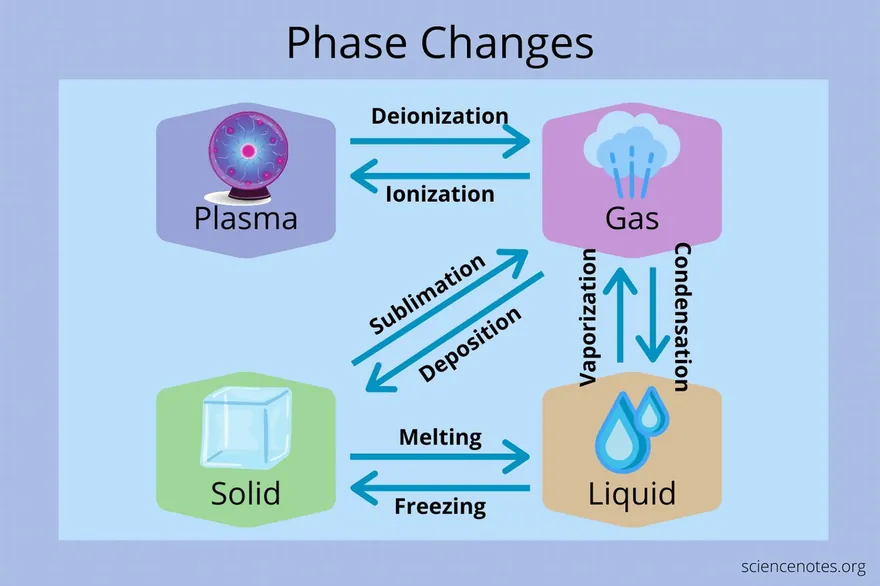
On heating: a solid to liquid, then the liquid boils to gas.
On heating: a solid melts to liquid, then the liquid boils to gas.
On cooling: a gas to liquid, then the liquid freezes to solid.
On cooling: a gas condenses to liquid, then the liquid freezes to solid.
is a solid turning directly into gas without becoming liquid.
Sublimation is a solid turning directly into gas without becoming liquid.
Sublimation examples: balls and dry ice (solid CO2).
Sublimation examples: camphor, naphthalene (moth)balls and dry ice (solid CO2).
is the reverse: gas changing directly into solid.
Deposition is the reverse: gas changing directly into solid.
Change: Melting / Fusion → Direction?
Direction
Solid to Liquid
Change: Freezing → Direction?
Direction
Liquid to Solid
Change: Vaporisation / Boiling → Direction?
Direction
Liquid to Gas
Change: Condensation → Direction?
Direction
Gas to Liquid
Change: Sublimation → Direction?
Direction
Solid to Gas
Change: Deposition → Direction?
Direction
Gas to Solid
What does this diagram show?
Changes of State
Latent Heat (Hidden Heat)
During a change of state the temperature stays constant even while heat is supplied.
This hidden absorbed heat is called latent heat (latent means hidden).
It is used to break bonds between particles, not to raise temperature.
Latent heat of fusion is the heat needed to melt 1 kg of a solid.
Latent heat of vaporisation is the heat needed to turn 1 kg of liquid into vapour.
Steam at 100°C burns worse than boiling water at 100°C because steam releases its extra latent heat on condensing.
Check yourself
What is latent heat?
The hidden heat absorbed during a change of state while the temperature stays constant — it is used to break bonds, not to raise temperature.
Why does steam at 100°C burn worse than boiling water at 100°C?
Steam releases its extra latent heat on condensing, on top of the heat of the water itself.
Latent heat of fusion vs vaporisation?
Fusion: heat needed to melt 1 kg of a solid. Vaporisation: heat needed to turn 1 kg of liquid into vapour.
Evaporation and Cooling
Evaporation is the slow change of liquid to vapour at the surface only.
It occurs at any temperature, which is why wet clothes dry on a cool day.
Only the fastest surface particles escape into the air.
Since energetic particles leave and slower ones stay, evaporation causes cooling.
This is why sweating cools the body and water stays cold in an earthen pot.
Evaporation is faster with higher temperature, more surface area, wind and lower humidity.
Check yourself
It occurs at , which is why wet clothes dry on a cool day.
It occurs at any temperature, which is why wet clothes dry on a cool day.
Only the escape into the air.
Only the fastest surface particles escape into the air.
Since energetic particles leave and slower ones stay, .
Since energetic particles leave and slower ones stay, evaporation causes cooling.
This is why and water stays cold in an earthen pot.
This is why sweating cools the body and water stays cold in an earthen pot.
Vapour Pressure and Boiling
In a closed container vapour builds up until the space is saturated.
The pressure of this trapped vapour on the walls is the vapour pressure.
When evaporation rate equals condensation rate it becomes the equilibrium (saturated) vapour pressure.
Vapour pressure rises as temperature rises, so temperature must always be stated.
Boiling is rapid vaporisation throughout the whole liquid, seen as bubbles.
Boiling occurs when the liquid's vapour pressure equals the external (atmospheric) pressure.
Normal boiling point is at 1 atm; standard boiling point is at 1 bar (slightly lower).
Feature
Evaporation
Boiling
Where
Surface only
Whole liquid
Temperature
Any temp
Fixed boiling point
Speed
Slow
Rapid
Bubbles
No
Yes
Check yourself
What is vapour pressure?
The pressure of trapped vapour on the walls of a closed container. When evaporation rate equals condensation rate it becomes the equilibrium (saturated) vapour pressure; it rises as temperature rises.
When does a liquid boil?
When its vapour pressure equals the external (atmospheric) pressure.
Normal vs standard boiling point?
Normal boiling point is at 1 atm; standard boiling point is at 1 bar, slightly lower.
Evaporation vs boiling — four differences?
Where: surface only vs whole liquid. Temperature: any temperature vs a fixed boiling point. Speed: slow vs rapid. Bubbles: none vs bubbles.
In a closed container vapour builds up until the space is .
In a closed container vapour builds up until the space is saturated.
Feature: Where → Evaporation · Boiling?
Evaporation
Surface only
Boiling
Whole liquid
Feature: Temperature → Evaporation · Boiling?
Evaporation
Any temp
Boiling
Fixed boiling point
Feature: Speed → Evaporation · Boiling?
Evaporation
Slow
Boiling
Rapid
Feature: Bubbles → Evaporation · Boiling?
Evaporation
No
Boiling
Yes
Boiling Point and Pressure
Boiling point depends on the outside pressure.
At high altitudes lower air pressure makes water boil below 100°C, so food cooks slowly.
A pressure cooker traps steam to raise pressure, so water boils hotter and food cooks faster.
Adding salt or sugar (a non-volatile solute) raises the boiling point of water.
Adding salt to water also lowers (depresses) the freezing point.
Check yourself
Why does food cook slowly at high altitudes?
Lower air pressure makes water boil below 100°C, so the food is cooked at a lower temperature.
How does a pressure cooker work?
It traps steam to raise the pressure, so water boils hotter than 100°C and food cooks faster.
What does adding salt do to water?
Raises the boiling point and lowers (depresses) the freezing point — both colligative effects.
Boiling point .
Boiling point depends on the outside pressure.
Temperature and the Kelvin Scale
Every gas law must use the absolute (Kelvin) temperature.
Convert using T (K) = t (°C) + 273.15.
The Kelvin scale starts at the coldest possible temperature, giving no negative values.
Absolute zero is 0 K = -273.15°C, the lowest temperature possible.
Quantity
Symbol
SI Unit
Pressure
P
pascal (Pa)
Volume
V
cubic metre / litre
Temperature
T
kelvin (K)
Amount
n
mole (mol)
Check yourself
How do you convert to the Kelvin scale?
T(K) = t(°C) + 273.15. Every gas law must use the absolute (Kelvin) temperature.
What is absolute zero?
0 K = −273.15°C, the lowest temperature possible. The Kelvin scale starts there, so it gives no negative values.
Quantity: Pressure → Symbol · SI Unit?
Symbol
P
SI Unit
pascal (Pa)
Quantity: Volume → Symbol · SI Unit?
Symbol
V
SI Unit
cubic metre / litre
Quantity: Temperature → Symbol · SI Unit?
Symbol
T
SI Unit
kelvin (K)
Quantity: Amount → Symbol · SI Unit?
Symbol
n
SI Unit
mole (mol)
The Gas Laws
A gas is described by three quantities: pressure (P), volume (V) and temperature (T).
Gay-Lussac's (Pressure) Law: at constant V, pressure is directly proportional to absolute temperature, so P/T = constant.
A constant-temperature P-V curve of a gas is called an isotherm.
Charles found a gas expands by 1/273.15 of its 0°C volume per 1°C rise.
Law
Constant
Relation
Boyle
Temperature
PV = constant
Charles
Pressure
V/T = constant
Gay-Lussac
Volume
P/T = constant
Avogadro
T and P
V proportional to n
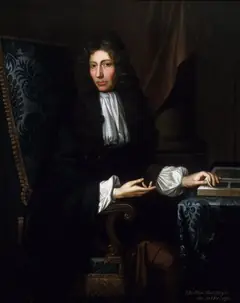
Robert BoyleBoyle's Law (1662): at constant T, volume is inversely proportional to pressure, so PV = constant.
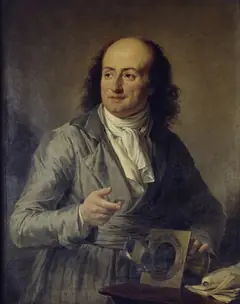
Jacques CharlesCharles's Law (~1787): at constant P, volume is directly proportional to absolute temperature, so V/T = constant.
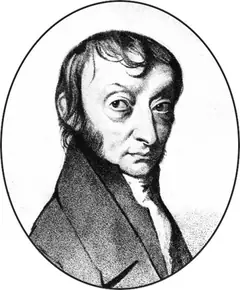
A. AvogadroAvogadro's Law: equal volumes of all gases at the same T and P contain equal numbers of molecules.
Check yourself
State Boyle's Law (1662).
At constant temperature, volume is inversely proportional to pressure: PV = constant.
State Charles's Law (~1787).
At constant pressure, volume is directly proportional to absolute temperature: V/T = constant. A gas expands by 1/273.15 of its 0°C volume per 1°C rise.
State Gay-Lussac's (Pressure) Law.
At constant volume, pressure is directly proportional to absolute temperature: P/T = constant.
State Avogadro's Law.
Equal volumes of all gases at the same temperature and pressure contain an equal number of molecules. Proposed by Amedeo Avogadro (1811).
What is an isotherm?
A constant-temperature P–V curve of a gas.
Law: Boyle → Constant · Relation?
Constant
Temperature
Relation
PV = constant
Law: Charles → Constant · Relation?
Constant
Pressure
Relation
V/T = constant
Law: Gay-Lussac → Constant · Relation?
Constant
Volume
Relation
P/T = constant
Law: Avogadro → Constant · Relation?
Constant
T and P
Relation
V proportional to n
Who is this, and what should you remember about them?
Robert Boyle
Boyle's Law (1662): at constant T, volume is inversely proportional to pressure, so PV = constant.
In the 1660s Robert Boyle described their behaviour: acids turn blue litmus red, bases turn red litmus blue.
Who is this, and what should you remember about them?
Jacques Charles
Charles's Law (~1787): at constant P, volume is directly proportional to absolute temperature, so V/T = constant.
Who is this, and what should you remember about them?
Amedeo Avogadro
Avogadro's Law: equal volumes of all gases at the same T and P contain equal numbers of molecules.
Ideal Gas Equation and STP
Combining all gas laws gives the master equation PV = nRT.
Here R is the universal gas constant and n is the number of moles.
At STP, one mole of any gas occupies a molar volume of about 22.7 litres.
An ideal gas perfectly obeys PV = nRT at all temperatures and pressures.
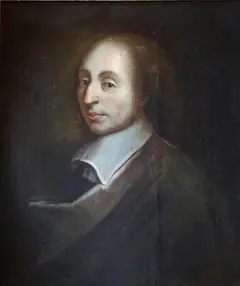
Blaise PascalSTP means 273.15 K (0°C) and 1 bar (10^5 pascal) pressure.
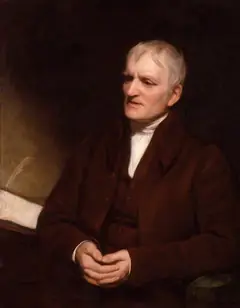
John DaltonDalton's Law: total pressure of a gas mixture equals the sum of partial pressures.
Check yourself
State Dalton's Law of partial pressures.
The total pressure of a gas mixture equals the sum of the partial pressures of its components.
What is the ideal gas equation?
PV = nRT, where R is the universal gas constant and n the number of moles. An ideal gas obeys it at all temperatures and pressures.
What is STP, and what is the molar volume there?
STP is 273.15 K (0°C) and 1 bar (10⁵ pascal). One mole of any gas occupies about 22.7 litres.
Combining all gas laws gives the master equation nRT.
Combining all gas laws gives the master equation PV =nRT.
Who is this, and what should you remember about them?
Blaise Pascal
STP means 273.15 K (0°C) and 1 bar (10^5 pascal) pressure.
Real Gases and Liquefaction
Real gases deviate from ideal behaviour at high pressure and low temperature.
They deviate because real molecules have size and attractive forces.
Real gases behave most ideally at low pressure and high temperature.
Gases are liquefied by applying high pressure and low temperature together.
A gas cannot be liquefied by pressure alone above its critical temperature.
The critical temperature is the highest temperature at which a gas can be liquefied.
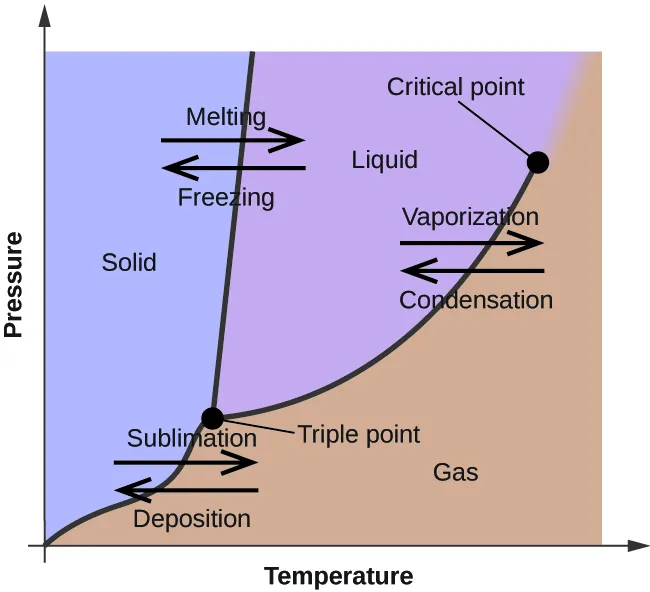
Triple point / states of matter phase diagram
Check yourself
When do real gases deviate from ideal behaviour?
At high pressure and low temperature, because real molecules have size and attractive forces. They behave most ideally at low pressure and high temperature.
What conditions liquefy a gas?
Low temperature and high pressure together.
What is the critical temperature?
The highest temperature at which a gas can be liquefied. Above it, pressure alone will never work.
What does this diagram show?
Triple point / states of matter phase diagram
Solutions, Mixtures and Lighter Gases
Two liquids form an ideal solution when they obey Raoult's law with no heat or volume change on mixing.
Milk is a colloid (an emulsion of fat droplets in water), not a true solution.
Hydrogen, helium, ammonia and methane are lighter than air.
Helium and hydrogen are lighter than air; sulfur dioxide and hydrogen chloride are heavier.
Diamond and graphite are allotropes of carbon: diamond is hardest, graphite conducts electricity and is soft.
Gas
Vs Air
Hydrogen (H2)
Lighter
Helium (He)
Lighter
Ammonia (NH3)
Lighter
Sulfur dioxide (SO2)
Heavier
Hydrogen chloride (HCl)
Heavier
Check yourself
When do two liquids form an ideal solution?
When they obey Raoult's law with no heat or volume change on mixing — i.e. enthalpy of mixing = 0.
Is milk a true solution?
No — milk is a colloid, an emulsion of fat droplets in water. Sol = solid-in-liquid, aerosol = liquid/solid-in-gas, foam = gas-in-liquid.
Which gases are lighter than air?
Hydrogen, helium, ammonia and methane (air ≈ 29 g/mol). Sulfur dioxide and hydrogen chloride are heavier.
How do diamond and graphite differ?
Both are allotropes of carbon: diamond is the hardest and an insulator; graphite conducts electricity and is soft.