Chemistry notes · Chapter 4 of 11
Chemical Bonding & Molecular Structure
12 sections, 82 flashcards. Open a card to check your answer, or revise them in the app with spaced revision.
What Is a Chemical Bond?
- A chemical bond is the attractive force that holds two or more atoms together in a molecule or compound.
- Atoms bond to reach a lower-energy, more stable state, just as a ball rolls downhill.
- Only the outermost valence electrons take part in bonding; inner electrons stay locked near the nucleus.
- The aim of bonding is to gain a full, stable outer shell like the nearest noble gas (He, Ne, Ar).
- Noble gases are unreactive because they already have a full outer shell (8 electrons; He has 2).
Check yourself
What is a chemical bond?
The attractive force that holds two or more atoms together in a molecule or compound.
Why do atoms bond at all?
To reach a lower-energy, more stable state — like a ball rolling downhill — by gaining a full outer shell like the nearest noble gas.
Which electrons take part in bonding?
Only the outermost valence electrons; inner electrons stay locked near the nucleus.
Noble gases are unreactive because they already have a (8 electrons; He has 2).
Noble gases are unreactive because they already have a full outer shell (8 electrons; He has 2).
Kössel–Lewis Approach & the Octet Rule
- In 1916, Kössel (Germany) and Lewis (USA) explained bonding using valence electrons, working independently.
- Lewis pictured the atom as a positive kernel (nucleus + inner electrons) with valence electrons at the corners of a cube.
- A Lewis dot symbol writes the element symbol with one dot per valence electron (Na has 1 dot, O has 6).
- Octet rule: atoms gain, lose or share electrons to get 8 electrons in the outer shell.
- Small atoms like H need only 2 electrons, a duplet, copying helium.
- Kössel stressed the ionic bond (electron transfer); Lewis introduced electron sharing (covalent bond).
Check yourself
What did Kössel and Lewis explain in 1916?
Bonding using valence electrons. Kössel stressed the ionic bond (electron transfer); Lewis introduced electron sharing (covalent bond).
What is a Lewis dot symbol?
The element symbol written with one dot per valence electron — Na has 1 dot, O has 6.
What is a duplet?
Small atoms like hydrogen need only 2 electrons, copying helium, instead of an octet.
In , Kössel (Germany) and Lewis (USA) explained bonding using valence electrons, working independently.
In 1916, Kössel (Germany) and Lewis (USA) explained bonding using valence electrons, working independently.
Lewis pictured the atom as a positive (nucleus + inner electrons) with valence electrons at the corners of a cube.
Lewis pictured the atom as a positive kernel (nucleus + inner electrons) with valence electrons at the corners of a cube.
: atoms gain, lose or share electrons to get 8 electrons in the outer shell.
Octet rule: atoms gain, lose or share electrons to get 8 electrons in the outer shell.
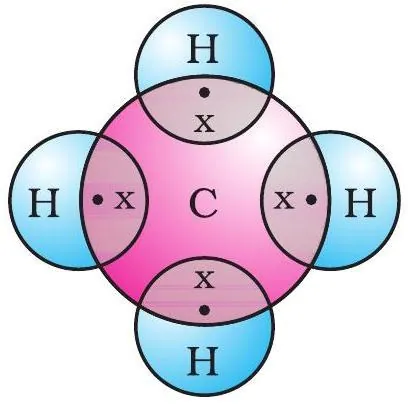
What does this diagram show?
Electron-dot (Lewis) structure of methane (CH₄): carbon shares four electron pairs with four hydrogens
The Three Main Types of Bond
- Ionic (electrovalent) bond: electrons fully transferred from a metal to a non-metal, forming + and − ions that attract.
- Example: NaCl forms as sodium gives its outer electron to chlorine.
- Covalent bond: two non-metals share one or more electron pairs, both counting the shared pair in their octet.
- Example: the hydrogen molecule H–H is the simplest covalent bond.
- Coordinate (dative) bond: a covalent bond where both shared electrons come from the same atom.
- Examples of dative bonds: ammonium ion NH4+ and ozone O3.
| Feature | Ionic bond | Covalent bond |
|---|---|---|
| Mechanism | Electron transfer | Electron sharing |
| Formed between | Metal + non-metal | Non-metal + non-metal |
| Particles | Ions (cation + anion) | Molecules |
| Example | NaCl | H2, CH4 |
Check yourself
What is an ionic (electrovalent) bond?
Electrons are fully transferred from a metal to a non-metal, forming + and − ions that attract. Example: NaCl.
What is a covalent bond?
Two non-metals share one or more electron pairs, both counting the shared pair in their octet. Example: H–H.
What is a coordinate (dative) bond?
A covalent bond in which both shared electrons come from the same atom — e.g. the ammonium ion NH₄⁺ and ozone O₃.
Ionic vs covalent — mechanism, particles and examples?
Ionic: electron transfer, metal + non-metal, gives ions, e.g. NaCl. Covalent: electron sharing, non-metal + non-metal, gives molecules, e.g. H₂, CH₄.
Example: forms as sodium gives its outer electron to chlorine.
Example: NaCl forms as sodium gives its outer electron to chlorine.
Example: the hydrogen molecule is the simplest covalent bond.
Example: the hydrogen molecule H–H is the simplest covalent bond.
Examples of dative bonds: ammonium ion and ozone O3.
Examples of dative bonds: ammonium ion NH4+ and ozone O3.
Feature: Mechanism → Ionic bond · Covalent bond?
- Ionic bond
- Electron transfer
- Covalent bond
- Electron sharing
Feature: Formed between → Ionic bond · Covalent bond?
- Ionic bond
- Metal + non-metal
- Covalent bond
- Non-metal + non-metal
Feature: Particles → Ionic bond · Covalent bond?
- Ionic bond
- Ions (cation + anion)
- Covalent bond
- Molecules
Feature: Example → Ionic bond · Covalent bond?
- Ionic bond
- NaCl
- Covalent bond
- H2, CH4
Covalent Bonds: Single, Double, Triple
- A single bond shares one electron pair, drawn as one dash (H–H).
- A double bond shares two pairs, drawn = (O=O, C=C).
- A triple bond shares three pairs, drawn ≡ (N≡N, C≡C).
- A bond pair is a shared pair holding two atoms; a lone pair is an unshared pair on one atom.
- A Lewis (dot) structure shows both bond pairs and lone pairs; replacing each shared pair with a dash gives a dash structure.
- Counting bond pairs and lone pairs is the first step to predicting a molecule's shape.
Check yourself
How are single, double and triple bonds drawn?
Single = one shared pair, H–H. Double = two pairs, O=O, C=C. Triple = three pairs, N≡N, C≡C.
Bond pair vs lone pair?
A bond pair is a shared pair holding two atoms together; a lone pair is an unshared pair sitting on one atom.
A shares one electron pair, drawn as one dash (H–H).
A single bond shares one electron pair, drawn as one dash (H–H).
A shows both bond pairs and lone pairs; replacing each shared pair with a dash gives a dash structure.
A Lewis (dot) structure shows both bond pairs and lone pairs; replacing each shared pair with a dash gives a dash structure.
Counting bond pairs and lone pairs is the first step to predicting a molecule's .
Counting bond pairs and lone pairs is the first step to predicting a molecule's shape.
Formal Charge & Limitations of the Octet Rule
- Formal charge = (valence electrons) − (lone-pair electrons) − ½(bonding electrons), used to pick the best Lewis structure.
- Incomplete octet: some atoms are stable with fewer than 8 electrons, e.g. BeCl2, BF3, LiCl.
- Expanded octet: third-period elements can hold more than 8 electrons, e.g. PCl5, SF6, H2SO4.
- Odd-electron molecules like NO and NO2 cannot satisfy the octet rule.
- The octet rule says nothing about molecular shape or relative stability.
Check yourself
Give examples of incomplete and expanded octets.
Incomplete: BeCl₂, BF₃, LiCl — stable with fewer than 8. Expanded: PCl₅, SF₆, H₂SO₄ — third-period elements hold more than 8.
Which molecules cannot satisfy the octet rule at all?
Odd-electron molecules like NO and NO₂.
What is formal charge used for?
Formal charge = valence electrons − lone-pair electrons − ½(bonding electrons); it is used to pick the best Lewis structure.
: some atoms are stable with fewer than 8 electrons, e.g. BeCl2, BF3, LiCl.
Incomplete octet: some atoms are stable with fewer than 8 electrons, e.g. BeCl2, BF3, LiCl.
: third-period elements can hold more than 8 electrons, e.g. PCl5, SF6, H2SO4.
Expanded octet: third-period elements can hold more than 8 electrons, e.g. PCl5, SF6, H2SO4.
The octet rule says nothing about or relative stability.
The octet rule says nothing about molecular shape or relative stability.
Bond Parameters (Key Values)
- Bond length is the equilibrium distance between nuclei of two bonded atoms; each atom's share is its covalent radius.
- Bond angle is the angle between two bonds at one atom: H–O–H in water = 104.5°.
- Bond enthalpy (bond energy) is the energy to break one mole of a bond; higher value means a stronger bond.
- Bond order is the number of bonds between two atoms: H2 = 1, O2 = 2, N2 = 3, CO = 3.
- As bond order rises, the bond gets shorter and stronger.
- N2 has bond order 3 and enthalpy 946 kJ/mol, making nitrogen gas very unreactive.
| Molecule | Bond order | Bond enthalpy (kJ/mol) | Length (pm) |
|---|---|---|---|
| H2 | 1 | 435.8 | 74 |
| F2 | 1 | 155 | 144 |
| O2 | 2 | 498 | 121 |
| N2 | 3 | 946 | 110 |
Check yourself
What is bond enthalpy?
The energy needed to break one mole of a bond. A higher value means a stronger bond.
Bond orders of H₂, O₂, N₂ and CO?
H₂ = 1, O₂ = 2, N₂ = 3, CO = 3. As bond order rises the bond gets shorter and stronger.
Why is nitrogen gas so unreactive?
N₂ has bond order 3 and a bond enthalpy of 946 kJ/mol — very hard to break.
is the equilibrium distance between nuclei of two bonded atoms; each atom's share is its covalent radius.
Bond length is the equilibrium distance between nuclei of two bonded atoms; each atom's share is its covalent radius.
is the number of bonds between two atoms: H2 = 1, O2 = 2, N2 = 3, CO = 3.
Bond order is the number of bonds between two atoms: H2 = 1, O2 = 2, N2 = 3, CO = 3.
Molecule: H2 → Bond order · Bond enthalpy (kJ/mol) · Length (pm)?
- Bond order
- 1
- Bond enthalpy (kJ/mol)
- 435.8
- Length (pm)
- 74
Molecule: F2 → Bond order · Bond enthalpy (kJ/mol) · Length (pm)?
- Bond order
- 1
- Bond enthalpy (kJ/mol)
- 155
- Length (pm)
- 144
Molecule: O2 → Bond order · Bond enthalpy (kJ/mol) · Length (pm)?
- Bond order
- 2
- Bond enthalpy (kJ/mol)
- 498
- Length (pm)
- 121
Molecule: N2 → Bond order · Bond enthalpy (kJ/mol) · Length (pm)?
- Bond order
- 3
- Bond enthalpy (kJ/mol)
- 946
- Length (pm)
- 110
Resonance & Bond Polarity
- Resonance: when one Lewis structure cannot describe a molecule, several canonical forms are drawn (e.g. O3, CO3 2−).
- The real molecule is a resonance hybrid, more stable than any single structure; resonance does not mean rapid switching.
- A non-polar covalent bond joins identical atoms with equal sharing (H2, Cl2).
- A polar covalent bond joins different atoms; the more electronegative one pulls the shared pair (HCl).
- Dipole moment (μ = charge × distance, unit Debye) measures bond/molecule polarity.
- CO2 is non-polar (linear, dipoles cancel) but H2O is polar (bent, dipoles add up).
Check yourself
What is resonance?
When one Lewis structure cannot describe a molecule, several canonical forms are drawn (O₃, CO₃²⁻). The real molecule is a resonance hybrid, more stable than any single form — it does not rapidly switch.
Polar vs non-polar covalent bond?
Non-polar joins identical atoms with equal sharing (H₂, Cl₂). Polar joins different atoms — the more electronegative one pulls the shared pair (HCl).
Why is CO₂ non-polar but H₂O polar?
CO₂ is linear, so the two dipoles cancel. H₂O is bent, so the dipoles add up.
What is dipole moment?
μ = charge × distance, measured in Debye — it measures bond or molecular polarity.
VSEPR Theory & Molecular Shapes
- VSEPR theory: electron pairs around the central atom repel and arrange themselves as far apart as possible.
- Repulsion order: lone pair–lone pair > lone pair–bond pair > bond pair–bond pair.
- Lone pairs push bonds closer, so they reduce the bond angle (water 104.5°, ammonia 107°).
- 2 pairs = linear, 3 = trigonal planar, 4 = tetrahedral, 5 = trigonal bipyramidal, 6 = octahedral.
- SF6 is octahedral (6 bond pairs, no lone pairs); CH4 is tetrahedral; NH3 is pyramidal; H2O is bent.
| Bond pairs | Lone pairs | Shape | Example |
|---|---|---|---|
| 2 | 0 | Linear | BeCl2, CO2 |
| 3 | 0 | Trigonal planar | BF3 |
| 4 | 0 | Tetrahedral | CH4 |
| 3 | 1 | Pyramidal | NH3 |
| 2 | 2 | Bent | H2O |
| 6 | 0 | Octahedral | SF6 |
Check yourself
What is the H–O–H bond angle in water?
104.5°. Ammonia's H–N–H angle is 107° — lone pairs push the bonds closer.
State VSEPR theory.
Electron pairs around the central atom repel and arrange themselves as far apart as possible.
What is the repulsion order in VSEPR?
lone pair–lone pair > lone pair–bond pair > bond pair–bond pair. Lone pairs therefore reduce the bond angle.
Shape for 2, 3, 4, 5 and 6 electron pairs?
2 = linear, 3 = trigonal planar, 4 = tetrahedral, 5 = trigonal bipyramidal, 6 = octahedral.
Shapes of SF₆, CH₄, NH₃ and H₂O?
SF₆ octahedral (6 bond pairs, no lone pairs) · CH₄ tetrahedral · NH₃ pyramidal · H₂O bent.
sp³d and sp³d² give which shapes?
sp³d = trigonal bipyramidal (PCl₅); sp³d² = octahedral (SF₆).
Bond pairs: 2 → Lone pairs · Shape · Example?
- Lone pairs
- 0
- Shape
- Linear
- Example
- BeCl2, CO2
Bond pairs: 3 → Lone pairs · Shape · Example?
- Lone pairs
- 0
- Shape
- Trigonal planar
- Example
- BF3
Bond pairs: 4 → Lone pairs · Shape · Example?
- Lone pairs
- 0
- Shape
- Tetrahedral
- Example
- CH4
Bond pairs: 3 → Lone pairs · Shape · Example?
- Lone pairs
- 1
- Shape
- Pyramidal
- Example
- NH3
Bond pairs: 2 → Lone pairs · Shape · Example?
- Lone pairs
- 2
- Shape
- Bent
- Example
- H2O
Bond pairs: 6 → Lone pairs · Shape · Example?
- Lone pairs
- 0
- Shape
- Octahedral
- Example
- SF6
Valence Bond Theory & Sigma/Pi Bonds
- Valence Bond Theory (VBT): a covalent bond forms when half-filled orbitals of two atoms overlap.
- A sigma (σ) bond forms by head-on, end-to-end overlap along the bond axis; it is strong and in every covalent bond.
- A pi (π) bond forms by sideways overlap of p-orbitals above and below the axis; it is weaker.
- A single bond is 1 σ; a double bond is 1 σ + 1 π; a triple bond is 1 σ + 2 π.
- A sigma bond allows free rotation, but a pi bond restricts rotation around the bond.
Check yourself
How does a sigma (σ) bond form?
By head-on, end-to-end overlap along the bond axis. It is strong and present in every covalent bond — always the first bond between two atoms.
How does a pi (π) bond form?
By sideways overlap of p-orbitals above and below the axis. It is weaker than a sigma bond.
Sigma/pi make-up of single, double and triple bonds?
Single = 1σ. Double = 1σ + 1π. Triple = 1σ + 2π.
Which bond allows free rotation?
A sigma bond allows free rotation; a pi bond restricts rotation around the bond.
: a covalent bond forms when half-filled orbitals of two atoms overlap.
Valence Bond Theory (VBT): a covalent bond forms when half-filled orbitals of two atoms overlap.
Hybridisation
- Hybridisation is the mixing of atomic orbitals of similar energy to form equal hybrid orbitals.
- sp = 2 hybrids, linear, 180° (BeCl2, C2H2).
- sp2 = 3 hybrids, trigonal planar, 120° (BF3, C2H4).
- sp3 = 4 hybrids, tetrahedral, 109.5° (CH4, NH3, H2O).
- sp3d = trigonal bipyramidal (PCl5); sp3d2 = octahedral (SF6).
- More s-character means a shorter, stronger bond and larger bond angle.
| Hybridisation | Shape | Angle | Example |
|---|---|---|---|
| sp | Linear | 180° | BeCl2, C2H2 |
| sp2 | Trigonal planar | 120° | BF3, C2H4 |
| sp3 | Tetrahedral | 109.5° | CH4 |
| sp3d | Trigonal bipyramidal | 90°,120° | PCl5 |
| sp3d2 | Octahedral | 90° | SF6 |
Check yourself
What is hybridisation?
The mixing of atomic orbitals of similar energy to form equal hybrid orbitals.
sp, sp² and sp³ — shape, angle and example?
sp: linear, 180°, BeCl₂/C₂H₂. sp²: trigonal planar, 120°, BF₃/C₂H₄. sp³: tetrahedral, 109.5°, CH₄/NH₃/H₂O.
What does more s-character do to a bond?
Gives a shorter, stronger bond and a larger bond angle.
= 2 hybrids, linear, 180° (BeCl2, C2H2).
sp = 2 hybrids, linear, 180° (BeCl2, C2H2).
= 3 hybrids, trigonal planar, 120° (BF3, C2H4).
sp2 = 3 hybrids, trigonal planar, 120° (BF3, C2H4).
= 4 hybrids, tetrahedral, 109.5° (CH4, NH3, H2O).
sp3 = 4 hybrids, tetrahedral, 109.5° (CH4, NH3, H2O).
= trigonal bipyramidal (PCl5); sp3d2 = octahedral (SF6).
sp3d = trigonal bipyramidal (PCl5); sp3d2 = octahedral (SF6).
Hybridisation: sp → Shape · Angle · Example?
- Shape
- Linear
- Angle
- 180°
- Example
- BeCl2, C2H2
Hybridisation: sp2 → Shape · Angle · Example?
- Shape
- Trigonal planar
- Angle
- 120°
- Example
- BF3, C2H4
Hybridisation: sp3 → Shape · Angle · Example?
- Shape
- Tetrahedral
- Angle
- 109.5°
- Example
- CH4
Hybridisation: sp3d → Shape · Angle · Example?
- Shape
- Trigonal bipyramidal
- Angle
- 90°,120°
- Example
- PCl5
Hybridisation: sp3d2 → Shape · Angle · Example?
- Shape
- Octahedral
- Angle
- 90°
- Example
- SF6
Molecular Orbital Theory (MOT)
- MOT: atomic orbitals combine to form molecular orbitals belonging to the whole molecule.
- Combining gives a low-energy bonding orbital and a high-energy antibonding orbital (marked *).
- Bond order = ½ (bonding electrons − antibonding electrons).
- A positive bond order means the molecule exists; zero means it does not (e.g. He2 has bond order 0).
- MOT explains why O2 is paramagnetic (it has two unpaired electrons), which VBT cannot.
Check yourself
How is bond order calculated in MOT?
Bond order = ½ (bonding electrons − antibonding electrons). Positive means the molecule exists; zero means it does not (He₂ = 0). CO gives ½(10 − 4) = 3.
What does MOT explain that valence bond theory cannot?
Why O₂ is paramagnetic — it has two unpaired electrons.
: atomic orbitals combine to form molecular orbitals belonging to the whole molecule.
MOT: atomic orbitals combine to form molecular orbitals belonging to the whole molecule.
Combining gives a low-energy and a high-energy antibonding orbital (marked *).
Combining gives a low-energy bonding orbital and a high-energy antibonding orbital (marked *).
Hydrogen Bonding
- A hydrogen bond forms when H attached to a highly electronegative atom (F, O, N) is attracted to another such atom.
- It is much weaker than a covalent bond but stronger than ordinary van der Waals forces.
- Intermolecular hydrogen bonds are between molecules (water, HF); intramolecular are within one molecule (o-nitrophenol).
- Hydrogen bonding gives water its high boiling point and makes ice less dense than water.
- It is vital in biology, holding together the DNA double helix and protein structures.
Check yourself
When does a hydrogen bond form?
When H attached to a highly electronegative atom (F, O or N) is attracted to another such atom. Weaker than a covalent bond but stronger than van der Waals forces.
What does hydrogen bonding explain in everyday terms?
Water's high boiling point, ice being less dense than water, and it holds together the DNA double helix and protein structures.
hydrogen bonds are between molecules (water, HF); intramolecular are within one molecule (o-nitrophenol).
Intermolecular hydrogen bonds are between molecules (water, HF); intramolecular are within one molecule (o-nitrophenol).
All 11 chapters of Chemistry notes
- Basic Concepts, Matter & Measurement13 sections
- Structure of Atom12 sections
- Periodic Table & Periodicity11 sections
- Chemical Bonding & Molecular Structure12 sections
- States of Matter & Gas Laws12 sections
- Chemical Reactions, Equilibrium & Catalysis13 sections
- Acids, Bases & Salts13 sections
- Organic Chemistry & Hydrocarbons12 sections
- Chemistry in Everyday Life & Important Compounds11 sections
- Biomolecules (Chemistry)13 sections
- Radioactivity & Nuclear Chemistry11 sections