Chemistry is the branch of science that studies matter and the changes it undergoes.
Matter is anything that has mass and occupies space (air, water, your body).
Early chemistry was practised as alchemy – attempts to turn cheap metals into gold.
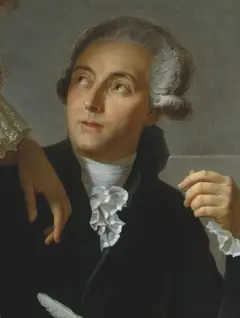
A. LavoisierAntoine Lavoisier is called the Father of Modern Chemistry; he named oxygen and hydrogen.
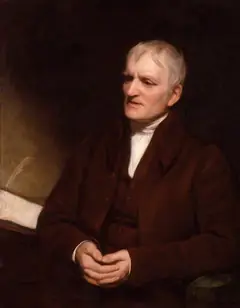
John DaltonJohn Dalton proposed the first scientific Atomic Theory (1808) – matter is made of indivisible atoms.
Check yourself
What does chemistry study?
Matter and the changes it undergoes. Matter is anything that has mass and occupies space.
What was early chemistry called?
Alchemy — attempts to turn cheap metals into gold.
Who is called the Father of Modern Chemistry?
Antoine Lavoisier. He named oxygen and hydrogen, explained combustion and proved the Law of Conservation of Mass.
Who proposed the first scientific Atomic Theory, and when?
John Dalton, 1808 — matter is made of indivisible atoms.
is the branch of science that studies matter and the changes it undergoes.
Chemistry is the branch of science that studies matter and the changes it undergoes.
is anything that has mass and occupies space (air, water, your body).
Matter is anything that has mass and occupies space (air, water, your body).
Who is this, and what should you remember about them?
Antoine Lavoisier
Antoine Lavoisier is called the Father of Modern Chemistry; he named oxygen and hydrogen.
Lavoisier proved the Law of Conservation of Mass – matter is neither created nor destroyed in a reaction.
Who is this, and what should you remember about them?
John Dalton
John Dalton proposed the first scientific Atomic Theory (1808) – matter is made of indivisible atoms.
John Dalton (1808) gave the first scientific atomic theory and is called the father of modern atomic theory.
Note: Dalton's theory did NOT explain the law of radioactivity (a common exam trap).
Dalton's Law: total pressure of a gas mixture equals the sum of partial pressures.
Scientists – Do Not Confuse
Scientist
Known For
Lavoisier
Father of Modern Chemistry; Conservation of Mass
Dalton
Atomic Theory (1808)
Rutherford
Discovered the nucleus
Raman
Raman effect (physicist)
A. LavoisierLavoisier proved the Law of Conservation of Mass – matter is neither created nor destroyed in a reaction.
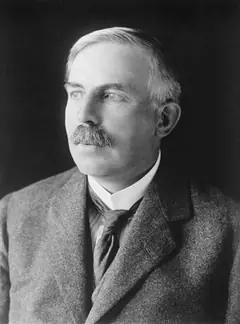
Ernest RutherfordRutherford discovered the atom's nucleus.
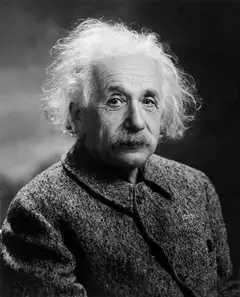
Albert EinsteinEinstein was a physicist (E = mc²), not a chemist.
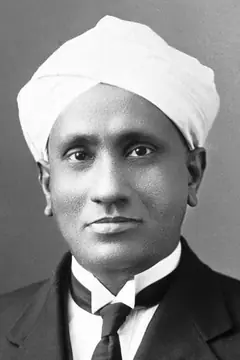
C. V. RamanC. V. Raman was an Indian physicist famous for the Raman effect of light.
Check yourself
Scientists not to confuse: Lavoisier, Dalton, Rutherford, Raman — known for what?
Lavoisier: Father of Modern Chemistry, conservation of mass. Dalton: Atomic Theory (1808). Rutherford: discovered the nucleus. Raman: the Raman effect — he was a physicist.
Was Einstein a chemist?
No — Einstein was a physicist (E = mc²). A common exam trap in 'Father of Chemistry' questions.
Scientist: Lavoisier → Known For?
Known For
Father of Modern Chemistry; Conservation of Mass
Scientist: Dalton → Known For?
Known For
Atomic Theory (1808)
Scientist: Rutherford → Known For?
Known For
Discovered the nucleus
Scientist: Raman → Known For?
Known For
Raman effect (physicist)
Who is this, and what should you remember about them?
Ernest Rutherford
Rutherford discovered the atom's nucleus.
E. Goldstein (1886) found positive 'canal rays'; the proton was later established by Rutherford.
Based on the famous gold-foil (alpha-particle scattering) experiment (1911).
Given by Niels Bohr in 1913 to fix Rutherford's stability problem.
Ernest Rutherford identified alpha and beta rays and proved alpha is a helium nucleus.
Rutherford proved alpha is helium: gaining 2 electrons it became ordinary helium gas.
Who is this, and what should you remember about them?
Albert Einstein
Einstein was a physicist (E = mc²), not a chemist.
Bose-Einstein Condensate (BEC) forms near absolute zero, particles act as one.
E = mc² (Einstein): a tiny loss of mass releases enormous energy.
Who is this, and what should you remember about them?
C. V. Raman
C. V. Raman was an Indian physicist famous for the Raman effect of light.
States of Matter
Matter is made of tiny moving particles with empty space between them.
A solid has fixed shape and fixed volume; particles only vibrate in place.
A liquid has fixed volume but no fixed shape; particles slide past each other.
A gas has neither fixed shape nor fixed volume; it fills any container.
Plasma is a super-hot ionised gas (Sun, stars, tube-lights).
State
Shape
Volume
Solid
Fixed
Fixed
Liquid
Not fixed
Fixed
Gas
Not fixed
Not fixed
Albert EinsteinBose-Einstein Condensate (BEC) forms near absolute zero, particles act as one.
Check yourself
Shape and volume of a solid, liquid and gas?
Solid: fixed shape, fixed volume (particles only vibrate). Liquid: fixed volume, no fixed shape (particles slide past). Gas: neither fixed — it fills any container.
What is plasma?
A super-hot ionised gas — found in the Sun, stars and tube-lights.
What is a Bose-Einstein Condensate?
A state formed near absolute zero in which particles act as one.
Matter is made of tiny moving particles with space between them.
Matter is made of tiny moving particles with emptyspace between them.
State: Solid → Shape · Volume?
Shape
Fixed
Volume
Fixed
State: Liquid → Shape · Volume?
Shape
Not fixed
Volume
Fixed
State: Gas → Shape · Volume?
Shape
Not fixed
Volume
Not fixed
Properties of Matter Particles
Particles are extremely tiny – diluting potassium permanganate keeps a faint colour.
Particles have space between them – salt dissolves in water with little rise in level.
Particles are always moving, causing diffusion (incense smell, ink spreading).
Heat makes particles move faster, so diffusion is quicker when warm.
Particles attract each other – strongest in solids, weakest in gases.
Check yourself
What everyday evidence shows particles are extremely tiny?
Diluting potassium permanganate again and again still keeps a faint colour.
What shows there is space between particles?
Salt dissolves in water with little rise in the water level.
What causes diffusion, and what speeds it up?
Particles are always moving (incense smell, ink spreading). Heat makes particles move faster, so diffusion is quicker when warm.
Where is the force of attraction between particles strongest and weakest?
Strongest in solids, weakest in gases.
Changes of State & Special Points
Melting point = solid turns to liquid; for ice it is 0°C (273 K).
Freezing point equals the melting point for a pure substance.
Boiling point = liquid turns to gas throughout; water boils at 100°C (373 K).
Triple point = the single temperature and pressure where solid, liquid and gas coexist (water ~0.01°C).
Heating in steps: solid → (melt) liquid → (boil) gas; cooling reverses it.
Change
From → To
Water Value
Melting
Solid → Liquid
0°C / 273 K
Freezing
Liquid → Solid
0°C / 273 K
Boiling
Liquid → Gas
100°C / 373 K
Check yourself
Melting point and boiling point of water?
Melting: 0°C (273 K). Boiling: 100°C (373 K). Freezing point equals melting point for a pure substance.
What is the triple point?
The single temperature and pressure at which solid, liquid and gas coexist — for water, about 0.01°C.
= solid turns to liquid; for ice it is 0°C (273 K).
Melting point = solid turns to liquid; for ice it is 0°C (273 K).
= liquid turns to gas throughout; water boils at 100°C (373 K).
Boiling point = liquid turns to gas throughout; water boils at 100°C (373 K).
Change: Melting → From → To · Water Value?
From → To
Solid → Liquid
Water Value
0°C / 273 K
Change: Freezing → From → To · Water Value?
From → To
Liquid → Solid
Water Value
0°C / 273 K
Change: Boiling → From → To · Water Value?
From → To
Liquid → Gas
Water Value
100°C / 373 K
Evaporation & Sublimation
Evaporation is the slow change of a liquid to gas from its surface only, at any temperature.
Evaporation is a cooling process – fastest particles escape, leaving the rest cooler (sweating, earthen pot).
Evaporation speeds up with heat, wind, larger surface area and dry air.
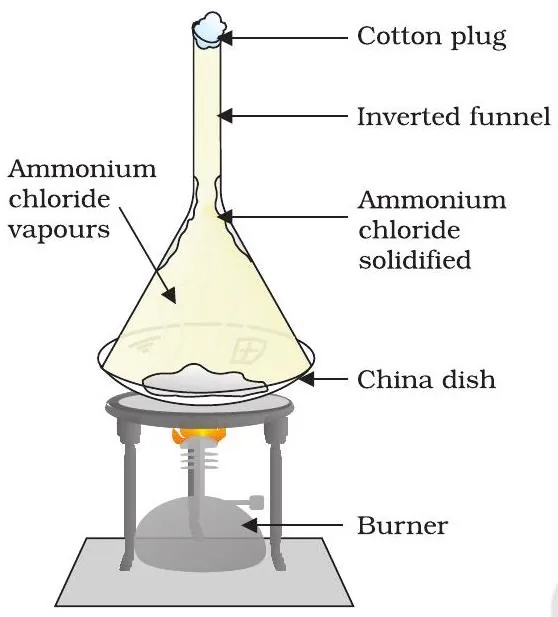
Sublimation is a solid changing directly into gas without becoming liquid.
Slaking quick lime, CaO + H₂O → Ca(OH)₂, gives out much heat (exothermic).
Diluting concentrated acid is exothermic – always add acid to water, never water to acid.
Evaporation and sublimation are endothermic, giving a cooling effect.
Exothermic (out)
Endothermic (in)
Slaking of quick lime
Melting of ice
Diluting acid
Evaporation
Respiration, burning fuel
Sublimation, dissolving some salts
Check yourself
Exothermic vs endothermic — which way does the heat go?
Exo = out: heat is released, surroundings feel warmer. Endo = in: heat is absorbed, surroundings feel cooler.
Is slaking of quick lime exothermic or endothermic?
Strongly exothermic: CaO + H₂O → Ca(OH)₂ gives out much heat.
Why must acid always be added to water and never water to acid?
Diluting concentrated acid is exothermic — a large amount of heat is released at once.
Which four processes are endothermic in the exam list?
Melting of ice, evaporation, sublimation and dissolving some salts — all absorb heat and give a cooling effect.
Slaking of quick lime — Exothermic (out) or Endothermic (in)?
Melting of ice — Exothermic (out) or Endothermic (in)?
Diluting acid — Exothermic (out) or Endothermic (in)?
Evaporation — Exothermic (out) or Endothermic (in)?
Respiration, burning fuel — Exothermic (out) or Endothermic (in)?
Sublimation, dissolving some salts — Exothermic (out) or Endothermic (in)?
The Atom & Subatomic Particles
An atom is the smallest particle of an element that takes part in a chemical reaction.
Protons carry a positive charge and sit in the central nucleus.
Neutrons have no charge and also sit in the nucleus.
Electrons carry a negative charge and move around the nucleus.
An atom is electrically neutral because protons equal electrons.
Particle
Charge
Location
Proton
Positive (+)
Nucleus
Neutron
Neutral (0)
Nucleus
Electron
Negative (-)
Outside nucleus
Check yourself
Charge and location of proton, neutron and electron?
Proton: positive, in the nucleus. Neutron: neutral, in the nucleus. Electron: negative, outside the nucleus.
Why is an atom electrically neutral?
The number of protons equals the number of electrons, so the charges cancel.
An is the smallest particle of an element that takes part in a chemical reaction.
An atom is the smallest particle of an element that takes part in a chemical reaction.
carry a positive charge and sit in the central nucleus.
Protons carry a positive charge and sit in the central nucleus.
have no charge and also sit in the nucleus.
Neutrons have no charge and also sit in the nucleus.
carry a negative charge and move around the nucleus.
Electrons carry a negative charge and move around the nucleus.
Particle: Proton → Charge · Location?
Charge
Positive (+)
Location
Nucleus
Particle: Neutron → Charge · Location?
Charge
Neutral (0)
Location
Nucleus
Particle: Electron → Charge · Location?
Charge
Negative (-)
Location
Outside nucleus
Atomic Number, Mass Number & Isotopes
Atomic number (Z) = number of protons; it decides which element it is.
Mass number (A) = number of protons + neutrons.
Isotopes = atoms of the same element with different numbers of neutrons (e.g. carbon-12, carbon-14).
Molecule = two or more atoms joined together (O₂, H₂O).
An ion is a charged atom: cation (positive) loses electrons, anion (negative) gains electrons.
Check yourself
Atomic number (Z) and mass number (A)?
Z = number of protons — it decides which element it is. A = protons + neutrons.
What are isotopes?
Atoms of the same element with different numbers of neutrons — e.g. carbon-12 and carbon-14.
Cation vs anion?
Cation is positive — it has lost electrons. Anion is negative — it has gained electrons.
Mnemonic for isotopes, isobars and isotones?
isotoPes = Proton same · isobar = mass bar (mass number) same · isotoNes = Neutron same.
= two or more atoms joined together (O₂, H₂O).
Molecule = two or more atoms joined together (O₂, H₂O).
An is a charged atom: cation (positive) loses electrons, anion (negative) gains electrons.
An ion is a charged atom: cation (positive) loses electrons, anion (negative) gains electrons.
Classification of Matter
Pure substances have a fixed composition: elements and compounds.
An element is made of one kind of atom (gold, oxygen).
A compound is two or more elements chemically combined in a fixed ratio (water, salt).
A mixture contains two or more substances not chemically combined.
Mixtures are homogeneous (uniform, like salt water) or heterogeneous (non-uniform, like sand in water).
Type
Example
Element
Gold, Oxygen
Compound
Water, Common salt
Homogeneous mixture
Salt solution, air
Heterogeneous mixture
Sand in water, oil in water
Check yourself
Element vs compound vs mixture?
Element: one kind of atom (gold, oxygen). Compound: two or more elements chemically combined in a fixed ratio (water, salt). Mixture: substances not chemically combined.
Homogeneous vs heterogeneous mixture?
Homogeneous is uniform throughout — salt solution, air. Heterogeneous is non-uniform — sand in water, oil in water.
have a fixed composition: elements and compounds.
Pure substances have a fixed composition: elements and compounds.
Type: Element → Example?
Example
Gold, Oxygen
Type: Compound → Example?
Example
Water, Common salt
Type: Homogeneous mixture → Example?
Example
Salt solution, air
Type: Heterogeneous mixture → Example?
Example
Sand in water, oil in water
Solutions, Solute & Solvent
A solution is a homogeneous mixture of two or more substances (table salt in water).
The solute is the dissolved substance; the solvent dissolves it (in salt water, salt = solute, water = solvent).
A saturated solution holds the maximum solute possible at that temperature; an unsaturated one can dissolve more.
Higher temperature usually lets a solvent dissolve more solute.
On adding more solvent (water) to a sugar solution, the amount/mass of sugar does not change – only concentration drops.
Check yourself
Solute vs solvent?
The solute is the dissolved substance; the solvent dissolves it. In salt water, salt = solute, water = solvent.
Saturated vs unsaturated solution?
A saturated solution holds the maximum solute possible at that temperature; an unsaturated one can still dissolve more.
On adding more water to a sugar solution, what changes?
Only the concentration drops. The amount/mass of sugar does not change, and in an unsaturated solution the volume stays the same too.
Higher temperature usually lets a solvent dissolve solute.
Higher temperature usually lets a solvent dissolve moresolute.
Concentration of a Solution
Concentration = amount of solute present per unit volume or unit mass of the solution/solvent.
Mass percentage = (mass of solute / mass of solution) × 100.
Dilute solution has little solute; concentrated solution has much solute.
Adding more solvent makes a solution more dilute (concentration falls).
The same solute may give different concentrations depending on how much solvent is used.
Check yourself
Define concentration.
The amount of solute per unit volume or unit mass of the solution/solvent. Units: molarity (mol/L solution), molality (mol/kg solvent), mass percent.
Formula for mass percentage?
(mass of solute ÷ mass of solution) × 100.
solution has little solute; concentrated solution has much solute.
Dilute solution has little solute; concentrated solution has much solute.
Adding more solvent makes a solution more (concentration falls).
Adding more solvent makes a solution more dilute (concentration falls).
Measurement & SI Units
The SI system gives standard base units used worldwide in science.
Length is measured in metre (m), mass in kilogram (kg), time in second (s).
Temperature is measured in kelvin (K); 0°C = 273 K and K = °C + 273.
The SI unit of amount of substance is the mole (mol).
Mass is the quantity of matter (constant everywhere); weight is the force of gravity on it (varies with place).
Memory tip
isotopes = p = proton same isobar = bar = mass same isotones = n = neutron same
Quantity
SI Unit
Symbol
Length
metre
m
Mass
kilogram
kg
Time
second
s
Temperature
kelvin
K
Amount of substance
mole
mol
Check yourself
SI units of length, mass, time and amount of substance?
metre (m), kilogram (kg), second (s) and mole (mol).
How do you convert Celsius to Kelvin?
K = °C + 273, so 0°C = 273 K. Temperature's SI unit is the kelvin (K).
Mass vs weight?
Mass is the quantity of matter — constant everywhere. Weight is the force of gravity on it — it varies with place.
The gives standard base units used worldwide in science.
The SI system gives standard base units used worldwide in science.
is measured in kelvin (K); 0°C = 273 K and K = °C + 273.
Temperature is measured in kelvin (K); 0°C = 273 K and K = °C + 273.