Chemistry notes · Chapter 9 of 11
Chemistry in Everyday Life & Important Compounds
11 sections, 118 flashcards. Open a card to check your answer, or revise them in the app with spaced revision.
Solutions, Concentration & pH
- A solution is a homogeneous (uniform) mixture; it looks and tastes the same throughout.
- Solute + Solvent = Solution; solute dissolves, solvent does the dissolving.
- Solutions exist in all states: brass (solid solution/alloy), salt water (liquid), air (gaseous solution).
- A saturated solution holds the maximum solute possible at that temperature; extra settles out.
- Concentration = amount of solute per unit volume or mass; tells how strong a solution is.
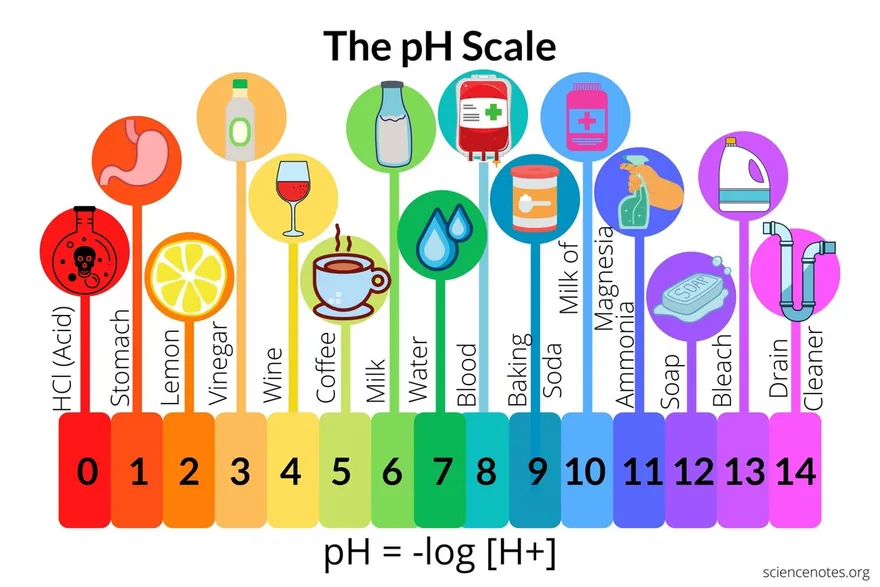
- pH scale runs 0-14: below 7 acidic, exactly 7 neutral (pure water), above 7 basic.
- Liquids conduct electricity only if they have free ions; salt water conducts, pure distilled water does not.
| pH range | Nature | Example |
|---|---|---|
| Below 7 | Acidic | Lemon, vinegar |
| = 7 | Neutral | Pure water |
| Above 7 | Basic/Alkaline | Soap, baking soda |
Check yourself
Give an example of a solid, liquid and gaseous solution.
Brass (solid solution/alloy), salt water (liquid), air (gaseous solution).
When does a liquid conduct electricity?
Only if it has free ions. Salt water conducts; pure distilled water does not.
What is the main ingredient of cement?
Limestone (CaCO₃). Gypsum is added only in a small amount at the end to control setting time.
What is added to petrol to raise the octane rating?
Tetraethyllead (TEL), an anti-knock agent — now phased out for being toxic.
Identify: cholecalciferol, venlafaxine, cetirizine.
Vitamin D, an antidepressant, and an antihistamine — the usual distractors in contraceptive-pill questions.
What is the powerful eye irritant in smoke?
Peroxyacetyl nitrate (PAN) — a secondary pollutant of photochemical smog and a lachrymator.
A is a homogeneous (uniform) mixture; it looks and tastes the same throughout.
A solution is a homogeneous (uniform) mixture; it looks and tastes the same throughout.
; solute dissolves, solvent does the dissolving.
Solute + Solvent = Solution; solute dissolves, solvent does the dissolving.
A holds the maximum solute possible at that temperature; extra settles out.
A saturated solution holds the maximum solute possible at that temperature; extra settles out.
= amount of solute per unit volume or mass; tells how strong a solution is.
Concentration = amount of solute per unit volume or mass; tells how strong a solution is.
: below 7 acidic, exactly 7 neutral (pure water), above 7 basic.
pH scale runs 0-14: below 7 acidic, exactly 7 neutral (pure water), above 7 basic.
pH range: Below 7 → Nature · Example?
- Nature
- Acidic
- Example
- Lemon, vinegar
pH range: = 7 → Nature · Example?
- Nature
- Neutral
- Example
- Pure water
pH range: Above 7 → Nature · Example?
- Nature
- Basic/Alkaline
- Example
- Soap, baking soda
What does this diagram show?
Solutions, Concentration & pH
Colligative Properties
- Colligative properties depend only on the NUMBER of solute particles, not their nature.
- A non-volatile solute like salt raises the boiling point and lowers the freezing point of water.
- Salt on icy roads melts ice by lowering its freezing point.
- Adding a more volatile liquid (e.g. methyl alcohol) actually LOWERS the mixture's boiling point.
- A pressure cooker traps steam, raises internal pressure, so water boils above 100 degrees C and cooks faster.
- A fan does not cool air; it speeds evaporation of sweat, which carries heat away from skin.
- An ideal solution obeys Raoult's law fully; its heat and volume change on mixing are zero.
Check yourself
What are colligative properties?
Properties that depend only on the NUMBER of solute particles, not their nature — boiling point elevation and freezing point depression.
Why is salt spread on icy roads?
It lowers the freezing point of water, melting the ice.
What happens to boiling point when methyl alcohol is added to water?
It LOWERS the mixture's boiling point, because the added liquid is more volatile and raises the vapour pressure. Salt, a non-volatile solute, does the opposite.
Does a fan cool the air?
No. It speeds evaporation of sweat, which carries heat away from the skin.
A traps steam, raises internal pressure, so water boils above 100 degrees C and cooks faster.
A pressure cooker traps steam, raises internal pressure, so water boils above 100 degrees C and cooks faster.
An obeys Raoult's law fully; its heat and volume change on mixing are zero.
An ideal solution obeys Raoult's law fully; its heat and volume change on mixing are zero.
Soaps & Detergents
- A soap is the sodium or potassium salt of a long-chain fatty acid (stearic, oleic, palmitic).
- Potassium soaps (from KOH) are softer on skin than sodium soaps (from NaOH).
- Soap is made by saponification: heating fat/oil with NaOH gives soap plus glycerol.
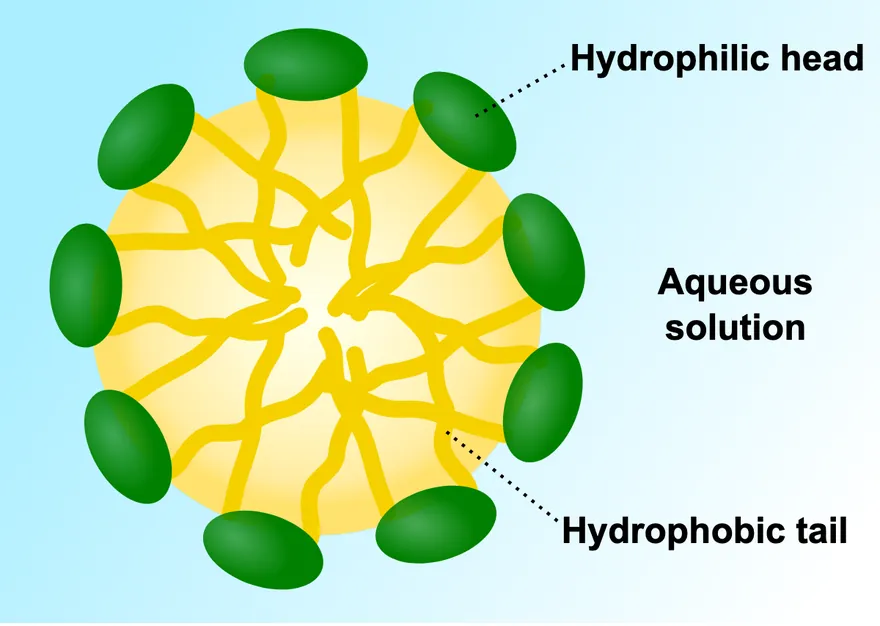
- A soap molecule has a hydrophilic head (water-loving) and a hydrophobic tail (oil-loving).
- Tails trap an oil droplet forming a micelle, which floats dirt away and makes water look cloudy.
- Soap fails in hard water (Ca/Mg salts), forming sticky scum and poor lather.
- Synthetic detergents lather even in hard and cold water; classed as anionic, cationic, non-ionic.
Check yourself
What is soap chemically?
The sodium or potassium salt of a long-chain fatty acid (stearic, oleic, palmitic). Potassium soaps (from KOH) are softer on skin than sodium soaps.
What is saponification?
Heating fat or oil with NaOH to give soap plus glycerol.
How does a soap molecule clean?
It has a hydrophilic (water-loving) head and a hydrophobic (oil-loving) tail. The tails trap an oil droplet forming a micelle, which floats dirt away and makes water look cloudy.
Why does soap fail in hard water?
Ca/Mg salts form sticky scum and poor lather. Synthetic detergents lather even in hard and cold water — they are anionic, cationic or non-ionic.
What are quicklime and slaked lime?
Quicklime = CaO, made by heating limestone (CaCO₃ → CaO + CO₂). Adding water gives slaked lime, Ca(OH)₂, with much heat.
What does this diagram show?
Soaps & Detergents
Polymers, Plastics & Rubber
- A polymer is a giant molecule made of many small repeating units called monomers.
- Addition polymerisation: monomers add on with nothing eliminated (e.g. polythene).
- Condensation polymerisation: monomers join and eject a small molecule like water.
- Copolymerisation uses two different monomers, e.g. buna-S from butadiene and styrene.
- Natural rubber is a polymer of isoprene (2-methyl-1,3- butadiene).
- Thermoplastics (PVC, polythene) soften and re-mould on heating; thermosetting plastics (bakelite, melamine) set permanently.
- Teflon (PTFE) coats non-stick cookware; polycarbonate is used in CDs, DVDs and helmets.
| Type | Behaviour on heating | Examples |
|---|---|---|
| Thermoplastic | Softens, re-mouldable | PVC, Polythene |
| Thermosetting | Sets permanently | Bakelite, Melamine |
Check yourself
Addition vs condensation polymerisation?
Addition: monomers add on with nothing eliminated (polythene). Condensation: monomers join and eject a small molecule like water.
What is copolymerisation? Give an example.
Polymerisation using two different monomers — e.g. buna-S from butadiene and styrene.
Uses of Teflon and polycarbonate?
Teflon (PTFE) coats non-stick cookware. Polycarbonate (Lexan) is used in CDs, DVDs and helmets.
A is a giant molecule made of many small repeating units called monomers.
A polymer is a giant molecule made of many small repeating units called monomers.
is a polymer of isoprene (2-methyl-1,3- butadiene).
Natural rubber is a polymer of isoprene (2-methyl-1,3- butadiene).
(PVC, polythene) soften and re-mould on heating; thermosetting plastics (bakelite, melamine) set permanently.
Thermoplastics (PVC, polythene) soften and re-mould on heating; thermosetting plastics (bakelite, melamine) set permanently.
Type: Thermoplastic → Behaviour on heating · Examples?
- Behaviour on heating
- Softens, re-mouldable
- Examples
- PVC, Polythene
Type: Thermosetting → Behaviour on heating · Examples?
- Behaviour on heating
- Sets permanently
- Examples
- Bakelite, Melamine
Fibres (Natural & Synthetic)
- Kevlar is an extremely strong fibre used in bullet-proof jackets and helmets.
- Boron fibres are also used in bullet-proof vests; both are very lightweight and tough.
- Rayon is 'artificial silk', made from cellulose/wood pulp.
- Acrylic is a synthetic fibre resembling wool (not made from cotton).
- Cotton is a natural plant fibre, good for summer as it absorbs sweat.
- PHBV is a biodegradable polymer used in eco-friendly packaging and drug release.
- Polyblend mixes recycled plastic powder with bitumen for longer-lasting, water-repellent roads.
| Fibre | Type | Key use |
|---|---|---|
| Kevlar | Synthetic | Bullet-proof gear |
| Rayon | Semi-synthetic | Artificial silk |
| Acrylic | Synthetic | Wool-like clothing |
| Cotton | Natural | Summer clothing |
Check yourself
What is Kevlar, and what is it used for?
A synthetic aramid fibre from DuPont, about five times stronger than steel per unit weight — used in bullet-proof jackets and helmets. Developed by Stephanie Kwolek in 1965. Boron fibres are also used in vests.
Which fibre is called 'artificial silk'?
Rayon — regenerated cellulose made from wood pulp. NOT acrylic, and NOT modified starch.
What is acrylic, and what is cotton good for?
Acrylic is a synthetic fibre resembling wool ('synthetic wool'), not made from cotton. Cotton is a natural plant fibre, good for summer as it absorbs sweat.
What are PHBV and Polyblend used for?
PHBV is a biodegradable polymer for eco-friendly packaging, surgical sutures and drug release. Polyblend mixes recycled plastic powder with bitumen for longer-lasting, water-repellent roads.
Origins of linen, coir, mohair and down?
Linen — flax plant · Coir — coconut husk · Mohair — Angora goat · Down — feathers of duck and geese.
Silver bromide vs silver iodide?
AgBr is light-sensitive and used in photographic films. AgI is used for cloud seeding to make artificial rain.
Neoprene, aspartame, oxytocin, rayon — identify each.
Specialised synthetic rubber · synthetic sweetener (~200× sweeter than sugar) · hormone · regenerated cellulose, NOT modified starch.
Fibre: Kevlar → Type · Key use?
- Type
- Synthetic
- Key use
- Bullet-proof gear
Fibre: Rayon → Type · Key use?
- Type
- Semi-synthetic
- Key use
- Artificial silk
Fibre: Acrylic → Type · Key use?
- Type
- Synthetic
- Key use
- Wool-like clothing
Fibre: Cotton → Type · Key use?
- Type
- Natural
- Key use
- Summer clothing
Allotropes of Carbon
- Allotropes are different physical forms of the same element; carbon has many.
- Diamond is the hardest natural substance; each carbon bonds to four others in 3D.
- Graphite is soft, slippery and the only non-metal that conducts electricity well.
- Graphite is thermodynamically the most stable form of carbon, not diamond.
- Fullerene (C-60) is a football-shaped molecule; graphene is a single sheet of carbon atoms.
- Lab-grown diamonds (LGDs) use a tiny diamond seed to start crystal growth.
- Charcoal, coke and lamp black are amorphous (non-crystalline) forms of carbon.
| Allotrope | Structure | Property |
|---|---|---|
| Diamond | 3D tetrahedral | Hardest, insulator |
| Graphite | Flat layers | Soft, conducts |
| Fullerene | Spherical C-60 | Molecular form |
Check yourself
Which is the thermodynamically most stable form of carbon?
Graphite, not diamond. Diamond is harder but metastable.
Diamond vs graphite — structure and property?
Diamond: 3D tetrahedral lattice, hardest natural substance, an insulator. Graphite: flat layers, soft and slippery, and the only non-metal that conducts electricity well.
What are fullerene and graphene?
Fullerene (C-60) is a football-shaped molecule; graphene is a single sheet of carbon atoms, a nanostructure (not an alloy or isotope). Stacked graphene layers make graphite.
What seed is used to grow lab-grown diamonds?
A tiny slice of graphite (pure carbon). LGDs are made by HPHT or CVD; moissanite, white sapphire and cubic zirconia are only simulants.
Which forms of carbon are amorphous?
Charcoal, coke and lamp black — non-crystalline forms.
Chronological order of lab synthesis: black gold, fullerene, graphene, Kevlar?
Kevlar (1965) → Fullerene (1985) → Graphene (2004) → Black gold (petroleum) — order 4-2-3-1.
are different physical forms of the same element; carbon has many.
Allotropes are different physical forms of the same element; carbon has many.
is the hardest natural substance; each carbon bonds to four others in 3D.
Diamond is the hardest natural substance; each carbon bonds to four others in 3D.
use a tiny diamond seed to start crystal growth.
Lab-grown diamonds (LGDs) use a tiny diamond seed to start crystal growth.
Allotrope: Diamond → Structure · Property?
- Structure
- 3D tetrahedral
- Property
- Hardest, insulator
Allotrope: Graphite → Structure · Property?
- Structure
- Flat layers
- Property
- Soft, conducts
Allotrope: Fullerene → Structure · Property?
- Structure
- Spherical C-60
- Property
- Molecular form
Metals, Alloys & Ores
- An alloy is a homogeneous mix of a metal with other metals or non-metals to improve properties.
- Brass = copper + zinc; bronze = copper + tin.
- Sodium is a soft, highly reactive metal stored under kerosene; it is a good conductor.
- Galvanisation coats iron with zinc to prevent rusting.
- Oil is not stored in galvanised iron because the zinc coating reacts with oil's free fatty acids.
- Silver articles turn black in air due to silver sulphide from H2S in the atmosphere.
- Bauxite is the ore of aluminium; ores are minerals from which metal is profitably extracted.
| Alloy | Composition | Use |
|---|---|---|
| Brass | Copper + Zinc | Utensils, fittings |
| Bronze | Copper + Tin | Statues, coins |
| Steel | Iron + Carbon | Construction |
Check yourself
What is an alloy? Give the three exam alloys.
A homogeneous mix of a metal with other metals or non-metals. Brass = copper + zinc, bronze = copper + tin, steel = iron + carbon.
What are cupronickel and sterling silver?
Copper + nickel and silver + copper — common distractors against brass and bronze.
Why is sodium stored in kerosene?
It is soft and highly reactive — it would react with air and moisture. It is also a good conductor and can be cut with a knife.
What is galvanisation, and why is oil not stored in galvanised iron?
Galvanisation coats iron with zinc to prevent rusting. But the zinc coating reacts with oil's free fatty acids, forming toxic compounds and causing rancidity.
Why do silver articles turn black?
Tarnishing — H₂S in the atmosphere forms a black coating of silver sulphide (Ag₂S).
Match the ores: bauxite, cinnabar, calamine, galena, limonite.
Bauxite — aluminium · Cinnabar — mercury · Calamine — zinc · Galena — lead · Limonite — iron (with hematite and magnetite).
Which two ores of aluminium appear together in exams?
Corundum (Al₂O₃) and cryolite (Na₃AlF₆). Cryolite is the flux in the Hall-Héroult process; corundum's varieties are ruby and sapphire.
Smelting vs roasting vs calcination vs froth flotation?
Smelting: heat ore with a reducing agent (coke) to get molten metal. Roasting: heat sulphide ore in excess air. Calcination: heat carbonate ore in limited air. Froth flotation: only ore concentration, not extraction.
Which are the true noble metals?
Gold, silver, platinum and the platinum group — found in pure (native) form in nature. Uranium and lead are NOT noble metals.
Properties of sodium, mercury, silver and lead in the matching question?
Sodium — easily cut with a knife. Mercury — liquid at room temperature. Silver — best conductor of electricity. Lead — poor conductor of heat.
What material makes smart (switchable) film?
Indium tin oxide (ITO) — a transparent conducting oxide combining conductivity with optical transparency.
Metals in vitamin B12, haemoglobin, chlorophyll and brass?
Cobalt, iron, magnesium, and copper (brass = copper + zinc).
; ores are minerals from which metal is profitably extracted.
Bauxite is the ore of aluminium; ores are minerals from which metal is profitably extracted.
Alloy: Brass → Composition · Use?
- Composition
- Copper + Zinc
- Use
- Utensils, fittings
Alloy: Bronze → Composition · Use?
- Composition
- Copper + Tin
- Use
- Statues, coins
Alloy: Steel → Composition · Use?
- Composition
- Iron + Carbon
- Use
- Construction
Important Compounds & Their Uses
- Baking soda is sodium hydrogen carbonate (NaHCO3); used in fire extinguishers and cooking.
- Blue Vitriol is copper sulphate (CuSO4.5H2O); used as fungicide and in electroplating.
- Bhopal Gas Tragedy (1984) was caused by leakage of Methyl Isocyanate (MIC).
- Urea contains carbon, hydrogen, oxygen and nitrogen; it was the first organic compound synthesised in lab.
- Cisplatin, a platinum compound, is used to treat cancer (carcinoma).
- Taxol is an anti-cancer drug; HMX stands for High Melting Explosive.
- Caffeine is an alkaloid present in tea, coffee and cola.
| Compound | Identity / Use |
|---|---|
| Baking soda | NaHCO3, fire extinguisher |
| Blue Vitriol | CuSO4, fungicide |
| Cisplatin | Cancer treatment |
| MIC | Bhopal tragedy gas |
Check yourself
Which metal is called white metal?
Platinum (Pt) — silvery-white lustre, high corrosion resistance, a noble metal with a very high melting point.
What caused the Bhopal Gas Tragedy?
The leak of Methyl Isocyanate (MIC) from the Union Carbide pesticide plant on 3 December 1984 — about 40 tonnes escaped.
What elements does urea contain?
Carbon, hydrogen, oxygen and nitrogen — CO(NH₂)₂. It was the first organic compound synthesised in a lab and is a high-nitrogen fertilizer.
What are cisplatin, Taxol and HMX?
Cisplatin — a platinum compound used to treat carcinoma. Taxol — an anti-cancer drug. HMX — High Melting Explosive.
Which everyday substance contains no oxygen?
Kerosene — a pure hydrocarbon of only carbon and hydrogen. Soil, glass and cement all contain oxygen. Methane and benzene are also oxygen-free.
Uses: blue vitriol, eosin, silver iodide, zinc phosphide?
Fungicide, red ink, artificial rain, rodenticide.
Kevlar, Taxol, zinc phosphide, nitrocellulose — match them.
Synthetic fibre, anticancer drug, rodenticide, explosive/propellant.
Which substance is NOT an explosive: TNT, nitroglycerine, RDX, nitrochloroform?
Nitrochloroform (chloropicrin) — a fumigant, pesticide and tear-gas, not an explosive.
Pasteurisation, desalination, reverse osmosis, denaturation — what does each act on?
Milk (brief high-temperature heating, not tea) · sea water · potable water through a membrane · proteins, whose weak bonds break.
Where is caffeine found?
It is an alkaloid present in tea, coffee and cola — a bitter white crystalline psychoactive stimulant. Lemon water has vitamin C, not caffeine.
Which firework colour comes from which metal?
Strontium — red · Sodium — yellow · Magnesium — brilliant white · Copper — blue.
What are the constituents of a soda acid fire extinguisher?
Sodium bicarbonate (NaHCO₃) solution and dilute sulphuric acid — they react to release CO₂: 2NaHCO₃ + H₂SO₄ → Na₂SO₄ + H₂O + 2CO₂.
is sodium hydrogen carbonate (NaHCO3); used in fire extinguishers and cooking.
Baking soda is sodium hydrogen carbonate (NaHCO3); used in fire extinguishers and cooking.
is copper sulphate (CuSO4.5H2O); used as fungicide and in electroplating.
Blue Vitriol is copper sulphate (CuSO4.5H2O); used as fungicide and in electroplating.
Compound: Baking soda → Identity / Use?
- Identity / Use
- NaHCO3, fire extinguisher
Compound: Blue Vitriol → Identity / Use?
- Identity / Use
- CuSO4, fungicide
Compound: Cisplatin → Identity / Use?
- Identity / Use
- Cancer treatment
Compound: MIC → Identity / Use?
- Identity / Use
- Bhopal tragedy gas
Medicines & Drugs
- The most useful classification of medicines is by their action on a particular target (drug-target).
- Sulpha drugs are antibacterials (antimicrobials) that fight bacterial infection.
- Analgesics relieve pain; antipyretics reduce fever; antibiotics kill microbes.
- Antacids like baking soda and milk of magnesia neutralise excess stomach acid.
- Oral contraceptive pills contain synthetic hormones (estrogen and progesterone derivatives).
- The breath analyser for drunk driving uses potassium dichromate on filter paper.
- Herbicides kill unwanted plants; e.g. 2,4-D and atrazine.
Check yourself
What is the most useful basis for classifying medicines?
By molecular targets — the biomolecules a drug acts upon (proteins, carbohydrates, lipids, nucleic acids, receptors, enzymes), because drugs sharing a target share a mechanism of action.
What are sulpha drugs?
Antibacterials (antimicrobials), first used in the 1930s; they block bacterial folate synthesis by inhibiting dihydropteroate synthase.
Analgesic, antipyretic, antibiotic, antacid — what does each do?
Analgesics relieve pain · antipyretics reduce fever · antibiotics kill microbes · antacids (baking soda, milk of magnesia) neutralise excess stomach acid.
What is used on the filter paper of a police breath analyser?
Potassium dichromate–sulfuric acid. Orange Cr₂O₇²⁻ (Cr⁶⁺) oxidises ethanol and turns green Cr³⁺; the extent of colour change shows blood alcohol concentration.
What is in oral contraceptive pills?
Synthetic hormones — estrogen and progesterone derivatives. Levonorgestrel mimics progesterone and prevents ovulation.
What are herbicides? Give examples.
Chemicals that kill unwanted weeds — e.g. 2,4-D, atrazine and sodium chlorate. Potassium permanganate and bleaching powder are disinfectants, not herbicides.
The most useful is by their action on a particular target (drug-target).
The most useful classification of medicines is by their action on a particular target (drug-target).
Gases in Daily Life & Industry
- LPG is mainly butane (with propane); used as cooking gas.
- Nitrous oxide (N2O) is known as laughing gas.
- Chlorine gas is used to purify (disinfect) drinking water.
- Steam Methane Reforming is used to obtain hydrogen gas.
- Hydrogen is stored physically as compressed gas or cryogenic (very cold) liquid.
- Oxygen is absent in compounds like hydrocarbons (e.g. methane, benzene).
- Hg in '140 mm Hg' blood pressure refers to mercury.
Check yourself
Which gas is laughing gas?
Nitrous oxide (N₂O) — first prepared by Joseph Priestley (1772), used as a dental/medical anaesthetic. Prepared by thermal decomposition of ammonium nitrate.
Which chemicals disinfect drinking water?
Chlorine gas, and also ozone (O₃), chlorine dioxide and chloramine. Ozone is a stronger oxidiser than chlorine.
Which hydrogen does Steam Methane Reforming produce?
Grey hydrogen — SMR releases CO₂. Brown comes from coal gasification; green from water electrolysis using renewable energy.
How is hydrogen stored physically?
By compressing hydrogen gas to 350–700 bar, or as a cryogenic liquid. Storing it as metal hydrides is chemical storage, not physical.
What gas is used in cigarette lighters?
Butane (C₄H₁₀) — stored under pressure as a liquid, it vaporises to a flammable gas when released.
What does 'Hg' mean in '140 mm Hg' blood pressure?
Mercury — pressure is read as the height of a mercury column. Normal adult reading is about 120/80 mm Hg.
is mainly butane (with propane); used as cooking gas.
LPG is mainly butane (with propane); used as cooking gas.
in compounds like hydrocarbons (e.g. methane, benzene).
Oxygen is absent in compounds like hydrocarbons (e.g. methane, benzene).
Environmental & Air Pollution Chemistry
- Greenhouse gases trap heat: carbon dioxide, methane, CFCs, nitrous oxide and water vapour.
- Oxygen is NOT a greenhouse gas; common trick in exams.
- CO2 mainly comes from thermal power stations and burning fossil fuels.
- CFCs (chlorofluorocarbons) damage the ozone layer and come from refrigerants and aerosols.
- RSPM (Respirable Suspended Particulate Matter) is fine dust below 10 micrometres, harmful to lungs.
- Crystallisation purifies solids; sand and naphthalene are separated by sublimation.
- Naphthalene sublimes (solid to gas directly), leaving sand behind.
| Greenhouse gas | Main source |
|---|---|
| Carbon dioxide | Thermal power stations |
| CFC | Refrigerants, aerosols |
| Methane | Paddy fields, cattle |
Check yourself
What is the night-glowing pigment used in exams?
Europium-doped strontium aluminate (SrAl₂O₄) — phosphorescent, non-toxic, afterglow up to 12 hours.
Name the greenhouse gases.
Carbon dioxide, methane, CFCs, nitrous oxide and water vapour. Oxygen is NOT a greenhouse gas — a common exam trick.
Match the greenhouse gas to its source.
CO₂ — thermal power stations and fossil fuels · CFCs — refrigerants and aerosols (not automobiles) · Methane/nitrous oxide — paddy fields and cattle · SO₂ — brick kilns.
What is RSPM?
Respirable Suspended Particulate Matter — fine dust below 5–10 micrometres that is inhaled deep into the lungs; mainly from combustion, vehicles and industry.
How are sand and naphthalene separated?
By sublimation — naphthalene turns straight to vapour and escapes, leaving the non-volatile sand. Crystallisation purifies solids.
mainly comes from thermal power stations and burning fossil fuels.
CO2 mainly comes from thermal power stations and burning fossil fuels.
damage the ozone layer and come from refrigerants and aerosols.
CFCs (chlorofluorocarbons) damage the ozone layer and come from refrigerants and aerosols.
Naphthalene (solid to gas directly), leaving sand behind.
Naphthalene sublimes (solid to gas directly), leaving sand behind.
Greenhouse gas: Carbon dioxide → Main source?
- Main source
- Thermal power stations
Greenhouse gas: CFC → Main source?
- Main source
- Refrigerants, aerosols
Greenhouse gas: Methane → Main source?
- Main source
- Paddy fields, cattle
All 11 chapters of Chemistry notes
- Basic Concepts, Matter & Measurement13 sections
- Structure of Atom12 sections
- Periodic Table & Periodicity11 sections
- Chemical Bonding & Molecular Structure12 sections
- States of Matter & Gas Laws12 sections
- Chemical Reactions, Equilibrium & Catalysis13 sections
- Acids, Bases & Salts13 sections
- Organic Chemistry & Hydrocarbons12 sections
- Chemistry in Everyday Life & Important Compounds11 sections
- Biomolecules (Chemistry)13 sections
- Radioactivity & Nuclear Chemistry11 sections