A biomolecule is any chemical compound made by living things (plants, animals, microbes) used to live, grow and work.
The four major classes are carbohydrates, proteins, lipids and nucleic acids.
Food supplies five main nutrients: carbohydrates, proteins, fats, vitamins and minerals, plus fibre and water.
A monomer is one small unit; a polymer is a long chain of many monomers; a macromolecule is a very large polymer.
Only three are true macromolecules: proteins, nucleic acids and polysaccharides; lipids are not (they are smaller).
If all units are alike it is a homopolymer; if units differ it is a heteropolymer (e.g. protein).
Check yourself
Name the four major classes of biomolecules.
Carbohydrates, proteins, lipids and nucleic acids.
Which biomolecules are true macromolecules?
Only proteins, nucleic acids and polysaccharides. Lipids are NOT macromolecules — they are smaller.
Homopolymer vs heteropolymer?
Homopolymer: all repeating units are alike. Heteropolymer: units differ — e.g. a protein, built from 20 different amino acids.
A is any chemical compound made by living things (plants, animals, microbes) used to live, grow and work.
A biomolecule is any chemical compound made by living things (plants, animals, microbes) used to live, grow and work.
Food supplies five main nutrients: proteins, fats, vitamins and minerals, plus fibre and water.
Food supplies five main nutrients: carbohydrates,proteins, fats, vitamins and minerals, plus fibre and water.
A is one small unit; a polymer is a long chain of many monomers; a macromolecule is a very large polymer.
A monomer is one small unit; a polymer is a long chain of many monomers; a macromolecule is a very large polymer.
Elements in Each Biomolecule
Carbohydrates and lipids contain mainly carbon, hydrogen and oxygen (C, H, O).
Proteins contain C, H, O plus nitrogen (N) and often sulphur (S).
Nucleic acids contain C, H, O, nitrogen and also phosphorus (P).
Exam key: nitrogen marks proteins and nucleic acids; phosphorus marks nucleic acids.
Nitrogen is not a constituent of pure carbohydrates or fats.
Biomolecule
Monomer
Key elements
Carbohydrate
Monosaccharide
C, H, O
Protein
Amino acid
C, H, O, N, S
Lipid (fat)
Fatty acid + glycerol
C, H, O
Nucleic acid
Nucleotide
C, H, O, N, P
Check yourself
Which elements are in carbohydrates and lipids?
Only carbon, hydrogen and oxygen (C, H, O) — no nitrogen.
Which elements mark proteins and nucleic acids?
Proteins: C, H, O plus nitrogen (N) and often sulphur (S). Nucleic acids: C, H, O, N plus phosphorus (P).
Exam key on nitrogen — where is it and where is it not?
Nitrogen marks proteins and nucleic acids (and chlorophyll). It is NOT a constituent of pure carbohydrates or fats.
What is natural silk made of, and which element marks it?
The proteins fibroin and sericin, chains of amino acids — so silk is rich in nitrogen (the amine −NH₂ group). Potassium, magnesium and phosphorus are absent.
Fructose > sucrose > glucose > maltose > lactose. Fructose is the sweetest naturally occurring sugar and gives fruits their sweet taste.
What is invert sugar, and why is it sweeter than sucrose?
Glucose + fructose, made by hydrolysing sucrose with invertase. It is sweeter because it contains free fructose — hydrolysis explains its origin, not its sweetness.
Disaccharide: Sucrose → Two sugars inside?
Two sugars inside
Glucose + fructose
Disaccharide: Maltose → Two sugars inside?
Two sugars inside
Glucose + glucose
Disaccharide: Lactose → Two sugars inside?
Two sugars inside
Glucose + galactose
Fermentation and Key Enzymes
Fermentation is yeast breaking down sugar without air (anaerobically) into ethyl alcohol and carbon dioxide.
The CO2 released makes bread dough rise; the alcohol makes fermented drinks.
The enzyme that converts glucose to ethyl alcohol is zymase: C6H12O6 → 2 C2H5OH + 2 CO2.
Full path from starch: diastase → maltase → zymase (starch to maltose to glucose to alcohol).
Remember the pairing: zymase = glucose to alcohol.
Enzyme
Acts on
Produces
Invertase
Sucrose
Glucose + fructose
Maltase
Maltose
Glucose
Diastase
Starch
Maltose
Zymase
Glucose
Ethanol + CO2
Check yourself
What is fermentation?
Yeast breaking down sugar without air (anaerobically) into ethyl alcohol and carbon dioxide. The CO₂ makes bread dough rise; the alcohol makes fermented drinks.
Which enzyme converts glucose to ethyl alcohol?
Zymase: C₆H₁₂O₆ → 2 C₂H₅OH + 2 CO₂. Remember the pairing — zymase = glucose to alcohol.
What is the full enzyme path from starch to alcohol?
Proteins are the main building and repair material (muscle, skin, hair) and act as enzymes.
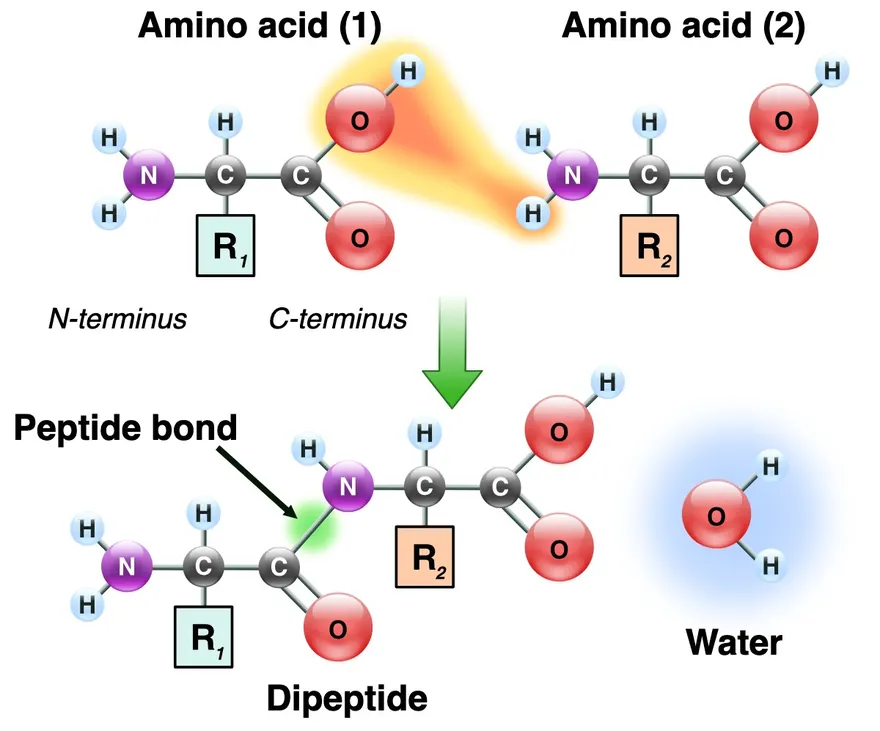
The monomer of a protein is an amino acid; there are 20 types of amino acids.
A protein is a heteropolymer because it uses different amino-acid units.
Essential amino acids must come from food; non-essential amino acids are made by the body.
Amino acids join through the peptide bond; the chain runs from the N-terminal to the C-terminal.
Collagen is the most abundant protein in animals; RuBisCO is the most abundant protein in the biosphere.
Proteins (The Body's Builders)
Check yourself
What is the monomer of a protein?
An amino acid — there are 20 types, joined by the peptide bond; the chain runs from the N-terminal to the C-terminal.
Essential vs non-essential amino acids?
Essential must come from food; non-essential are made by the body.
Most abundant protein in animals and in the biosphere?
Collagen in animals; RuBisCO in the biosphere.
Proteins are the main (muscle, skin, hair) and act as enzymes.
Proteins are the main building and repair material (muscle, skin, hair) and act as enzymes.
What does this diagram show?
Proteins (The Body's Builders)
Functions and Special Proteins
Proteins transport nutrients across cell membranes (e.g. carrier proteins).
As antibodies they fight infection; as hormones (e.g. insulin) they signal.
As enzymes they speed up reactions; as receptors they receive signals.
Keratin (a protein) is the chief constituent of hair, nails and natural silk/wool.
Tyrosine is an amino acid in protein-rich food, a precursor of thyroid hormone and melanin.
Casein protein gives milk its white colour (by scattering light along with fat).
Check yourself
What do proteins do in the body?
Transport nutrients across membranes, act as antibodies against infection, as hormones (insulin), as enzymes speeding reactions, and as receptors receiving signals.
What is keratin?
The protein that is the chief constituent of hair, nails and natural silk/wool.
What is tyrosine, and what does it NOT do?
An amino acid in protein-rich food, precursor of thyroid hormone and melanin; it boosts energy, helps with stress and combats depression. It does NOT protect against free radicals — that is the role of antioxidants.
Why is milk white?
Casein protein forms micelles with calcium and phosphate that scatter and reflect light (along with fat). Lactose, albumins and carotenes are not responsible.
Four Levels of Protein Structure
Primary structure is the exact order (sequence) of amino acids in the chain.
Secondary structure is local coiling into a helix or folding into a beta-pleated sheet; only right-handed helices occur.
Tertiary structure is the full 3-D folded shape, essential for the protein to work.
Quaternary structure is two or more folded chains joining together.
Haemoglobin, the blood oxygen-carrier, is a classic quaternary protein (four chains).
Heat or acid denatures a protein – it unfolds and loses function (e.g. egg white cooking).
Level
What it is
Primary
Sequence of amino acids
Secondary
Helix / beta-sheet
Tertiary
Full 3-D folded shape
Quaternary
Several chains joined
Check yourself
Name the four levels of protein structure.
Primary — sequence of amino acids. Secondary — helix or beta-pleated sheet (only right-handed helices). Tertiary — the full 3-D folded shape. Quaternary — several folded chains joined.
Give a classic quaternary protein.
Haemoglobin, the blood oxygen-carrier — it has four chains.
What is denaturation?
Heat or acid unfolds a protein and it loses function — as when egg white cooks.
Level: Primary → What it is?
What it is
Sequence of amino acids
Level: Secondary → What it is?
What it is
Helix / beta-sheet
Level: Tertiary → What it is?
What it is
Full 3-D folded shape
Level: Quaternary → What it is?
What it is
Several chains joined
Lipids (Fats and Oils)
Lipids are fats and oils – the body's most concentrated energy store (more energy per gram than carbohydrate).
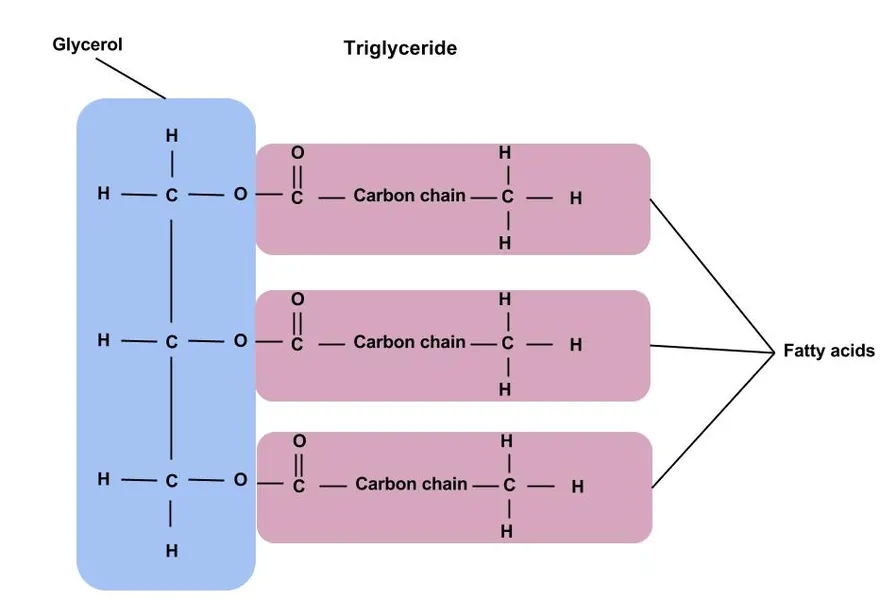
A fat is made of glycerol + three fatty acids (a triglyceride).
Saturated fats (no double bonds) are solid, mostly animal; unsaturated fats (double bonds) are liquid oils, mostly plant.
Lipids form cell membranes (phospholipids) and store fat-soluble vitamins.
Cholesterol is a steroid lipid; it builds membranes and is the raw material for some hormones.
Fat type
Bonds
State / source
Saturated
No double bonds
Solid, animal fat
Unsaturated
Has double bonds
Liquid oil, plant
Lipids (Fats and Oils)
Check yourself
What is a fat made of?
Glycerol + three fatty acids — a triglyceride. Lipids are the body's most concentrated energy store.
Saturated vs unsaturated fats?
Saturated: no double bonds, solid, mostly animal. Unsaturated: has double bonds, liquid oils, mostly plant.
What is cholesterol?
A steroid lipid — it builds membranes and is the raw material for some hormones.
are fats and oils – the body's most concentrated energy store (more energy per gram than carbohydrate).
Lipids are fats and oils – the body's most concentrated energy store (more energy per gram than carbohydrate).
Lipids form (phospholipids) and store fat-soluble vitamins.
Lipids form cell membranes (phospholipids) and store fat-soluble vitamins.
Fat type: Saturated → Bonds · State / source?
Bonds
No double bonds
State / source
Solid, animal fat
Fat type: Unsaturated → Bonds · State / source?
Bonds
Has double bonds
State / source
Liquid oil, plant
What does this diagram show?
Lipids (Fats and Oils)
Nucleic Acids (DNA and RNA)
Nucleic acids store and carry genetic information; the two types are DNA and RNA.
Their monomer is the nucleotide = nitrogen base + sugar + phosphate.
DNA has the sugar deoxyribose and is a double helix; RNA has ribose and is single-stranded.
DNA bases are A, T, G, C; in RNA, thymine (T) is replaced by uracil (U).
Base pairing rule: A pairs with T (or U), and G pairs with C.
Feature
DNA
RNA
Sugar
Deoxyribose
Ribose
Bases
A, T, G, C
A, U, G, C
Strands
Double
Single
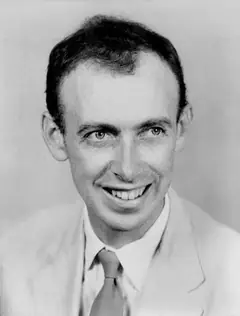
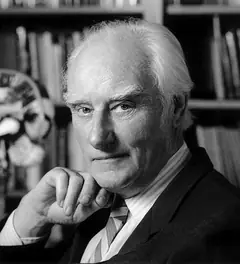
James WatsonFrancis CrickDNA's double-helix model was given by Watson and Crick (1953).
Check yourself
What is the monomer of a nucleic acid?
The nucleotide = nitrogen base + sugar + phosphate.
DNA vs RNA — sugar, strands and bases?
DNA: deoxyribose, double helix, bases A T G C. RNA: ribose, single-stranded, thymine replaced by uracil (U).
State the base pairing rule.
A pairs with T (or U), and G pairs with C.
Who gave DNA's double-helix model?
Watson and Crick, 1953.
store and carry genetic information; the two types are DNA and RNA.
Nucleic acids store and carry genetic information; the two types are DNA and RNA.
Feature: Sugar → DNA · RNA?
DNA
Deoxyribose
RNA
Ribose
Feature: Bases → DNA · RNA?
DNA
A, T, G, C
RNA
A, U, G, C
Feature: Strands → DNA · RNA?
DNA
Double
RNA
Single
Who is this, and what should you remember about them?
James Watson
DNA's double-helix model was given by Watson and Crick (1953).
Who is this, and what should you remember about them?
Francis Crick
DNA's double-helix model was given by Watson and Crick (1953).
Enzymes (Biological Catalysts)
Enzymes are mostly proteins that speed up body reactions without being used up – biological catalysts.
Each enzyme is specific, acting on one substrate (lock-and-key model).
They work best at an optimum temperature and pH; extreme heat denatures and destroys them.
Names usually end in -ase (maltase, lactase, lipase).
Check yourself
What are enzymes?
Mostly proteins that speed up body reactions without being used up — biological catalysts. Each is specific, acting on one substrate (lock-and-key model), and names usually end in -ase.
What destroys enzyme activity?
Extreme heat — it denatures them. They work best at an optimum temperature and pH.
Name the three digestive enzymes and what they act on.