An element is the simplest pure substance that cannot be split into anything simpler by chemical means.
There are about 118 known elements; only about 94 occur naturally, the rest are man-made.
The Periodic Table arranges elements so that those with similar properties sit in the same column.
Properties repeat at regular intervals; this repeating pattern is called periodicity.
Its big use is prediction – an element's place tells you its size, reactivity and bonding.
Check yourself
How many elements occur naturally?
About 94 of the 118 known elements occur naturally; the rest are man-made.
What is periodicity?
Properties repeat at regular intervals, so elements with similar properties sit in the same column.
An is the simplest pure substance that cannot be split into anything simpler by chemical means.
An element is the simplest pure substance that cannot be split into anything simpler by chemical means.
The arranges elements so that those with similar properties sit in the same column.
The Periodic Table arranges elements so that those with similar properties sit in the same column.
Its big use is – an element's place tells you its size, reactivity and bonding.
Its big use is prediction – an element's place tells you its size, reactivity and bonding.
History – Scientists Who Built the Table
Döbereiner (1817) grouped elements into triads: mass of the middle element ≈ average of the other two.
Newlands (1866) gave the Law of Octaves – every eighth element had similar properties; it broke down after calcium.
Mendeleev's Periodic Law: properties are a periodic function of atomic mass.
Year
Scientist
Contribution
1817
Döbereiner
Law of Triads
1866
Newlands
Law of Octaves
1869
Mendeleev
Periodic Law (atomic mass)
1913
Moseley
Atomic number is the true basis
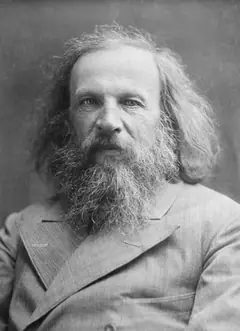
D. MendeleevMendeleev (1869) arranged 63 elements by atomic mass and left gaps, predicting eka-aluminium (gallium) and eka-silicon (germanium).
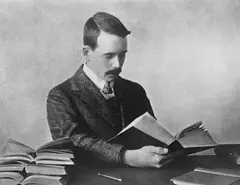
Henry MoseleyMoseley (1913) proved order depends on atomic number, fixing Mendeleev's wrong-order pairs.
Check yourself
Döbereiner's contribution (1817)?
Law of Triads — the mass of the middle element is about the average of the other two.
Newlands' contribution (1866)?
Law of Octaves — every eighth element had similar properties. It broke down after calcium.
What did Mendeleev do in 1869?
Gave the Periodic Law based on atomic mass, arranged 63 elements and left gaps, predicting eka-aluminium (gallium) and eka-silicon (germanium).
What did Moseley prove in 1913?
That order depends on atomic number, not atomic mass — fixing Mendeleev's wrong-order pairs like argon–potassium and cobalt–nickel, and giving isotopes a proper place.
Year: 1817 → Scientist · Contribution?
Scientist
Döbereiner
Contribution
Law of Triads
Year: 1866 → Scientist · Contribution?
Scientist
Newlands
Contribution
Law of Octaves
Year: 1869 → Scientist · Contribution?
Scientist
Mendeleev
Contribution
Periodic Law (atomic mass)
Year: 1913 → Scientist · Contribution?
Scientist
Moseley
Contribution
Atomic number is the true basis
Who is this, and what should you remember about them?
Dmitri Mendeleev
Mendeleev (1869) arranged 63 elements by atomic mass and left gaps, predicting eka-aluminium (gallium) and eka-silicon (germanium).
It also gave a proper place to isotopes, which Mendeleev's mass-based table could not.
Who is this, and what should you remember about them?
Henry Moseley
Moseley (1913) proved order depends on atomic number, fixing Mendeleev's wrong-order pairs.
Modern Periodic Law
Modern Periodic Law: properties of elements are a periodic function of their atomic numbers.
Atomic number (Z) = number of protons; it defines the element and fixes its place.
Using atomic number removed defects like the argon– potassium and cobalt–nickel wrong-order pairs.
The version used today is the long form Periodic Table.
D. MendeleevIt also gave a proper place to isotopes, which Mendeleev's mass-based table could not.
Check yourself
State the Modern Periodic Law.
Properties of elements are a periodic function of their atomic numbers. The version used today is the long form periodic table.
= number of protons; it defines the element and fixes its place.
Atomic number (Z) = number of protons; it defines the element and fixes its place.
Inside the Atom
The nucleus is the tiny dense centre holding protons (+) and neutrons (no charge).
Electrons (−) move around the nucleus; the atom is mostly empty space.
Mass number (A) = protons + neutrons.
Number of neutrons is found by neutrons = A − Z.
Outermost-shell electrons are the valence electrons and control all chemistry.
Check yourself
The is the tiny dense centre holding protons (+) and neutrons (no charge).
The nucleus is the tiny dense centre holding protons (+) and neutrons (no charge).
(−) move around the nucleus; the atom is mostly empty space.
Electrons (−) move around the nucleus; the atom is mostly empty space.
= protons + neutrons.
Mass number (A) = protons + neutrons.
Number of neutrons is found by .
Number of neutrons is found by neutrons = A − Z.
Outermost-shell electrons are the and control all chemistry.
Outermost-shell electrons are the valence electrons and control all chemistry.
Structure – Periods and Groups
Horizontal rows are periods; vertical columns are groups (families).
There are 7 periods and 18 groups, numbered 1 to 18 by IUPAC.
Period number = highest electron shell (n) being filled in that row.
Elements in the same group have the same number of valence electrons, so similar chemistry.
The lanthanoids and actinoids are placed in two separate rows at the bottom to keep the chart compact.
Period
No. of elements
Shell filled
1
2
1st
2 and 3
8 each
2nd, 3rd
4 and 5
18 each
4th, 5th
6
32
6th
7
32 (incomplete)
7th
Check yourself
How many periods and groups are there?
7 periods (horizontal rows) and 18 groups (vertical columns), numbered 1 to 18 by IUPAC.
What does the period number tell you?
The highest electron shell (n) being filled in that row.
How many elements are in each period?
Period 1: 2. Periods 2 and 3: 8 each. Periods 4 and 5: 18 each. Period 6: 32. Period 7: 32 (incomplete).
Elements in the same group have the valence electrons, so similar chemistry.
Elements in the same group have the same number ofvalence electrons, so similar chemistry.
The are placed in two separate rows at the bottom to keep the chart compact.
The lanthanoids and actinoids are placed in two separate rows at the bottom to keep the chart compact.
Period: 1 → No. of elements · Shell filled?
No. of elements
2
Shell filled
1st
Period: 2 and 3 → No. of elements · Shell filled?
No. of elements
8 each
Shell filled
2nd, 3rd
Period: 4 and 5 → No. of elements · Shell filled?
No. of elements
18 each
Shell filled
4th, 5th
Period: 6 → No. of elements · Shell filled?
No. of elements
32
Shell filled
6th
Period: 7 → No. of elements · Shell filled?
No. of elements
32 (incomplete)
Shell filled
7th
The Four Blocks (s, p, d, f)
Blocks are named after the orbital that receives the last added electron.
The s-block (Groups 1–2) holds alkali metals and alkaline earth metals.
The p-block (Groups 13–18) uniquely contains metals, non-metals and metalloids together.
The d-block (Groups 3–12) holds the transition elements like iron, copper and zinc.
The f-block holds the inner-transition lanthanoids and actinoids.
s-block plus p-block are called Representative (Main Group) Elements.
Block
Groups
Example elements
s
1–2
Na, Ca
p
13–18
C, O, Al
d
3–12
Fe, Cu, Zn
f
Separate rows
Lanthanoids, Actinoids
Check yourself
What are the four blocks and their groups?
s-block groups 1–2 (Na, Ca) · p-block groups 13–18 (C, O, Al) · d-block groups 3–12, the transition elements (Fe, Cu, Zn) · f-block, the lanthanoids and actinoids in separate rows.
Which block uniquely holds metals, non-metals and metalloids together?
The p-block (groups 13–18).
What are Representative (Main Group) Elements?
The s-block plus p-block elements.
Blocks are named after the orbital that receives the added electron.
Blocks are named after the orbital that receives the lastadded electron.
The (Groups 1–2) holds alkali metals and alkaline earth metals.
The s-block (Groups 1–2) holds alkali metals and alkaline earth metals.
The (Groups 3–12) holds the transition elements like iron, copper and zinc.
The d-block (Groups 3–12) holds the transition elements like iron, copper and zinc.
Block: s → Groups · Example elements?
Groups
1–2
Example elements
Na, Ca
Block: p → Groups · Example elements?
Groups
13–18
Example elements
C, O, Al
Block: d → Groups · Example elements?
Groups
3–12
Example elements
Fe, Cu, Zn
Block: f → Groups · Example elements?
Groups
Separate rows
Example elements
Lanthanoids, Actinoids
Important Groups (Families)
Group 1 – Alkali metals (Li, Na, K…): 1 valence electron, very reactive, soft, stored in kerosene.
Group 2 – Alkaline earth metals (Be, Mg, Ca…): 2 valence electrons, reactive but less than Group 1.