Indian Polity · Chapter 18 of 37
Parliament — Lok Sabha: BPSC Prelims PYQs
149 previous-year questions on Parliament — Lok Sabha, asked 1992–2026. Each one opens to its answer and explanation.
What is the minimum age laid down for a person to seek election to the Lok Sabha?
- A18 years
- B21 years
- C25 years
- DNone of these
In order to be chosen a member of the Lok Sabha, a person must not be less than the age of?
- A18 years
- B21 years
- C25 years
- D30 years
- ENone of the above/ More than one of the above
Minimum age for Lok Sabha, Rajya Sabha and President is
- A25, 30 and 35
- B25, 35 and 45
- C25, 30 and 30
- D25, 35 and 35
What is the minimum age for a Member of the Parliament?
- A18 years
- B21 years
- C25 years
- D30 years
- ENone of the above / more than one of the above
The state-wise allocation of seats in Lok Sabha is based on the 1971 Census. Up to which year does this remain intact?
- A2031
- B2026
- C2021
- D2011
The determination of Lok Sabha seats in each state is done by the Delimitation Commission. Until which year has this delimitation been put on hold?
- A2024
- B2025
- C2026
- D2027
- ENone of the above
Presently the number of seats of each state in Lok Sabha is allotted on the basis of-
- ACensus of 1951
- BCensus of 1961
- CCensus of 1971
- DCensus of 1981
Who holds power to appoint the nominees from Anglo-Indian Community in the Lok Sabha?
- AMinorities Commission
- BPresident of India
- CPrime Minister
- DVice-President
What is the position of representation of Anglo-Indian Community in Lok Sabha?
- ANomination of them has been done away with by 104th Constitutional Amendment
- BTwo Anglo-Indians are nominated by the President
- CThey are nominated as per their population
- DOne Anglo-Indian is nominated by the President
Which Amendment to the Constitution abolished the two seats that were reserved for the Anglo-Indian community?
- A108th
- B100th
- C102nd
- D104th
Prior to the completion of tenure, the Lok Sabha can be dissolved by–
- AThe will of President
- BSpeaker
- CThe President on the recommendation of Council of Ministers
- DThe President on the recommendation of the Speaker
Lok Sabha can be dissolved before the completion of its term.
- AAt the discretion of the President
- BAt the discretion of the Prime Minister
- CAt the discretion of the speaker of Lok Sabha
- DBy the President on the recommendation of the Prime Minister
Generally how many sessions are there in the Lok Sabha?
- A3
- B4
- C5
- D6
- ENone of the above/More than one of the above
Session of Lok Sabha is called for at least-
- AOnce in a year
- BTwo times in a year
- CThree times in a year
- DFour times in a year
What should be the interval between the two consecutive sessions of Parliament?
- AFour Month
- BSix Month
- C1 Year
- DFixed by the President
Which State sends the largest number of members in Lok Sabha?
- ABihar
- BMadhya Pradesh
- CWest Bengal
- DUttar Pradesh
So long as the representation in Lok Sabha is concerned, which states rank second and third?
- ABihar and Maharashtra
- BMadhya Pradesh and Tamil Nadu
- CMadhya Pradesh and Maharashtra
- DBihar and Madhya Pradesh
A candidate of Lok Sabha Poll loses his security amount if he/she does not get –
- A1/3 of valid votes
- B1/4 of valid votes
- C1/5 valid votes
- DNone of the above
First General Election of Lok Sabha was held in-
- A1949
- B1952
- C1950
- D1954
9th Lok Sabha was dissolved on –
- AMarch, 1991
- BJune, 1996
- CApril, 1997
- DFebruary, 1998
The election for 12th Lok Sabha of India was held in-
- AApril, 1996
- BJune, 1996
- CApril, 1997
- DFebruary, 1998
Who is the leader of the Lok Sabha?
- APresident
- BPrime Minister
- CSpeaker
- DNone of the above
Speaker of the Lok Sabha is elected by –
- AAll members of parliament
- BPublic directly
- CAll members of Lok Sabha
- DThe members of parties in majority
The power to recruit the Secretarial staff of the House of the People is vested in:
- AUnion Public Service Commission
- BPrime Minister's Office (PMO)
- CStaff Selection Commission
- DPresident after consultation with the Speaker of the House of the people
Present Lok Sabha Deputy Speaker is -
- AMr. P.M. Sayeed
- BMrs. Nazma Heptulla
- CMr. G.M.C. Balayogi
- DNone of these
Money Bill can be presented -
- AOnly in the Lok Sabha
- BOnly in the Rajya Sabha
- CIn both the Houses
- DIn joint meeting of both the Houses
- ENone of the above / more than one of the above
What constitutes the definition of money bill under article 110 of the Indian Constitution?
- AThe imposition, abolition, alteration or regulation of any tax
- BThe regulation of borrowings of money
- CThe appropriation of money out of the consolidated fund of India
- DDeclaration of any expenditure to be charged on the consolidated fund of India
- ENone of the above / More than one of the above
Under which Article of the Indian Constitution the Annual Financial Statement (Budget) is necessary to be laid before the Parliament?
- AArticle 113
- BArticle 114
- CArticle 112
- DArticle 111
By whom are the expenses of the Parliament of India controlled?
- ALok Sabha
- BRajya Sabha
- CFinance Commission
- DComptroller and Auditor General
- ENone of the above/More than one of the above
Who presides over the joint session of the Parliament?
- APresident
- BVice President
- CSpeaker of the Lok Sabha
- DPrime Minister
- ENone of the above
What is the object of “cut motion” in Parliament?
- ATo move a proposal to reduce expenditure in the budget proposals
- BTo restrict day-to-day financial expenditure of the government
- CTo restrict grants from consolidated fund of India
- DTo restrict the grants of the Government
A seat of an M.P. can be declared vacant if he absents himself from the house for a continuous period of –
- ASix months
- BTwo months
- CThree months
- DOne year
- ENone of the above/More than one of the above
The Speaker of the Lok Sabha enjoys
- AThe right to vote only in case of a tie
- BThe right to vote like other members of the House
- CTwo votes - one in ordinary course and the other in case of a tie
- DNo right to vote
Which Article of the Constitution restrict a Member of Parliament to hold the office of profit?
- AArticle 102 (1) (c)
- BArticle 102 (1) (b)
- CArticle 102 (1) (d)
- DArticle 102 (1) (a)
Which among the following is true about a Money Bill?
- (1) Any bill that provides for the imposition or abolition of any tax by any local authority automatically qualifies to be a Money Bill.
- (2) If the Council of States makes some recommendations on the Money Bill, the House of the People is bound to accept those recommendations.
- (3) If the Money Bill is not returned to the House of the People within fourteen days by the Council of States, it is deemed to be passed.
Select the correct answer using the codes given below:
- AOnly (1)
- B(1) and (3)
- C(2) and (3)
- DOnly (3)
The removal of the Speaker of the Lok Sabha requires:
- ASimple majority
- BEffective majority
- CAbsolute majority
- DSpecial majority
Which of the following statements are correct?
- 1. Calling Attention Motion is an Indian innovation.
- 2. Calling Attention Motion is not mentioned in the Rules of Procedure.
- AOnly (1)
- BOnly (2)
- CBoth (1) and (2)
- DNone of the above
Match List-I with List-II and select the correct answer using the codes given below the lists:
List-I List-II a. Speaker 1. Fixes the time limit for discussion of demands b. Finance Minister 2. Examines the financial operation of the executive c. President 3. Makes mention in Parliament about the annual financial statement d. C&AG 4. Participates in the formulation of the Five Year Plan Codes (in the order a b c d):
- A4 1 3 2
- B4 1 2 3
- C1 4 2 3
- D1 4 3 2
In India, the enactment of the budget in Parliament goes through the following five stages:
- 1. General discussion
- 2. Voting on demands
- 3. Introduction
- 4. Finance bill
- 5. Appropriation bill
Arrange the above in a sequential order.
- A3, 1, 2, 5, 4
- B1, 2, 3, 4, 5
- C3, 2, 1, 4, 5
- D3, 1, 2, 4, 5
Which one of the following is not correct with regard to the elections to the Lok Sabha?
- AThe elections are on the basis of adult suffrage
- BThe Election Commission is required to conduct the elections
- CThe electoral rolls are prepared under the direction and control of the President of India
- DOn the request of the Election Commission, the President is required to make available to the Election Commission such staff as may be necessary for the discharge of its functions
The strength of the Lok Sabha was increased from 525 to 545 through which Amendment?
- A31st
- B35th
- C42nd
- D45th
In the General Elections 2009, election for 543 Lok Sabha Constituencies was held. Out of these, how many Lok Sabha constituencies are from the States?
- A525
- B528
- C530
- D532
How many seats are reserved for UTs in Lok Sabha?
- A20
- B25
- C30
- DThere is no reserved seats
Reservation of seats for Scheduled Tribes in the Lok Sabha does not exist in the states of:
- AKerala and Tamil Nadu
- BKarnataka and Kerala
- CTamil Nadu and Karnataka
- DAll of the above
If the number of seats allocated to a state in the Lok Sabha is 42, then the number of seats reserved for the Scheduled Castes in that state will be:
- A21
- B14
- C7
- D6
Which one of the following States has the highest number of reserve seats for the Scheduled Tribes in the Lok Sabha?
- ABihar
- BUttar Pradesh
- CMadhya Pradesh
- DGujarat
How many members may be nominated by the President from Anglo-Indian Community, if he is of the opinion that the community is not adequately represented in the House of the People?
- A3
- B5
- C1
- D2
The sitting of House of the People may the terminated by:
- AAdjournment
- BProrogation
- CDissolution
- DAll of the above
What is the quorum to constitute a meeting of Lok Sabha?
- AOne sixth of the total members of the House
- BOne tenth of the total members of the House
- COne fourth of the total members of the House
- DOne third of the total members of the House
In India which State has the largest representation in Lok Sabha and Rajya Sabha?
- AUttar Pradesh
- BMadhya Pradesh
- CMaharashtra
- DAndhra Pradesh
After Uttar Pradesh, the highest number of Lok Sabha seats have been allotted to:
- AAndhra Pradesh
- BBihar
- CMaharashtra
- DWest Bengal
Seats allocated to Bihar in the House of People is the total of seats allocated to:
- AAssam and Madhya Pradesh
- BAssam and Tamil Nadu
- CKarnataka and Rajasthan
- DPunjab and West Bengal
Which one of the following pair of States has equal seats in Lok Sabha?
- APunjab and Assam
- BGujarat and Rajasthan
- CMadhya Pradesh and Tamil Nadu
- DAndhra Pradesh and West Bengal
Which one of the following (State – Seats in Lok Sabha) is not correctly matched?
- AAndhra Pradesh - 42
- BAssam - 13
- CPunjab - 13
- DWest Bengal - 42
From which of the following States two members of the Lok Sabha are elected?
- ATripura
- BMizoram
- CNagaland
- DSikkim
After delimitation the largest Lok Sabha Constituency in terms of number of voters in U.P. is:
- AAmethi
- BUnnao
- CLucknow
- DBaghpat
The Speaker of the Lok Sabha addresses his letter of resignation to the:
- APrime Minister of India
- BPresident of India
- CDeputy Speaker of Lok Sabha
- DVice President of India
The Speaker of Lok Sabha can be removed from his office before the expiry of his term:
- ABy the President on the recommendation of the Prime Minister
- BIf the Lok Sabha passes a resolution to this effect
- CIf the Lok Sabha and the Prime Minister so decide
- DIf both the Houses of Parliament pass a resolution to this effect
The function of the protem Speaker is to:
- AConduct the proceedings of the House in the absence of the Speaker
- BAdminister oath to members
- COfficiate as a Speaker when the Speaker is unlikely to be elected
- DOnly check if the election certificates of the members are in order
The Speaker of the Lok Sabha makes use of his casting vote only:
- ATo save the existing Government
- BIn case of Constitutional Amendment
- CIn case of emergency
- DIn case of a tie when votes are equally divided
Who was the first Speaker of the Lok Sabha of India?
- AShri Ganesh Vasudev Mavlankar
- BRavi Rai
- CMeera Kumar
- DBalram Jakhar
The first Speaker against whom a Motion of No-confidence was moved in the Lok Sabha was:
- AB.R. Jakhad
- BG.V. Mavalankar
- CHukum Singh
- DK.S. Hegde
The first female Speaker of Lok Sabha is:
- AVijay Laxmi Pandit
- BSucheta Kripalani
- CTarkeshwari Sinha
- DMeira Kumar
Who among the following was the first Tribal Speaker of Lok Sabha?
- AG.V. Mavalankar
- BG.M.C. Balayogi
- CManohar Joshi
- DP.A. Sangma
If the Deputy Speaker is presiding over the Lok Sabha, he has one right, namely, that he may:
- Atake part in the deliberations of the Lok Sabha
- Bvote as a member of the House on any motion before it
- Cvote in the event of equality of votes
- Dnot have the right to preside over the joint sitting of Parliament in the absence of the Speaker
The minimum number required for the Speaker of the Lok Sabha to grant official recognition to a political party or a coalition of political parties as the Opposition is:
- A50 members
- B60 members
- C80 members
- D1/3 of the total membership of the Lok Sabha
Match List-I with List-II:
List-I (Lok Sabha) List-II (Lok Sabha Speaker) A. 11th Lok Sabha 1. Om Birla B. 12th Lok Sabha 2. P. A. Sangma C. 14th Lok Sabha 3. Somnath Chatterjee D. 17th Lok Sabha 4. G.M.C. Balyogi Select the correct answer using the codes given below (in the order A B C D):
- A2 4 3 1
- B4 2 3 1
- C3 2 4 1
- D2 3 4 1
The Lok Sabha Secretariat comes under the direct control of the:
- AUnion Home Ministry
- BMinistry of Parliamentary Affairs
- CPrime Minister
- DSpeaker of the Lok Sabha
With reference to the post's in Secretariate of the Parliament, which of the following statement/s is/are correct?
- 1. Common posts may be created for the Secretariate of each House of Parliament.
- 2. The Parliament has right to regulate the service conditions of Secretariate staff of either House of it.
Select the correct answer from the code given below:
- AOnly (2)
- BNeither (1) nor (2)
- COnly (1)
- DBoth (1) and (2)
With reference to the special address of the President of India, which of the following/statements is/are correct?
- 1. The President addresses the joint meeting of both houses of Parliament at the commencements of the first session after each general election of the house of the people and at the commencement of the first session of each year.
- 2. The President in his address informs the Parliament of the causes of its summons.
Select the correct answer using the codes given below.
- A1 only
- B2 only
- CBoth 1 and 2
- DNeither 1 nor 2
Which of the following is/are stated in the Constitution of India?
- 1. The President shall not be a member of either of the Houses of the Parliament.
- 2. The Parliament shall consist of the President and both Houses.
Select the correct answer from the codes given below:
- ABoth 1 and 2
- BOnly 2
- CNeither 1 nor 2
- DOnly 1
The Parliament of India consists of:
- i. President
- ii. Rajya Sabha
- iii. Lok Sabha
- iv. Vice-President
Select the correct answer using the code given below:
- A(i), (ii) and (iii)
- B(ii) and (iii)
- C(ii), (iii) and (iv)
- D(i), (ii), (iii) and (iv)
Minimum how many times the Parliament has to meet in a year:
- AOnce
- BTwice
- CThrice
- DFour times
The Officers of the Parliament include:
- 1. Speaker, Lok Sabha
- 2. Deputy Speaker, Lok Sabha
- 3. Secretary-General, Lok Sabha
- 4. Chairman of the Rajya Sabha
Select the correct answer from the codes given below:
- A1 and 2
- B1, 2 and 3
- C1, 3 and 4
- DAll the four
After how many days of absence from Parliament without permission can a M.P. be disqualified?
- A30 days
- B60 days
- C90 days
- D120 days
For the first time, a MP/MLA was disqualified from the membership on the ground of remaining absent from sixty consecutive meetings of the House without the permission. He was a member of:
- ACouncil of States
- BHouse of People
- CPunjab Legislative Assembly
- DRajasthan Legislative Assembly
Who will decide the Office of Profit?
- APresident and Governor
- BUnion Parliament
- CSupreme Court
- DUnion Public Service Commission
Which one of the following is not a collective privilege of the members of Parliament?
- AFreedom of debates and proceedings
- BThe Rights to regulate the internal matters of the Parliament
- CFreedom from attendance as Witness
- DThe privileges of excluding strangers from the house
Under which Article of the Constitution the Courts have been prohibited from inquiring the proceedings of the Parliament?
- AArticle 127
- BArticle 122
- CArticle 126
- DArticle 139
Parliament may legislate on any subject of State List when:
- AThere is assent of President
- BResolution thereof has been passed by State
- CIn any situation
- DGeneral permission of State Legislative Assembly has been received
Who can legislate on the subjects which are not included in any of the lists of subjects given in the Constitution?
- ASupreme Court
- BParliament
- CState Legislature
- DRegional Councils
Time of zero-hour in Parliament is:
- A9 am to 10 am
- B10 am to 11 am
- C11 am to 12 noon
- D12 noon to 1.00 pm
At which of the following stages does general discussion on a Bill take place in the Lok Sabha?
- ADuring introduction of the Bill
- BDuring second reading
- CDuring report stage
- DDuring third reading
With reference to the joint sitting of Parliament, which statement/s is/are correct?
- 1. Article 109 provides for the joint sitting of both Houses in certain cases.
- 2. The Speaker presides the joint sitting of the two Houses of Parliament.
Select the correct answer using the code given below:
- ABoth (1) and (2)
- BNeither (1) nor (2)
- COnly (2)
- DOnly (1)
Who among the following presides over a joint sitting of two houses of the Parliament?
- APresident
- BPrime Minister
- CChairman of the Rajya Sabha
- DSpeaker of the Lok Sabha
The 1st joint meeting of both Houses of the Indian Parliament was held in connection with:
- ADowry Abolition Bill
- BHindu Code Bill
- CBank Nationalisation Bill
- DGold Control Bill
Which of the Constitutional Provision lays down that taxes can neither be levied nor collected without the authority of law?
- AArticle 265
- BArticle 266
- CArticle 300
- DArticle 368
Who has the right to issue money from the Consolidated Fund of India?
- AComptroller and Auditor General
- BFinance Minister of India
- CAuthorized Minister
- DNone of the above
Which one of the following is not a mandatory expenditure charged on the Consolidated Fund of India?
- ADebt Charges for which Government of India is liable
- BSalary and Pension of the members of the Election Commission of India
- CPension payable to Judges of High Courts
- DAllowances of Deputy Chairman of Council of States
Which of the following Articles of the Indian Constitution is related to Contingency Fund?
- AArticle 265
- BArticle 266
- CArticle 267
- DArticle 268
Money Bill has been defined by the Constitution under Article:
- A109
- B110
- C111
- DBoth (b) and (c)
Which one of the following subject is not included in the provisions of the Money Bills?
- AProvision regarding taxes
- BProvision regarding borrowings
- CProvision regarding custody of the Consolidated and Contingency Funds
- DProvision for imposition of fines or penalties
Who among the following decides whether a particular Bill is a Money Bill?
- APresident
- BSpeaker of Lok Sabha
- CPrime Minister
- DThe Cabinet
Which one of the following statements is correct regarding submission of Money bill?
- AThe Finance Bill is presented in Rajya Sabha
- BIt can be presented in either House of Parliament
- CIt cannot be presented in Lok Sabha
- DIt is presented in Lok Sabha
Which of the following procedures will enable the adoption of a Money Bill that was once passed by the Lok Sabha but was amended by the Rajya Sabha?
- AIt will go to the President
- BThe Lok Sabha will have to pass it with 2/3rd majority of the members sitting and voting
- CA Joint session of the two Houses will be called
- DIt will be deemed to have been passed if the Lok Sabha passes it again either by accepting or rejecting the amendments
A Bill which merely involves expenditure and does not include any of the matters specified in Article 110 can be:
- AInitiated only in Lok Sabha
- BInitiated in either House of Parliament
- CInitiated only in Rajya Sabha
- DInitiated only in joint session of both House of Parliament
Which one of the following terms does not mentioned in the Constitution of India?
- AAnnual Financial Statement
- BAppropriation Bill
- CBudget
- DConsolidated Fund of India
Economic Survey is presented in Parliament every year:
- ABefore presentation of the Budget for the coming year
- BAfter presentation of the Budget for the coming year
- CAfter presentation of Finance Bill
- DAnd has no relation with presentation of the Budget
'Votes on Account' permits Union Government to:
- AGo for public loan
- BBorrow money from the Reserve Bank of India
- CGive grant-in-aid to States
- DWithdraw money from the Consolidated Fund of India for specific period
The stages in the normal financial legislation include:
- 1. Presentation of the Budget
- 2. Discussion on the Budget
- 3. Passing of Appropriation Bill
- 4. Vote on Account
- 5. Passing of the Finance Bill
Select the correct answer from the code given below:
- A1, 2 and 3
- B1, 3 and 4
- C1, 2, 3 and 4
- D1, 2, 3 and 5
Prior sanction of the President of India is required before introducing a Bill in the Parliament on:
- 1. Formation of a new State
- 2. Affecting taxation in which States are interested
- 3. Altering the boundaries of the States
- 4. Money bill
Select the correct answer using the codes given below:
- A1, 2 and 3
- B2, 3 and 4
- C1, 2 and 4
- DAll of the above
Which of the following proposals is related to the Union Budget?
- ACensure Motion
- BCalling Attention
- CCut Motion
- DAdjournment Motion
Which one of the following is not correctly matched?
- APolicy cut motion – Budget demand be reduced to Rs. one
- BEconomy cut motion – Budget demand be reduced by a specified amount
- CToken cut motion – Budget demand be reduced by rupees one hundred
- DVote on Account – Parliamentary sanction of all budgetary demands for grants in a financial year
The Provision for the Calling Attention Notices has restricted the scope of which of the following?
- AShort duration discussion
- BQuestion Hour
- CAdjournment Motion
- DZero Hour
By which of the following means does the Parliament of India exercise control over the functions of the Council of Ministers?
- 1. Adjournment Motion
- 2. Question Hour
- 3. Supplementary Questions
Select the correct answer using the code given below:
- AOnly 1
- BOnly 2 and 3
- COnly 1 and 3
- D1, 2 and 3
Consider the following statements:
- Assertion (A): N.D.A. Government does not like discussion under Rule 184 of Rules of Procedure and Conduct of Business in Lok Sabha.
- Reason (R): This Rule provides for voting also along with discussion.
Select the correct answer using the code given below:
- ABoth (A) and (R) are true, and (R) is the correct explanation of (A).
- BBoth (A) and (R) are true, but (R) is not the correct explanation of (A).
- C(A) is true, but (R) is false.
- D(A) is false, but (R) is true.
Examine the following statements and choose the correct answer from the given options:
- 1. Right to Property is not a Fundamental Right now.
- 2. Rajya Sabha can stop a Financial Bill.
- 3. In the Preamble of Indian Constitution Secular and Democratic words were added by 42nd amendment of the Indian Constitution.
- 4. Any dispute of the Parliament can be resolved by the system of Speaker of the Lok Sabha.
Select the correct answer using the codes given below:
- A1 and 2
- B1 and 3
- C1 and 4
- D2 and 3
Sovereignty of Indian Parliament is restricted by:
- APowers of the President of India
- BJudicial review
- CLeader of the opposition
- DPowers of the Prime Minister of India
The Golden Jubilee of Indian Parliament was celebrated on:
- A01-01-1997
- B15-08-1997
- C26-01-2002
- D13-05-2002
Who was the Nationalist leader to be elected as Speaker of Central Legislative Assembly in 1925?
- AMoti Lal Nehru
- BVitthalbhai Patel
- CVallabhbhai Patel
- DC.R. Das
Consider the following statements:
- I. If any question arises as to whether a Member of the House of the People has become subject to disqualification under the Tenth Schedule, the President's decision in accordance with the opinion of the Council of Union Ministers shall be final.
- II. There is no mention of the word 'political party' in the Constitution of India.
Which of the statements given above is/are correct?
- AI only
- BII only
- CBoth I and II
- DNeither I nor II
Consider the following statements:
- I. On the dissolution of the House of the People, the Speaker shall not vacate his/her office until immediately before the first meeting of the House of the People after the dissolution.
- II. According to the provisions of the Constitution of India, a Member of the House of the People on being elected as Speaker shall resign from his/her political party immediately.
- III. The Speaker of the House of the People may be removed from his/her office by a resolution of the House of the People passed by a majority of all the then Members of the House, provided that no resolution shall be moved unless at least fourteen days' notice has been given of the intention to move the resolution.
Which of the statements given above are correct?
- AI and II only
- BII and III only
- CI and III only
- DI, II and III
Which of the following statements are correct in respect of a Money Bill in the Parliament?
- 1. Article 109 mentions special procedure in respect of Money Bills.
- 2. A Money Bill shall not be introduced in the Council of States.
- 3. The Rajya Sabha can either approve the Bill or suggest changes but cannot reject it.
- 4. Amendments to a Money Bill suggested by the Rajya Sabha have to be accepted by the Lok Sabha.
Select the correct answer using the code given below:
- A1 and 2 only
- B2 and 3 only
- C1, 2 and 3
- D1, 3 and 4
With reference to the Speaker of the Lok Sabha, consider the following statements: While any resolution for the removal of the Speaker of the Lok Sabha is under consideration:
- 1. He/She shall not preside.
- 2. He/She shall not have the right to speak.
- 3. He/She shall not be entitled to vote on the resolution in the first instance.
Which of the statements given above is/are correct?
- A1 only
- B1 and 2 only
- C2 and 3 only
- D1, 2 and 3
With reference to the Indian Parliament, consider the following statements:
- 1. A bill pending in the Lok Sabha lapses on its dissolution.
- 2. A bill passed by the Lok Sabha and pending in the Rajya Sabha lapses on the dissolution of the Lok Sabha.
- 3. A bill in regard to which the President of India notified his/her intention to summon the Houses to a joint sitting lapses on the dissolution of the Lok Sabha.
Which of the statements given above is/are correct?
- A1 only
- B1 and 2
- C2 and 3
- D3 only
With reference to the Parliament of India, consider the following statements:
- 1. Prorogation of a House by the President of India does not require the advice of the Council of Ministers.
- 2. Prorogation of a House is generally done after the House is adjourned sine die but there is no bar to the President of India proroguing the House which is in session.
- 3. Dissolution of the Lok Sabha is done by the President of India who, save in exceptional circumstances, does so on the advice of the Council of Ministers.
Which of the statements given above is/are correct?
- A1 only
- B1 and 2
- C2 and 3
- D3 only
With reference to Finance Bill and Money Bill in the Indian Parliament, consider the following statements:
- 1. When the Lok Sabha transmits Finance Bill to the Rajya Sabha, it can amend or reject the Bill.
- 2. When the Lok Sabha transmits Money Bill to the Rajya Sabha, it cannot amend or reject the Bill, it can only make recommendations.
- 3. In the case of disagreement between the Lok Sabha and the Rajya Sabha, there is no joint sitting for Money Bill, but a joint sitting becomes necessary for Finance Bill.
How many of the above statements are correct?
- AOnly one
- BOnly two
- CAll three
- DNone
Which of the following is/are the exclusive power(s) of Lok Sabha?
- 1. To ratify the declaration of Emergency
- 2. To pass a motion of no-confidence against the Council of Ministers
- 3. To impeach the President of India
Select the correct answer using the code given below:
- A1 and 2
- B2 only
- C1 and 3
- D3 only
With reference to Deputy Speaker of Lok Sabha, consider the following statements:
- 1. As per the Rules of Procedure and Conduct of Business in Lok Sabha, the election of Deputy Speaker shall be held on such date as the Speaker may fix.
- 2. There is a mandatory provision that the election of a candidate as Deputy Speaker of Lok Sabha shall be from either the principal opposition party or the ruling party.
- 3. The Deputy Speaker has the same power as of the Speaker when presiding over the sitting of the House and no appeal lies against his rulings.
- 4. The well established parliamentary practice regarding the appointment of Deputy Speaker is that the motion is moved by the Speaker and duly seconded by the Prime Minister.
Which of the statements given above is/are correct?
- A1 and 3 only
- B1, 2 and 3
- C3 and 4 only
- D2 and 4 only
With reference to anti-defection law in India, consider the following statements:
- 1. The law specifies that a nominated legislator cannot join any political party within six months of being appointed to the House.
- 2. The law does not provide any time-frame within which the presiding officer has to decide a defection case.
Which of the statements given above is/are correct?
- A1 only
- B2 only
- CBoth 1 and 2
- DNeither 1 nor 2
Consider the following statements:
- 1. The President of India can summon a session of the Parliament at such place as he/she thinks fit.
- 2. The Constitution of India provides for three sessions of the Parliament in a year, but it is not mandatory to conduct all three sessions.
- 3. There is no minimum number of days that the Parliament is required to meet in a year.
Which of the statements given above is/are correct?
- A1 only
- B2 only
- C1 and 3 only
- D2 and 3 only
With reference to the funds under Members of Parliament Local Area Development Scheme (MPLADS), which of the following statements are correct?
- 1. MPLADS funds must be used to create durable assets like physical infrastructure for health, education, etc.
- 2. A specified portion of each MP's fund must benefit SC/ST populations.
- 3. MPLADS funds are sanctioned on a yearly basis and the unused funds cannot be carried forward to the next year.
- 4. The district authority must inspect at least 10% of all works under implementation every year.
Select the correct answer using the code given below:
- A1 and 2 only
- B3 and 4 only
- C1, 2 and 3 only
- D1, 2 and 4 only
Consider the following statements:
- 1. The Parliament (Prevention of Disqualification) Act, 1959 exempts several posts from disqualification on the grounds of 'Office of Profit'.
- 2. The above-mentioned Act was amended five times.
- 3. The term 'Office of Profit' is well-defined in the Constitution of India.
Which of the statements given above is/are correct?
- A1 and 2 only
- B3 only
- C2 and 3 only
- D1, 2 and 3
Regarding Money Bill, which of the following statements is not correct?
- AA bill shall be deemed to be a Money Bill if it contains only provisions relating to imposition, abolition, remission, alteration or regulation of any tax.
- BA Money Bill has provisions for the custody of the Consolidated Fund of India or the Contingency Fund of India.
- CA Money Bill is concerned with the appropriation of moneys out of the Contingency Fund of India.
- DA Money Bill deals with the regulation of borrowing of money or giving of any guarantee by the Government of India.
Consider the following statements:
- 1. In the first Lok Sabha, the single largest party in the opposition was the Swatantra Party.
- 2. In the Lok Sabha, a "Leader of the Opposition" was recognised for the first time in 1969.
- 3. In the Lok Sabha, if a party does not have a minimum of 75 members, its leader cannot be recognised as the Leader of the Opposition.
Which of the statements given above is/are correct?
- A1 and 3 only
- B2 only
- C2 and 3 only
- D1, 2 and 3
With reference to the Parliament of India, consider the following statements:
- 1. A private member's bill is a bill presented by a Member of Parliament who is not elected but only nominated by the President of India.
- 2. Recently, a private member's bill has been passed in the Parliament of India for the first time in its history.
Which of the statements given above is/are correct?
- A1 only
- B2 only
- CBoth 1 and 2
- DNeither 1 nor 2
Which of the following statements is/are correct?
- 1. A Bill pending in the Lok Sabha lapses on its prorogation.
- 2. A Bill pending in the Rajya Sabha, which has not been passed by the Lok Sabha, shall not lapse on dissolution of the Lok Sabha.
Select the correct answer using the code given below:
- A1 only
- B2 only
- CBoth 1 and 2
- DNeither 1 nor 2
When a bill is referred to a joint sitting of both the Houses of the Parliament, it has to be passed by:
- Aa simple majority of members present and voting
- Bthree-fourths majority of members present and voting
- Ctwo-thirds majority of the Houses
- Dabsolute majority of the Houses
Consider the following statements regarding a No-Confidence Motion in India:
- 1. There is no mention of a No-Confidence Motion in the Constitution of India.
- 2. A Motion of No-Confidence can be introduced in the Lok Sabha only.
Which of the statements given above is/are correct?
- A1 only
- B2 only
- CBoth 1 and 2
- DNeither 1 nor 2
What will follow if a Money Bill is substantially amended by the Rajya Sabha?
- AThe Lok Sabha may still proceed with the Bill, accepting or not accepting the recommendations of the Rajya Sabha
- BThe Lok Sabha cannot consider the Bill further
- CThe Lok Sabha may send the Bill to the Rajya Sabha for reconsideration
- DThe President may call a joint sitting for passing the Bill
A deadlock between the Lok Sabha and the Rajya Sabha calls for a joint sitting of the Parliament during the passage of:
- 1. Ordinary Legislation
- 2. Money Bill
- 3. Constitution Amendment Bill
Select the correct answer using the code given below:
- A1 only
- B2 and 3 only
- C1 and 3 only
- D1, 2 and 3
In the Parliament of India, the purpose of an adjournment motion is:
- Ato allow a discussion on a definite matter of urgent public importance
- Bto let opposition members collect information from the ministers
- Cto allow a reduction of specific amount in demand for grant
- Dto postpone the proceedings to check the inappropriate or violent behaviour on the part of some members
Consider the following statements:
- 1. Union Territories are not represented in the Rajya Sabha.
- 2. It is within the purview of the Chief Election Commissioner to adjudicate the election disputes.
- 3. According to the Constitution of India, the Parliament consists of the Lok Sabha and the Rajya Sabha only.
Which of the statements given above is/are correct?
- A1 only
- B2 and 3
- C1 and 3
- DNone
Regarding the office of the Lok Sabha Speaker, consider the following statements:
- 1. He/She holds the office during the pleasure of the President.
- 2. He/She need not be a member of the House at the time of his/her election but has to become a member of the House within six months from the date of his/her election.
- 3. If he/she intends to resign, the letter of his/her resignation has to be addressed to the Deputy Speaker.
Which of the statements given above is/are correct?
- A1 and 2 only
- B3 only
- C1, 2 and 3
- DNone
Which one of the following is the largest (area-wise) Lok Sabha constituency?
- AKangra
- BLadakh
- CKachchh
- DBhilwara
Who was the Speaker of the first Lok Sabha?
- AHukam Singh
- BG.V. Mavalankar
- CK.M. Munshi
- DU.N. Dhebar
Consider the following statements:
- 1. The Speaker of Lok Sabha has the power to adjourn the House sine die but, on prorogation, it is only the President who can summon the House.
- 2. Unless sooner dissolved or there is an extension of the term, there is an automatic dissolution of the Lok Sabha by efflux of time, at the end of the period of five years, even if no formal order of dissolution is issued by the President.
- 3. The Speaker of Lok Sabha continues in office even after the dissolution of the House and until 'immediately before the first meeting of the House'.
Which of the statements given above are correct?
- A1 and 2
- B2 and 3
- C1 and 3
- D1, 2 and 3
Which one of the following statements is not correct?
- AIn Lok Sabha, a no-confidence motion has to set out the grounds on which it is based.
- BIn the case of a no-confidence motion in Lok Sabha, no conditions of admissibility have been laid down in the Rules.
- CA motion of no-confidence, once admitted, has to be taken up within ten days of the leave being granted.
- DRajya Sabha is not empowered to entertain a motion of no-confidence.
With reference to the Indian Parliament, which one of the following is not correct?
- AThe Appropriation Bill must be passed by both Houses of Parliament before it can be enacted into law.
- BNo money shall be withdrawn from the Consolidated Fund of India except under the appropriation made by the Appropriation Act.
- CFinance Bill is required for proposing new taxes but no another Bill/Act is required for making changes in the rates of taxes which are already under operation.
- DNo Money Bill can be introduced except on the recommendation of the President.
Who among the following was never the Lok Sabha Speaker?
- AK.V.K. Sundaram
- BG.S. Dhillon
- CBaliram Bhagat
- DHukam Singh
Which one of the following statements is correct?
- AOnly the Rajya Sabha and not the Lok Sabha can have nominated members
- BThere is a constitutional provision for nominating two members belonging to the Anglo-Indian community to the Rajya Sabha
- CThere is no constitutional bar for a nominated member to be appointed as Union minister
- DA nominated member can vote both in the Presidential and Vice-Presidential elections
Consider the following statements:
- 1. The joint sitting of the two Houses of the Parliament in India is sanctioned under Article 108 of the Constitution.
- 2. The first joint sitting of Lok Sabha and Rajya Sabha was held in the year 1961.
- 3. The second joint sitting of the two Houses of Indian Parliament was held to pass the Banking Service Commission (Repeal) Bill.
Which of these statements are correct?
- A1 and 2
- B2 and 3
- C1 and 3
- D1, 2 and 3
The term of the Lok Sabha:
- Acannot be extended under any circumstances
- Bcan be extended by six months at a time
- Ccan be extended by one year at a time during the proclamation of emergency
- Dcan be extended for two years at a time during the proclamation of emergency
Speaker can ask a member of the House to stop speaking and let another member speak. This phenomenon is known as:
- ADecorum
- BCrossing the floor
- CInterpellation
- DYielding the floor
The State which has the largest number of seats reserved for the Scheduled Tribes in Lok Sabha is:
- ABihar
- BGujarat
- CUttar Pradesh
- DMadhya Pradesh
Which one of the following statements about a Money Bill is not correct?
- AA Money Bill can be tabled in either House of Parliament
- BThe Speaker of Lok Sabha is the final authority to decide whether a Bill is a Money Bill or not
- CThe Rajya Sabha must return a Money Bill passed by Lok Sabha and send it for consideration within 14 days
- DThe President cannot return a Money Bill to Lok Sabha for reconsideration
If the number of seats allocated to a State in the Lok Sabha is 42, then the number of seats reserved for the Scheduled Castes in that State will be:
- A21
- B14
- C17
- D6
Consider the following statements in respect of questions asked by the Members in the Parliament of India:
- 1. Unstarred questions are those to which a Member desires an oral answer in the House.
- 2. Starred questions are those to which a Member desires a written answer.
- 3. No supplementary question can be asked on an unstarred question.
Which one of the following conclusions based on the above statements is correct?
- AAll the three statements are correct.
- BThere are two correct statements, that include statement 2.
- CThere is only one correct statement.
- DThere is no correct statement.
Consider the chart given below:
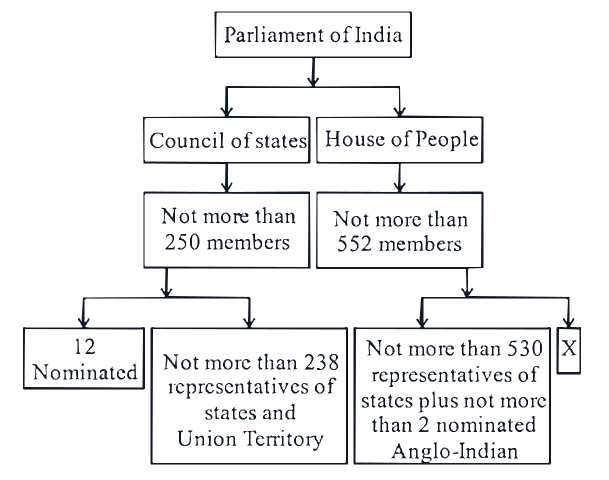
Which one of the following will fit in the place marked 'X'?
- AMinisters who are not Members of Parliament but who must get elected to either House of Parliament within six months after taking office
- BNot more than 20 nominated members
- CNot more than 20 representatives of the Union Territories
- DThe Attorney General, who has the right to speak and take part in the proceedings of either House of Parliament
All 37 chapters of Indian Polity
- Constitutional Development of India47 questions · 1990–2026
- Committees of the Constituent Assembly9 questions · 1991–2026
- Source of Constitution20 questions · 1998–2025
- Parts of Indian Constitution and Articles48 questions · 1997–2026
- Schedules51 questions · 1996–2025
- The Preamble38 questions · 1994–2026
- The Governance System64 questions · 1990–2026
- State and Union Territories49 questions · 1990–2025
- The Citizenship11 questions · 1994–2026
- Fundamental Rights104 questions · 1992–2026
- Directive Principles of State Policy57 questions · 1994–2026
- Fundamental Duties26 questions · 1996–2026
- The President84 questions · 1992–2025
- The Vice-President22 questions · 1992–2026
- Council of Ministers52 questions · 1992–2026
- Attorney General & CAG32 questions · 1991–2026
- Order of Precedence5 questions · 2000–2023
- Parliament — Lok Sabha149 questions · 1992–2026
- Rajya Sabha43 questions · 1990–2026
- Parliamentary Committees27 questions · 2001–2026
- Parliamentary Acts34 questions · 1991–2026
- Supreme Court93 questions · 1990–2026
- The Governor37 questions · 1992–2025
- The State Legislature and Council of Ministers50 questions · 1995–2026
- The High Court and Subordinate Courts38 questions · 1992–2025
- Centre State Relations38 questions · 1991–2025
- Emergency Provisions22 questions · 1992–2024
- The Finance Commission21 questions · 1993–2025
- Planning Commission / NITI Aayog27 questions · 1991–2026
- Election Commission50 questions · 1992–2026
- Political Parties29 questions · 1995–2026
- Constitutional Amendments56 questions · 1992–2026
- Official Language15 questions · 1998–2026
- Panchayati Raj and Community Development143 questions · 1991–2026
- Special Provisions for Certain Classes25 questions · 1991–2026
- Miscellaneous154 questions · 1990–2026
- Lokpal and Commissions39 questions · 1991–2025