Physics · Chapter 2 of 13
Motion: BPSC & UPPCS Prelims PYQs
43 previous-year questions on Motion, asked 1994–2026. Each one opens to its answer and explanation.
We apply a force of 200 Newtons on a wooden Box and push it on the floor at constant velocity. The marginal friction force will be:
- A200 Newtons
- B100 Newtons
- C300 Newtons
- D400 Newtons
A truck starts from rest down a hill with a constant acceleration. It achieves 400 meters in 20 seconds. If the weight of the truck is 7 tons then what will be the force acting on it?
- A12000 Newtons
- B11000 Newtons
- C13000 Newtons
- D14000 Newtons
Which of the following is a non-contact force?
- AMagnetic force
- BFrictional force
- CImpact force
- DNone of these
A bus covers the first half of a certain distance with speed v₁ and the second half with a speed v₂. The average speed during the whole journey is:
- A(2 v₁ v₂)/(v₁+v₂)
- B(v₁+v₂)/2
- C(v₁ v₂)/(v₁+v₂)
- D√(v₁ v₂)
Ball bearings are used to convert static friction into
- Arolling friction
- Bdrag
- Csliding friction
- DMore than one of the above
- ENone of the above
A goalkeeper in a game of football pulls his hands backwards after holding the ball shot at the goal. This enables the goalkeeper to
- Adecrease the rate of change of momentum
- Bexert large force on the ball
- Cincrease the force exerted by the ball on hands
- DMore than one of the above
- ENone of the above
Centripetal force is responsible to
- Aindependent motion of the object in space
- Bkeep the body moving along the circular path
- Cfly the object along a straight line
- DMore than one of the above
- ENone of the above
A bus is moving along a straight path and takes a sharp turn to the right side suddenly. The passengers sitting on the bus will
- Abent towards right side
- Bfall in the forward direction
- Cbent towards left side
- DMore than one of the above
- ENone of the above
The working principle of a washing machine is
- Adiffusion
- Bcentrifugation
- Cdialysis
- Dreverse osmosis
- ENone of the above/More than one of the above
Who is the first person to define speed?
- ANewton
- BKepler
- CPtolemy
- DGalileo
- ENone of the above/More than one of the above
What is the correct equation for finding the acceleration?
- Aa = (v − u)/t
- Ba = u + vt
- Ca = (v + u)/t
- Da = (v + u)/2
Force is the product of –
- AMass and velocity
- BMass and acceleration
- CWeight and velocity
- DWeight and acceleration
Which of the following makes use of Newton's Third Law of Motion?
- AArchery
- BSpace rocket
- CVenturimeter
- DMore than one of the above
- ENone of the above
According to Newton's second law of motion, the acceleration of an object is directly proportional to-
- AThe inverse of the object's mass
- BThe force acting on the object
- CMass of the object
- DMore than one of the above
- ENone of the above
The force required to keep an object at a constant velocity is-
- ANet force
- BFrictional force
- CGravitational force
- DMore than one of the above
- ENone of the above
For a body moving with constant speed in a horizontal circle, which of the following remains constant?
- AVelocity
- BAcceleration
- CCentripetal force
- DKinetic energy
- ENone of the above/More than one of the above
Match the concepts in List-I with their correct examples in List-II:
List-I (Concept) List-II (Example) a. Balanced forces 1. Recoil of a gun when a bullet is fired b. First law of motion 2. A wooden block pulled equally from both sides remains at rest c. Second law of motion 3. A passenger falls backwards when the bus starts moving from rest d. Third law of motion 4. A fielder pulls his hands back gradually while catching a fast-moving ball Codes:
- Aa-2, b-3, c-4, d-1
- Ba-2, b-4, c-3, d-1
- Ca-1, b-3, c-4, d-2
- Da-1, b-4, c-3, d-2
Which force is responsible for the separation of cream from churned milk?
- ACentripetal force
- BCentrifugal force
- CGravitational force
- DCohesive force
A particle is found to be at rest when observed from a reference frame S₁, and the same particle is found to move with a constant velocity when observed from another frame S₂. Which of the following statements is true?
- AS₁ is an inertial frame, but S₂ is a non-inertial frame.
- BS₂ is an inertial frame, but S₁ is a non-inertial frame.
- CBoth S₁ and S₂ are non-inertial frames.
- DBoth S₁ and S₂ are inertial frames.
A car moves along a straight road, covering a displacement x with a constant velocity v₁ and then another equal displacement x with a constant velocity v₂. What is the average velocity of the car for the entire journey?
- A(v₁ + v₂)/2
- B√(v₁v₂)
- C(v₁² + v₂²)/(v₁ + v₂)
- D2v₁v₂/(v₁ + v₂)
Given below are two statements: one is labelled as Assertion (A) and the other is labelled as Reason (R).
Assertion (A): At the highest position in a vertical circular motion, the tension in the string is minimum.
Reason (R): At the highest point, the tension = centrifugal force − weight of the body. This is the minimum value of the tension throughout the motion.
In the light of the above statements, choose the most appropriate answer from the options given below:
- ABoth (A) and (R) are correct and (R) is the correct explanation of (A)
- B(A) is correct but (R) is incorrect
- C(A) is incorrect but (R) is correct
- DNone of the above is correct
Which of the following laws explains why it is difficult to fix a nail on a freely suspended wooden frame?
- APascal's law
- BNewton's second law of motion
- CNewton's third law of motion
- DNewton's law of inertia
A displacement–time graph is a straight line through the origin, rising evenly from 0 m at 0 s to 40 m at 10 s. The graph shows:
- AAn object in uniform motion
- BA stationary object
- CAn object moving with constant acceleration
- DNone of the above
Which of the following is a vector quantity?
- ATime
- BSpeed
- CDisplacement
- DDistance
A man is standing on a sensitive balance. If he inhales deeply, the reading of the balance:
- AIncreases
- BDecreases
- CRemains unaffected
- DMay increase or decrease depending on the atmospheric pressure
The working principle of a washing machine is:
- ACentrifugation
- BDialysis
- CReverse osmosis
- DDiffusion
As the train starts moving, the head of the passenger sitting inside leans backward because of:
- AInertia of Rest
- BInertia of Motion
- CMoment of Inertia
- DConservation of Mass
It is difficult to walk on the ice than on the road because:
- AIce is harder than the road
- BRoad is harder than the ice
- CIce does not offer any reaction when we push it with our foot
- DIce has a lesser friction than the road
Consider the following statement and conclusions which can be drawn from it. Choose the correct conclusion. Statement: In starting a loaded cart, one has to push harder than to keep it moving. Conclusion:
- AThe weight of a moving object is less
- BThe wheels tend to slip initially
- CThere is less friction once the cart starts moving
- DPractice makes perfect
Ball bearings are used in bicycles, cars, etc., because
- Athe actual area of contact between the wheel and axle is increased
- Bthe effective area of contact between the wheel and axle is increased
- Cthe effective area of contact between the wheel and axle is reduced
- DNone of the above statements is correct
Which of the following pairs is/are correctly matched?
Inventor Invention 1. Christopher Cockerell Hovercraft 2. David Bushnell Submarine 3. J. C. Perier Steamship Select the correct answer using the code given below:
- A1, 2 and 3
- B1 and 2 only
- C2 and 3 only
- D1 and 3 only
A spherical body moves with a uniform angular velocity around a circular path of radius r. Which one of the following statements is correct?
- AThe body has no acceleration
- BThe body has a radial acceleration directed towards the centre of the path
- CThe body has a radial acceleration directed away from the centre of the path
- DThe body has an acceleration tangential to its path
Consider the following statements:
A 4-wheel vehicle moving in a sharp circular path at high speed will
- 1. overturn about its outer wheels
- 2. overturn about its inner wheels
- 3. skid outwards
- 4. skid inwards
Which of the statements given above are correct?
- A1 and 3
- B2 and 4
- C2 and 3
- D1 and 4
An oil tanker is partially filled with oil and moves forward on a level road with uniform acceleration. The free surface of oil then
- Aremains horizontal
- Bis inclined to the horizontal with smaller depth at the rear end
- Cis inclined to the horizontal with larger depth at the rear end
- Dassumes parabolic curve
Consider the following statements:
A simple pendulum is set into oscillation. Then
- I. the acceleration is zero when the bob passes through the mean position
- II. in each cycle the bob attains a given velocity twice
- III. both acceleration and velocity of the bob are zero when it reaches its extreme position during its oscillation
- IV. the amplitude of oscillation of the simple pendulum decreases with time
Which of the statements given above are correct?
- AI and II
- BIII and IV
- CI, II and IV
- DII, III and IV
Consider the following features of newer models of motor cars:
- I. Radial tyres
- II. Streamlined body
- III. Multipoint fuel injection
- IV. Catalytic converter with exhaust
Which of these features make the newer models of motor cars more fuel efficient?
- AI and II
- BII and III
- CII, III and IV
- DI, III and IV
Consider the following statements, one labelled Assertion (A) and the other Reason (R):
- Assertion (A): A man standing on a completely frictionless surface can propel himself by whistling.
- Reason (R): If no external force acts on a system, its momentum cannot change.
Select the correct answer using the code given below:
- ABoth A and R are true, and R is the correct explanation of A
- BBoth A and R are true, but R is not the correct explanation of A
- CA is true, but R is false
- DA is false, but R is true
A ball is dropped from the top of a high building with a constant acceleration of 9.8 m/s². What will be its velocity after 3 seconds?
- A9.8 m/s
- B19.6 m/s
- C29.4 m/s
- D39.2 m/s
Which one of the following distance–time (x–t) graphs shows uniform motion in one dimension?
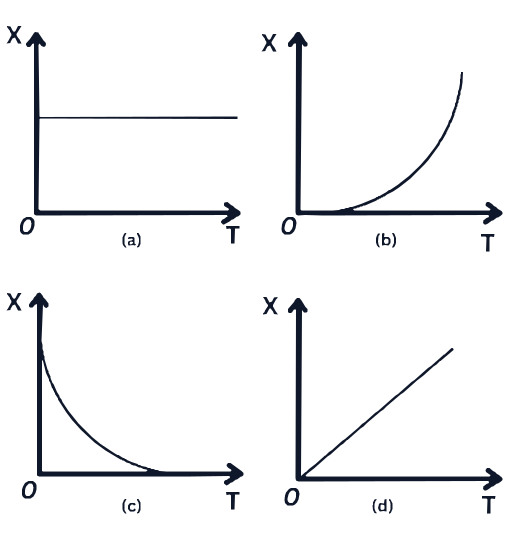
- AGraph (a)
- BGraph (b)
- CGraph (c)
- DGraph (d)
A boy standing at the point O in the given diagram throws a ball three times with the same force, but at different angles to the ground. The paths of the three throws are drawn in the diagram:
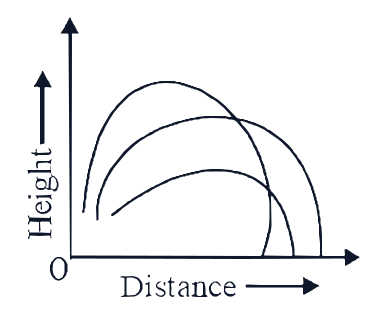
Which one of the following is a valid conclusion?
- AThe larger the initial angle, the longer the throw
- BThe larger the height reached, the longer the throw
- CThe larger the height reached, the shorter the throw
- DThe larger the initial angle, the greater the height reached
The distance–time graph of a race among four persons is shown in the given figure:
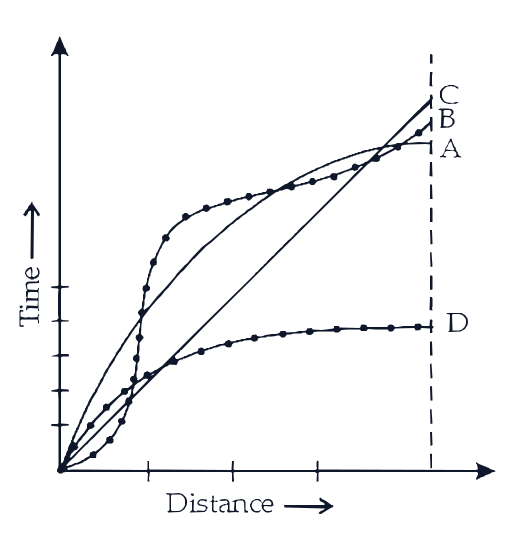
Consider the following statements in this regard:
- I. 'A' stood first in the race.
- II. 'C' led all the way.
- III. 'D' ran faster than the others in the later part of the race.
Of these statements:
- AI and III are false and II is true
- BI and II are false and III is true
- CI and III are true and II is false
- DI is true and II and III are false
The change of displacement (d) with time (t) for a particle falling freely from rest under gravity is correctly shown by:
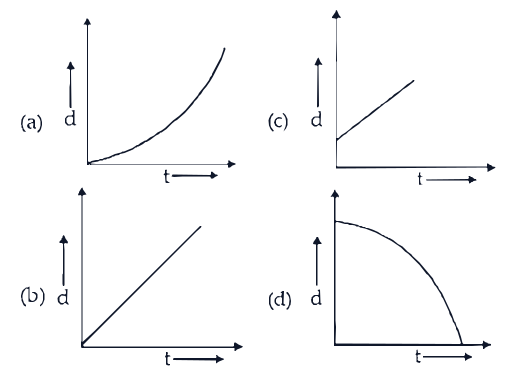
- AGraph (a)
- BGraph (b)
- CGraph (c)
- DGraph (d)
A parachutist jumps from a height of 5,000 metres. The relation between his falling speed v and the distance fallen d is best shown by:
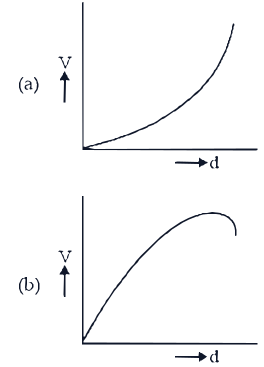
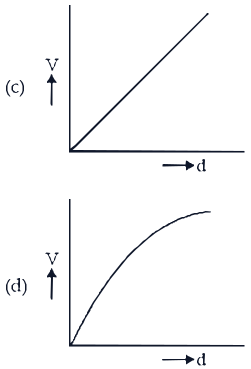
- AGraph (a)
- BGraph (b)
- CGraph (c)
- DGraph (d)
All 13 chapters of Physics
- Units77 questions · 1990–2026
- Motion43 questions · 1994–2026
- Gravitation31 questions · 1990–2026
- Energy14 questions · 1996–2024
- Fluids40 questions · 1992–2023
- Thermo75 questions · 1993–2026
- Waves73 questions · 1990–2026
- Optics132 questions · 1990–2026
- Electricity97 questions · 1990–2026
- Magnetism27 questions · 1990–2026
- Modern Physics181 questions · 1990–2026
- Computer & IT115 questions · 1993–2026
- Space & Defence190 questions · 1990–2026