Physics · Chapter 5 of 13
Fluids: BPSC & UPPCS Prelims PYQs
40 previous-year questions on Fluids, asked 1992–2023. Each one opens to its answer and explanation.
A piece of ice is floating in a beaker containing water up to its brim. When the whole of the ice melts
- Athe water will spill on the floor
- Bthe level of water will come down in the beaker
- Cthe level of water will first fall and then it will spill out of the beaker
- Dthe water level will not change
- ENone of the above/More than one of the above
The temperature point at which solid, liquid and gaseous states may stay together is known as
- Aboiling point
- Bmelting point
- Cfreezing point
- Dtriple point
- ENone of the above/More than one of the above
The highest viscosity among the following is of
- Awater
- Bair
- Cblood
- Dhoney
- ENone of the above / More than one of the above
Which one of the following quantities does not have unit?
- AStress
- BForce
- CStrain
- DPressure
- ENone of the above / More than one of the above
The velocity of wind is measured by
- ABarometer
- BAnemometer
- CHydrometer
- DWind Vane
Which one of the following denotes water salinity gradient?
- AThermocline
- BHalocline
- CPycnocline
- DChemocline
When ice melts, then the
- Avolume increases
- Bvolume decreases
- Cmass increases
- Dmass decreases
Which of the following do spray bottles used as window or household cleaners or perfume sprayers work on?
- ACapillary action
- BBernoulli's principle
- CPascal's Law
- DMore than one of the above
- ENone of the above
Spherical form of a raindrop is due to –
- ADensity of liquid
- BSurface tension
- CAtmospheric pressure
- DGravitational force
A sudden rise in the barometric height indicates
- AComing of storm or cyclone
- BPossibility of rain
- CDry weather
- DExtremely dry weather
- ENone of the above/More than one of the above
With reference to the mechanical properties of solids, which of the following statement/s is/are correct?
- 1. The Young's Modulus of rubber is greater than that of steel.
- 2. The stretching of a coil is determined by its Shear Modulus.
Select the correct answer using the codes given below:
- AOnly (2)
- BNeither (1) nor (2)
- CBoth (1) and (2)
- DOnly (1)
The rain drops are spherical because:
- AThey fall from height
- BThe air has resistance
- CThe water has surface tension
- DNone of the above
Oil spreads on water surface because:
- AOil is denser than water
- BOil is less dense than water
- CSurface tension of oil is more than water
- DSurface tension of oil is less than water
Pressure inside a soap bubble is:
- AMore than atmospheric pressure
- BLess than atmospheric pressure
- CEqual to atmospheric pressure
- DHalf of atmospheric pressure
What happens when some charge is placed on a soap bubble?
- AIts radius increases
- BIts radius decreases
- CThe bubble collapses
- DNone of the above
While travelling by plane, the ink of the pen starts to come out:
- ADue to decrease in air pressure
- BDue to increase in air pressure
- CDue to increase in volume of ink
- DDue to excessive load
A sudden fall in barometer reading indicates that the weather will be:
- AStormy weather
- BRainy weather
- CCool dry weather
- DHot and humid weather
For the streamline flow of an ideal liquid, the velocity (v) of fluid particles inside a cylindrical pipe is represented as:
- AArrows of equal length across the whole cross-section of the pipe
- BArrows longest near the walls of the pipe and shortest along its central axis
- CArrows growing steadily longer from the top wall to the bottom wall
- DA parabolic profile: arrows shortest near the walls and longest along the central axis
Increasing the amount of a substance does not change its:
- AVolume
- BWeight
- CMass
- DDensity
What changes will the volume of water show if the temperature is lowered from 9°C to 3°C:
- AThe volume will not change
- BThe volume will first increase and then decrease
- CThe volume will first decrease and then increase
- DWater will freeze
At which temperature is the density of water maximum?
- A4°C
- B0°C
- C–4°C
- D–8°C
In cold weather, aquatic animals survive even when water at the top layer of the lake freezes into ice because:
- AThey can breathe in ice
- BThey have enough of accumulated oxygen inside them
- CTheir body structure is such that they can survive without oxygen
- DWater has the highest density at 4°C so underneath the top layer of ice there is a layer of water
Why does an iron nail float on mercury while it sinks in water?
- ADue to less chemical interaction of iron with mercury than it is with water
- BIron is heavier than water and lighter than mercury
- CIron has greater density than water and lesser than mercury
- DMercury is heavier than water
A needle sinks in water whereas a ship made of iron floats on it because:
- AThe edge of the needle is pointed
- BThe ship is flat
- CThe ship is driven by a powerful engine
- DRelative density of the needle is greater than that of water displaced by it
An iron needle floats on the surface of water due to:
- AUpthrust of water
- BSurface tension
- CViscosity
- DGravitational force
While lifting a bucket of water from a well, we feel that the bucket:
- ABecomes heavier above the surface of water
- BBecomes lighter above the surface of water
- CLoses stability on coming out of the water
- DHas gained mass on coming out of water
200 gm of water is filled in a weightless balloon. Its weight in water will be:
- AZero
- B100 gm
- C200 gm
- D400 gm
While floating in a sea what part of an iceberg is above the surface of the sea?
- A1/9
- B1/10
- C1/6
- D1/4
Why is it easier to swim in the sea than in a river?
- AThe sea water is salty
- BThe sea water is deep
- CThe sea water is heavier
- DThe sea water is lighter
When a ship enters a sea from a river, what happens?
- AIt rises a little
- BIt remains at the same level
- CIt sinks a little
- DIt immerses in the bottom of the sea
Consider the following statements:
If there were no phenomenon of capillarity
- 1. it would be difficult to use a kerosene lamp
- 2. one would not be able to use a straw to consume a soft drink
- 3. the blotting paper would fail to function
- 4. the big trees that we see around would not have grown on the Earth
Which of the statements given above are correct?
- A1, 2 and 3 only
- B1, 3 and 4 only
- C2 and 4 only
- D1, 2, 3 and 4
Four wires of same material and of dimensions as under are stretched by a load of same magnitude separately. Which one of them will be elongated maximum?
- AWire of 1 m length and 2 mm diameter
- BWire of 2 m length and 2 mm diameter
- CWire of 3 m length and 1.5 mm diameter
- DWire of 1 m length and 1 mm diameter
A hydrogen-inflated polythene balloon is released from the surface of the earth. As the balloon rises to an altitude up in the atmosphere, it will
- Adecrease in size
- Bflatten into a disc-like shape
- Cincrease in size
- Dmaintain the same size and shape
Consider the following statements, one labelled Assertion (A) and the other Reason (R):
- Assertion (A): With the increase of temperature, the viscosity of glycerine increases.
- Reason (R): Rise of temperature increases kinetic energy of molecules.
Select the correct answer using the code given below:
- ABoth A and R are true, and R is the correct explanation of A
- BBoth A and R are true, but R is not the correct explanation of A
- CA is true, but R is false
- DA is false, but R is true
Consider the following statements, one labelled Assertion (A) and the other Reason (R):
- Assertion (A): An iron ball floats on mercury but gets immersed in water.
- Reason (R): The specific gravity of iron is more than that of mercury.
Select the correct answer using the code given below:
- ABoth A and R are true, and R is the correct explanation of A
- BBoth A and R are true, but R is not the correct explanation of A
- CA is true, but R is false
- DA is false, but R is true
Which of the following weather conditions is indicated by a sudden fall in barometer reading?
- AStormy weather
- BCalm weather
- CCold and dry weather
- DHot and sunny weather
For which one of the following is capillarity not the only reason?
- ABlotting of ink
- BRising of underground water
- CSpread of water drop on a cotton cloth
- DRising of water from the roots of a plant to its foliage
The tendency of a liquid drop to contract and occupy minimum area is due to
- Aviscosity
- Bsurface tension
- Cdensity
- Dvapour pressure
When an air bubble at the bottom of a lake rises to the top, it will
- Aincrease in size
- Bdecrease in size
- Cmaintain its size
- Dflatten into a disk-like shape
A liquid flows in a streamlined manner through a cylindrical pipe. Along a section containing the axis of the pipe, the flow profile will be:
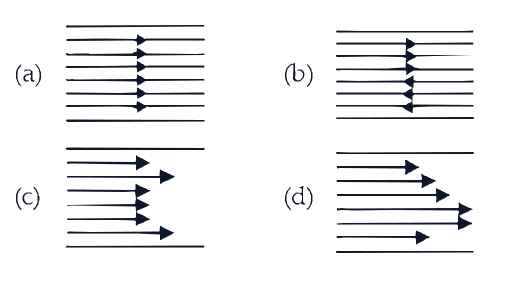
- AFigure (a)
- BFigure (b)
- CFigure (c)
- DFigure (d)
All 13 chapters of Physics
- Units77 questions · 1990–2026
- Motion43 questions · 1994–2026
- Gravitation31 questions · 1990–2026
- Energy14 questions · 1996–2024
- Fluids40 questions · 1992–2023
- Thermo75 questions · 1993–2026
- Waves73 questions · 1990–2026
- Optics132 questions · 1990–2026
- Electricity97 questions · 1990–2026
- Magnetism27 questions · 1990–2026
- Modern Physics181 questions · 1990–2026
- Computer & IT115 questions · 1993–2026
- Space & Defence190 questions · 1990–2026