The distance–time graph of a race among four persons is shown in the given figure:
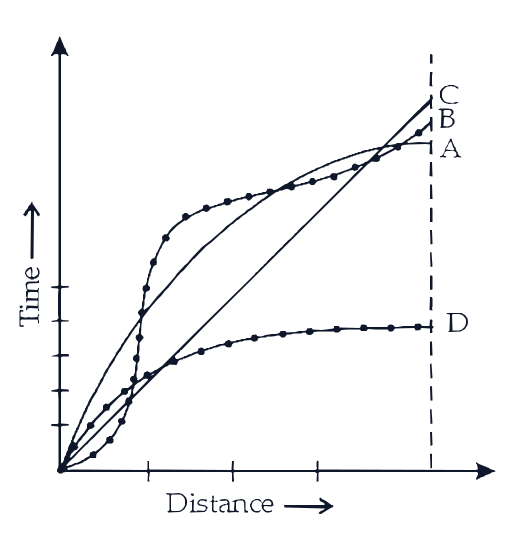
Consider the following statements in this regard:
- I. 'A' stood first in the race.
- II. 'C' led all the way.
- III. 'D' ran faster than the others in the later part of the race.
Of these statements:
- AI and III are false and II is true
- BI and II are false and III is true
- CI and III are true and II is false
- DI is true and II and III are false
Show answer and explanation
Correct answer: (b) I and II are false and III is true
Explanation
Here time is on the vertical axis. At the finish line (the dashed line) the runner whose curve is lowest took the least time and won: that is D, not A (I false). Early in the race the curves cross and C falls behind, so C did not lead all the way (II false). In the later part D's curve is almost flat: D covered much distance in very little time, so D ran fastest then (III true).