Geography · Chapter 25 of 30
World Climate, Soils, Tribes & Languages: BPSC Prelims PYQs
84 previous-year questions on World Climate, Soils, Tribes & Languages, asked 1992–2025. Each one opens to its answer and explanation.
In which of the following areas, Mediterranean climate does not prevail?
- ACentral Chile
- BCape Town
- CAdelaide
- DPampas
- ENone of the above/More than one of the above
Match the following:
List-I List-II (A) Extremely hot 1. Chile (B) Extremely cold 2. Cherrapunji (C) Excessive rainfall 3. Antarctica (D) Extreme Drought 4. Sahara Desert Code: A B C D
- A1 2 3 4
- B4 3 2 1
- C2 3 1 4
- D3 2 4 1
The ‘leaching’ process is related to?
- AHeavy rainfall area
- BMinerals and soil
- CPlant roots
- DMore than one of the above
- ENone of the above
The formal development of Terrarossa takes place in that part of land which consists of –
- ALimestone
- BCynite
- CGranite
- DSandstone
Afrikaners indicate the people:
- AOf Indo-African descent in the U.S
- BIndigenous tribal communities in Africa
- CThe white minority group in South Africa
- DMore than one of the above
The native African tribe ‘Pygmies’ is found in which of the following river basins –
- ANiger
- BCongo
- CNile
- DZambezi
Pygmies are inhabitants of –
- AAfrica
- BAsia
- CAustralia
- DSouth America
Eskimos are inhabitants of –
- ACanada
- BMongolia
- CMalaya
- DSri Lanka
Which of the following tribal communities belongs to the Negrito race?
- ABahu
- BKyrgyz
- CSemang
- DMasai
One of the following pairs is a mismatch?
- AMasai - Central Eastern Africa
- BSakai - Malaysia
- CBedouin - Arabian Peninsula
- DKirghiz - Central Asia
- ENone of the above/More than one of the above
Which of the following human races inhabit China, Mongolia and Japan?
- AAustraloid
- BNegro
- CMongoloid
- DNordic
What is Esperanto?
- AHighest mountain of Latin America
- BSeaport city of Spain
- CThe name of a game
- DAn artificial language to serve as world language
The main languages spoken in Switzerland are-
- AOnly German
- BOnly French
- COnly German and French
- DGerman, French and Italian
Which of the following climatic zones lies around 40° to 60° latitude?
- ATemperate
- BTropical
- CArctic
- DSubtropical
In which area of the world is the process of leaching very intensive and quick?
- AMoist tropical region
- BCold temperate region
- CDry tropical region
- DMid-latitude region
The main factor which determines the climate of any area is:
- AAltitude
- BLatitude
- CTypes of vegetation
- Dproximity to the sea
Amount of rain depends upon:
- AAir Pressure
- BHumidity in Atmosphere
- CWater Cycle
- DTemperature
By which of the following is the maximum percentage of Earth covered?
- AArid Region
- BSemi-arid Region
- CSub-humid land
- DHumid Region
Which of the following continents has all types of climatic zones?
- ASouth America
- BNorth America
- CAustralia
- DAsia
Which among the following countries doesn't come under the category of equatorial climate?
- ACongo
- BEthiopia
- CGabon
- DZaire
Consider the following statements:
- Assertion (A): The environment of the equatorial regions is conducive for plants not for humans.
- Reason (R): The average annual temperature difference is very low in equatorial regions. By using the code given below, select the correct answer:
Select the correct answer using the code given below:
- ABoth (A) and (R) are true, and (R) is the correct explanation of (A).
- BBoth (A) and (R) are true, but (R) is not the correct explanation of (A).
- C(A) is true, but (R) is false.
- D(A) is false, but (R) is true.
Which one of the following is correctly matched?
- AWet winter dry summer - Italy
- BWet throughout the year - Sudan
- CWet summer dry winter - Iran
- DDry throughout the year - Chile
Given below are two statements, one is labelled as Assertion (A) and the other as Reason (R).
- Assertion (A): The interior part of Australia is desert and semi-desert.
- Reason (R): Northern Australia is situated in the temperate zone.
Select the correct answer using the code given below:
- ABoth (A) and (R) are true, and (R) is the correct explanation of (A).
- BBoth (A) and (R) are true, but (R) is not the correct explanation of (A).
- C(A) is true, but (R) is false.
- D(A) is false, but (R) is true.
Match List-I with List-II:
List-I (Region) List-II (Type of Climate) A. California 1. Mediterranean B. West Australia 2. Tropical Monsoon C. Bangladesh 3. Cold Temperate D. Siberia 4. Hot Desert Select the correct answer using the codes given below (in the order A B C D):
- A1 2 3 4
- B1 4 2 3
- C2 3 4 1
- D2 4 1 3
Match List-I with List-II:
List-I (Type of climate) List-II (Region) A. Equatorial 1. California B. Mediterranean 2. Bangladesh C. Monsoon 3. Sudan D. Savannah 4. Congo Select the correct answer using the codes given below (in the order A B C D):
- A4 1 2 3
- B2 3 1 4
- C1 2 3 4
- D4 3 2 1
Consider the following statements:
- Assertion (A): The Mediterranean regions have rainy winters
- Reason (R): During winter they lie in the belt of the Westerlies.
Select the correct answer using the code given below:
- ABoth (A) and (R) are true, and (R) is the correct explanation of (A).
- BBoth (A) and (R) are true, but (R) is not the correct explanation of (A).
- C(A) is true, but (R) is false.
- D(A) is false, but (R) is true.
Two statements are given below, one is labeled as Assertion (A) and the other as Reason (R).
- Assertion (A): In Mediterranean climate regions, rainfall occurs in winter.
- Reason (R): In summer, these regions remain under the influence of dry continental trade winds.
Select the correct answer using the code given below:
- ABoth (A) and (R) are true, and (R) is the correct explanation of (A).
- BBoth (A) and (R) are true, but (R) is not the correct explanation of (A).
- C(A) is true, but (R) is false.
- D(A) is false, but (R) is true.
Consider the following statements with reference to Mediterranean climate:
- 1. It receives rainfall in winter season.
- 2. Due to winter solstice, air pressure belts shift to the South.
Which of the above statements is/are correct?
- AOnly 2
- BNeither 1 nor 2
- COnly 1
- DBoth 1 and 2
Consider the following statements:
- Assertion (A): The ports of north west Europe are open throughout the year.
- Reason (R): The south-westerly winds blow over north-west Europe throughout the year.
Select the correct answer using the code given below:
- ABoth (A) and (R) are true, and (R) is the correct explanation of (A).
- BBoth (A) and (R) are true, but (R) is not the correct explanation of (A).
- C(A) is true, but (R) is false.
- D(A) is false, but (R) is true.
Consider the following statements with respect to the climate of Western Europe:
- 1. Western Europe receives rainfall in all months.
- 2. Western Europe is located in the belt of Westerlies.
Which of the above statements is/are correct?
- ABoth 1 and 2
- BNeither 1 nor 2
- COnly 1
- DOnly 2
Which of the following climates are associated with the shifting of the pressure belts?
- 1. Equatorial climate
- 2. Mediterranean climate
- 3. Monsoon climate
- 4. Western European climate
Select the correct answer using the codes given below:
- A1 and 2
- B1 and 3
- C2 and 3
- D2 and 4
Which one of the following is the correct sequence of the climatic regions while going from Zaire to the Netherlands?
- 1. Equatorial climate
- 2. Mediterranean climate
- 3. Hot desert climate
- 4. West European climate
Select the correct answer using the codes given below:
- A1, 3, 2, 4
- B1, 4, 2, 3
- C2, 3, 4, 1
- D3, 2, 1, 4
The world's wettest place is:
- ACherrapunji
- BMawsynram
- CSingapore
- DWaialeale
The coldest place on the earth is:
- AHalifax
- BChicago
- CSiachin
- DVerkhoyansk
El-Nino develops in the:
- APacific Ocean
- BIndian Ocean
- CMediterranean Sea
- DAtlantic Ocean
With reference to the "El-Nino", which of the following statement/s is/are correct?
- 1. El Nino involves the appearance of a warm current off the coast of Peru in the eastern Pacific.
- 2. This warm current increases the temperature of water on the Peruvian coast by 10°C, thereby increasing the amount of plankton in the sea.
Select the correct answer using the code given below:
- AOnly 1
- BBoth 1 and 2
- COnly 2
- DNeither 1 nor 2
Hekistotherms are plants growing in:
- Abright light
- Bhigh temperature
- Cvery low temperature
- Dvery low light
'Vegetation is the true index of climate'. This statement is associated with:
- AThornthwaite
- BKoppen
- CTrewartha
- DStamp
Match List-I with List-II:
List-I (Ethnic Group) List-II (Country) A. Jews 1. Egypt B. Teda 2. Iran C. Beja 3. Libya D. Lur 4. Israel Select the correct answer using the codes given below (in the order A B C D):
- A1 2 3 4
- B4 1 2 3
- C4 1 3 2
- D4 3 1 2
Which one of the following is not pastoral nomads?
- APygmies
- BKazaks
- CMasai
- DLapps
Which of the following is correctly matched?
- AEskimo - Canada
- BOraon - Japan
- CLapps - India
- DGonds - Africa
Which of the following is correctly matched?
- AEskimo - Amazon Basin
- BPygmy - Irrawadi Basin
- CBundu - Sahara
- DBushman - Kalahari
Which of the following pairs (Tribe – Habitat) is / are NOT correctly matched?
- 1. Bushman – Kalahari Desert
- 2. Eskimo – Northern Canada
- 3. Pygmy – Congo Basin
- 4. Masai – West Africa
Select the correct answer from the code given below:
- AOnly 1, 2 and 3
- BOnly 4
- COnly 3 and 4
- DOnly 1
Match List-I with List-II:
List-I (Tribe) List-II (Country) A. Eskimo 1. Botswana B. Maasai 2. Saudi Arabia C. Bedouins 3. Canada D. Bushman 4. Kenya Select the correct answer using the codes given below (in the order A B C D):
- A1 2 3 4
- B4 3 2 1
- C3 4 2 1
- D2 4 1 3
Match List-I with List-II:
List-I (Tribes) List-II (Area) A. Khirghiz 1. Japan B. Bushman 2. Arab C. Ainu 3. Central Asia D. Bedouin 4. Kalahari Select the correct answer using the codes given below (in the order A B C D):
- A3 1 4 2
- B2 3 4 1
- C3 4 1 2
- D1 2 3 4
Match List-I with List-II:
List-I (Means in polar areas) List-II (Function) A. Kayak 1. Boat for transport B. Inuit 2. Dog pulled vehicle C. Umiak 3. Narrow hunting Boat D. Sledge 4. Snow house Select the correct answer using the codes given below (in the order A B C D):
- A3 4 1 2
- B2 1 4 3
- C1 2 3 4
- D4 3 2 1
Match List-I with List-II:
List-I (Tribe) List-II (Country) A. Bushman 1. Congo B. Bedouins 2. Namibia C. Pigmies 3. Saudi Arabia D. Maasai 4. Kenya Select the correct answer using the codes given below (in the order A B C D):
- A1 2 3 4
- B4 3 2 1
- C2 3 1 4
- D4 3 1 2
In which dense tropical forest do the Semang tribe live?
- AAmazonia
- BIndonesia
- CMalaysia
- DCongo
Which one of the following pairs is not correctly matched?
- ABerber - Morocco
- BInuits - Canada
- CSemangs - Indonesia
- DVeddas - Sri Lanka
Which one of the following is Not correctly matched?
- AAinu - Japan
- BBushmen - Union of South Africa
- CMaasai - Kenya
- DPapuans - New Guinea
Which one of the following is correctly matched?
- AHemites - Uganda
- BSemites - Malaysia
- CSakai - Sudan
- DBushmen - Botswana
Which one of the following is not correctly matched?
- ACentral Asia - Alpine
- BCongo basin - Negrito
- CKalahari - Bushmen
- DScandinavia - Nordic
Which of the following is not correctly matched?
- AKyrgyz - Central Asia
- BMaasai - Western Africa
- CRed Indians - North America
- DEskimos - Greenland
Which of the following pairs is not correctly matched?
- AMaori - New Zealand
- BMaasai - Zambia
- CMayas - Guatemala
- DBushman - Kalahari
The Inuit people are not found in:
- AAlaska
- BGreenland
- CCanada
- DSweden
Which of the following pairs is not correctly matched?
- AFulani-West Africa
- BBantu-Sahara
- CMasai-East Africa
- DNuba- Sudan
Which of the following region is famous for 'Lapps' tribe?
- AAlaska
- BScandinavia
- CGreenland
- DIceland
To which of the following racial groups the natives of North America belong?
- AAustric
- BCaucasoid
- CMongoloid
- DNegroid
Which of the following pairs (Tribe – Place) is not correctly matched?
- APygmy - Congo basin
- BAngami - Nagaland
- CAinu - Japan
- DKhirghiz - Sudan
Which of the following pairs (Place – Tribe) is NOT correctly matched?
- AAlaska - Koryak
- BBorneo - Punan
- CArab Desert - Ruwala
- DSweden and Finland - Lapps
Consider the following description:
- 1. Annual and daily range of temperatures is low.
- 2. Precipitation occurs throughout the year.
- 3. Precipitation varies between 50 cm - 250 cm.
What is this type of climate?
- AEquatorial climate
- BChina type climate
- CHumid subtropical climate
- DMarine West coast climate
Consider the following statements:
- Statement-I: The soil in tropical rain forests is rich in nutrients.
- Statement-II: The high temperature and moisture of tropical rain forests cause dead organic matter in the soil to decompose quickly.
Which one of the following is correct in respect of the above statements?
- ABoth Statement-I and Statement-II are correct, and Statement-II explains Statement-I
- BBoth Statement-I and Statement-II are correct, but Statement-II does not explain Statement-I
- CStatement-I is correct, but Statement-II is not correct
- DStatement-I is not correct, but Statement-II is correct
"Each day is more or less the same, the morning is clear and bright with a sea breeze; as the sun climbs high in the sky, heat mounts up, dark clouds form, then rain comes with thunder and lightning. But rain is soon over." Which of the following regions is described in the above passage?
- ASavannah
- BEquatorial
- CMonsoon
- DMediterranean
The seasonal reversal of winds is the typical characteristic of:
- AEquatorial climate
- BMediterranean climate
- CMonsoon climate
- DAll of the above climates
Which one of the following is the characteristic climate of the Tropical Savannah Region?
- ARainfall throughout the year
- BRainfall in winter only
- CAn extremely short dry season
- DA definite dry and wet season
A geographic region has the following distinct characteristics:
- 1. Warm and dry climate
- 2. Mild and wet winter
- 3. Evergreen oak trees
The above features are the distinct characteristics of which one of the following regions?
- AMediterranean
- BEastern China
- CCentral Asia
- DAtlantic coast of North America
A geographical area with an altitude of 400 metres has following characteristics:
Month Average maximum temp. (°C) Average minimum temp. (°C) Rainfall (mm) January 31 21 51 February 31 21 85 March 31 21 188 April 31 21 158 May 30 21 139 June 30 21 121 July 29 20 134 August 28 20 168 September 29 20 185 October 29 20 221 November 30 20 198 December 31 20 86 If this geographic area were to have a natural forest, which one of the following would it most likely be?
- AMoist temperate coniferous forest
- BMontane subtropical forest
- CTemperate forest
- DTropical rain forest
A new type of El Nino called El Nino Modoki appeared in the news. In this context, consider the following statements:
- 1. Normal El Nino forms in the Central Pacific Ocean whereas El Nino Modoki forms in Eastern Pacific Ocean.
- 2. Normal El Nino results in diminished hurricanes in the Atlantic Ocean but El Nino Modoki results in a greater number of hurricanes with greater frequency.
Which of the statements given above is/are correct?
- A1 only
- B2 only
- CBoth 1 and 2
- DNeither 1 nor 2
Consider the following statements:
- 1. In the world, the tropical deserts occur along the western margins of continents within the trade wind belt.
- 2. In India, the East Himalayan region gets high rainfall from north-east winds.
Which of the statements given above is/are correct?
- A1 only
- B2 only
- CBoth 1 and 2
- DNeither 1 nor 2
Consider the following statements, one labelled Assertion (A) and the other Reason (R):
- Assertion (A): Areas lying within five to eight degrees latitude on either side of the equator receive rainfall throughout the year.
- Reason (R): High temperatures and high humidity cause convectional rain to fall mostly in the afternoons near the equator.
Select the correct answer using the code given below:
- ABoth A and R are true, and R is the correct explanation of A
- BBoth A and R are true, but R is not the correct explanation of A
- CA is true, but R is false
- DA is false, but R is true
Consider the following statements, one labelled Assertion (A) and the other Reason (R):
- Assertion (A): Unlike temperate forests, the tropical rain forests, if cleared, can yield productive farm land that can support intensive agriculture for several years even without chemical fertilizers.
- Reason (R): The primary productivity of the tropical rain forest is very high when compared to that of the temperate forests.
Select the correct answer using the code given below:
- ABoth A and R are true, and R is the correct explanation of A
- BBoth A and R are true, but R is not the correct explanation of A
- CA is true, but R is false
- DA is false, but R is true
Consider the following statements:
- 1. In equatorial regions, the year is divided into four main seasons.
- 2. In Mediterranean region, summer receives more rain.
- 3. In China type climate, rainfall occurs throughout the year.
- 4. Tropical highlands exhibit vertical zonation of different climates.
Which of these statements are correct?
- A1, 2, 3 and 4
- B1, 2 and 3
- C1, 2 and 4
- D3 and 4
Consider the following ecosystems:
- 1. Taiga
- 2. Tropical evergreen
- 3. Tropical deciduous
- 4. Tundra
The correct sequence in decreasing order of the albedo values of these ecosystems is:
- A1, 4, 3, 2
- B4, 1, 2, 3
- C4, 1, 3, 2
- D1, 4, 2, 3
The temperature and rainfall of a meteorological station are given below:
Month Temperature (°C) Rainfall (cm) January 9.4 12.2 February 10.6 9.1 March 11.7 7.9 April 12.2 2.5 May 13.3 1.8 June 13.9 0.3 July 13.9 - August 14.4 - September 15.6 0.8 October 15.0 2.5 November 13.3 6.1 December 10.6 11.7 Average temperature: 12.8 °C; average rainfall: 54.9 cm per annum. Identify the region having the above climatic pattern from amongst the following:
- AMediterranean region
- BMonsoon region
- CSteppe region
- DN.W. European region
Consider the following temperature and rainfall data:
Month Temperature (°C) Rainfall (cm) January 6.7 14.0 February 6.7 13.2 March 7.2 11.4 April 8.9 9.4 May 11.1 8.1 June 13.9 8.1 July 15.0 9.6 August 15.0 12.2 September 13.9 10.4 October 11.1 14.4 November 8.9 14.0 December 7.8 16.8 The climate to which this data pertains is:
- ASt. Lawrence type
- BChina type
- CWest European type
- DMediterranean type
Consider the following climatic conditions (northern hemisphere):
Month Temperature (°C) Rainfall (cm) January 3.9 4.7 February 4.4 5.7 March 8.3 8.2 April 14.4 9.2 May 20.0 9.2 June 23.3 17.7 July 27.8 14.5 August 27.8 14.0 September 22.3 12.7 October 18.3 7.0 November 12.2 5.0 December 6.7 3.5 These are most likely to be found in the natural regions of:
- AChina type
- BEquatorial type
- CHot desert type
- DMonsoon type
Consider the following statements, one labelled Assertion (A) and the other Reason (R):
- Assertion (A): Areas near the equator receive rainfall throughout the year.
- Reason (R): High temperatures and high humidity cause convectional rain in most afternoons near the equator.
Select the correct answer using the code given below:
- ABoth A and R are true, and R is the correct explanation of A
- BBoth A and R are true, but R is not the correct explanation of A
- CA is true, but R is false
- DA is false, but R is true
Consider the following statements:
- Statement-I: In January, in the Northern Hemisphere, the isotherms bend equatorward while crossing the landmasses, and poleward while crossing the oceans.
- Statement-II: In January, the air over the oceans is warmer than that over the landmasses in the Northern Hemisphere.
Which one of the following is correct in respect of the above statements?
- ABoth Statement-I and Statement-II are correct, and Statement-II explains Statement-I
- BBoth Statement-I and Statement-II are correct, but Statement-II does not explain Statement-I
- CStatement-I is correct, but Statement-II is not correct
- DStatement-I is not correct, but Statement-II is correct
Which of the following is/are correct inference/inferences from isothermal maps in the month of January?
- 1. The isotherms deviate to the north over the ocean and to the south over the continent.
- 2. The presence of cold ocean currents, Gulf Stream and North Atlantic Drift make the North Atlantic Ocean colder and the isotherms bend towards the north.
Select the correct answer using the code given below:
- A1 only
- B2 only
- CBoth 1 and 2
- DNeither 1 nor 2
Consider the following statements:
- Statement-I: The temperature contrast between continents and oceans is greater during summer than in winter.
- Statement-II: The specific heat of water is more than that of land surface.
Which one of the following is correct in respect of the above statements?
- ABoth Statement-I and Statement-II are correct, and Statement-II explains Statement-I
- BBoth Statement-I and Statement-II are correct, but Statement-II does not explain Statement-I
- CStatement-I is correct, but Statement-II is not correct
- DStatement-I is not correct, but Statement-II is correct
The annual range of temperature in the interior of the continents is high as compared to coastal areas. What is/are the reason/reasons?
- 1. Thermal difference between land and water
- 2. Variation in altitude between continents and oceans
- 3. Presence of strong winds in the interior
- 4. Heavy rains in the interior as compared to coasts
Select the correct answer using the codes given below.
- A1 only
- B1 and 2 only
- C2 and 3 only
- D1, 2, 3 and 4
What could be the main reason/reasons for the formation of African and Eurasian desert belt?
- 1. It is located in the sub-tropical high pressure cells.
- 2. It is under the influence of warm ocean currents.
Which of the statements given above is/are correct in this context?
- A1 only
- B2 only
- CBoth 1 and 2
- DNeither 1 nor 2
The graph given below shows the mean monthly temperature (in °C) and the mean monthly rainfall (in cm) of a place:
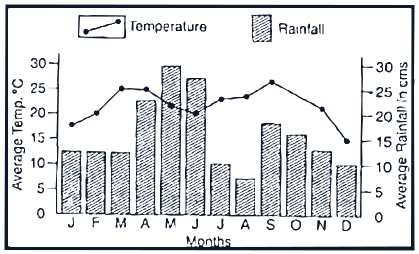
This graph is typical of which one of the climatic zones of the world?
- AWet and dry tropical
- BRainy tropical
- CSemi-arid tropical
- DTemperate marine
Consider the map given below:
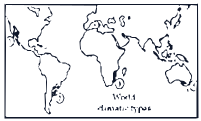
Of the shaded areas in the map, the one with hot, dry summers, mild, moist winters and a seasonal reversal of winds is the area labelled:
- A1
- B2
- C3
- D4
All 30 chapters of Geography
- Introduction, Area, Extent & Standard Time47 questions · 1990–2026
- Physical Divisions141 questions · 1990–2026
- Coastline & Island Groups34 questions · 1992–2025
- States & Union Territories50 questions · 1990–2026
- Species & Tribes43 questions · 1991–2025
- Drainage System, River Cities, Waterfalls & Lakes188 questions · 1990–2026
- Climate & Natural Disasters74 questions · 1993–2026
- Soils, Erosion & Conservation50 questions · 1994–2026
- Natural Vegetation35 questions · 1991–2026
- Irrigation, Canals & River Valley Projects84 questions · 1993–2026
- Agriculture & Green Revolution50 questions · 1994–2026
- Crops & Animal Husbandry241 questions · 1990–2026
- Mineral Resources159 questions · 1991–2026
- Electrical Energy53 questions · 1991–2023
- Industry70 questions · 1994–2026
- Transport108 questions · 1991–2026
- Universe, Solar System & Earth131 questions · 1990–2025
- Geological History & Rocks28 questions · 1994–2025
- Volcanoes, Earthquakes, Continents & Landforms102 questions · 1992–2026
- Countries, Borders, Capitals & Sobriquets131 questions · 1990–2026
- Hydrosphere & Ocean Currents64 questions · 1991–2025
- Ocean Salinity & Rivers of the World57 questions · 1992–2026
- Landforms, Islands, Straits, Canals & Atmosphere138 questions · 1990–2026
- Winds & Forests67 questions · 1992–2025
- World Climate, Soils, Tribes & Languages84 questions · 1992–2025
- Agriculture & Livestock69 questions · 1990–2025
- The Minerals92 questions · 1991–2025
- Cities, Industries, Transport & Ports66 questions · 1992–2025
- Environment & Ecology82 questions · 1992–2026
- Research Centres & Miscellaneous73 questions · 1990–2024